







What Nebius & CoreWeave Tell Us About AI Compute
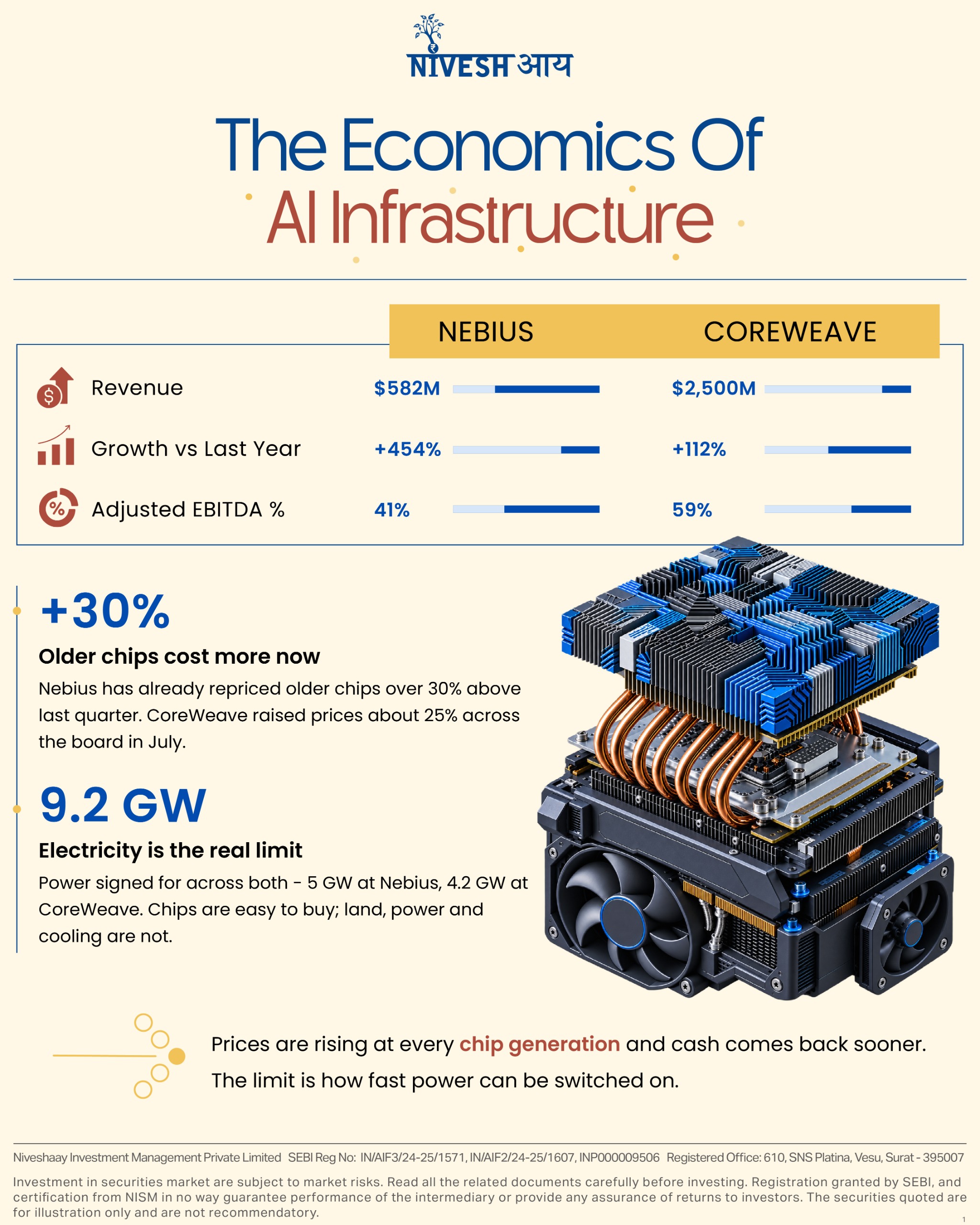
Two companies rent out AI computing power at scale. Nebius and CoreWeave both reported their June quarter in August — and read together, they say something the market spent July doubting.
Prices are rising at every generation of chip.
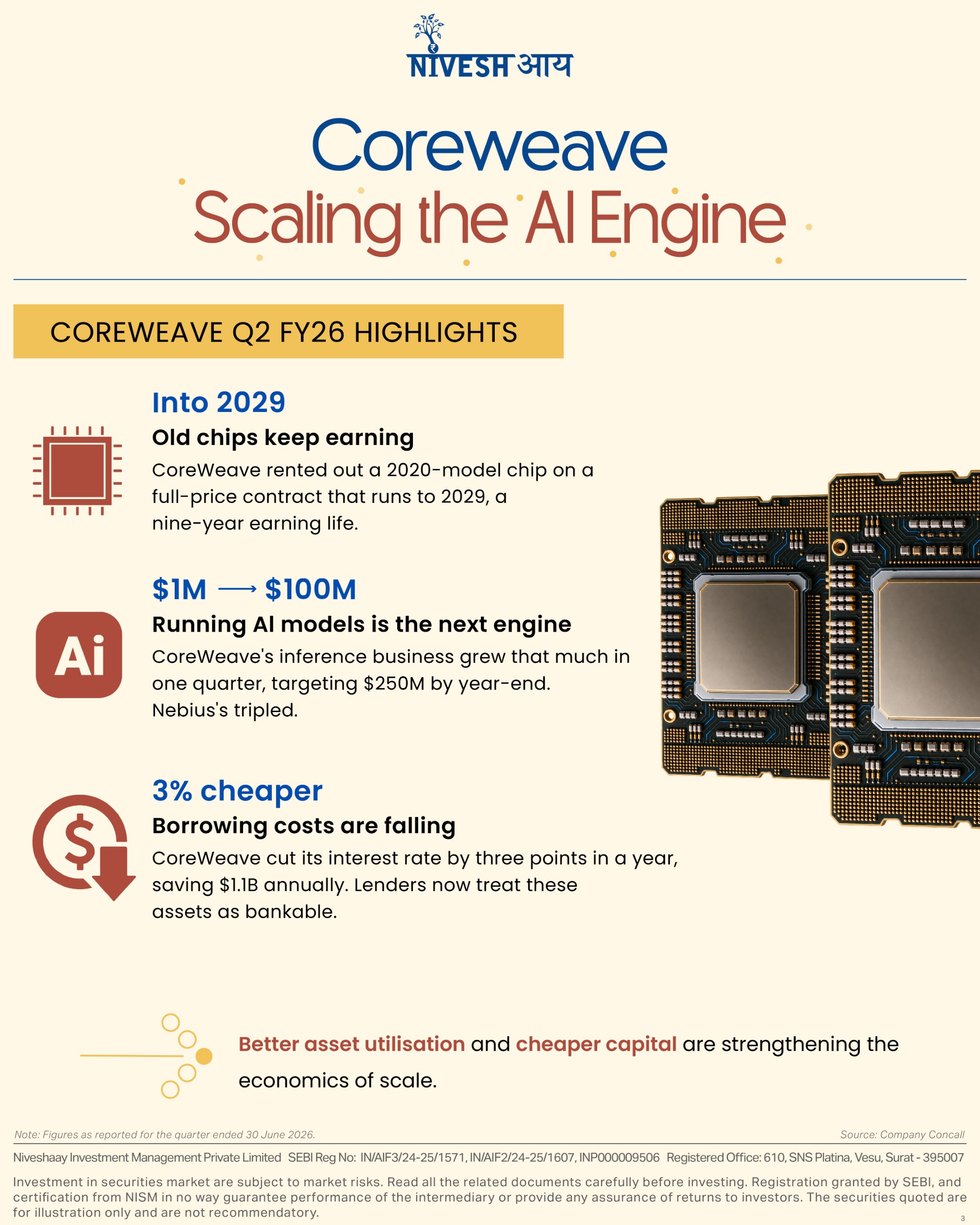
Nebius has repriced its older GPUs more than 30% above last quarter. CoreWeave raised prices roughly 25% across its whole range in July — and rented out a 2020-model chip on a full-price contract running to 2029. A nine-year earning life on hardware many had assumed was obsolete in three.
Beyond pricing, the two look nothing alike.
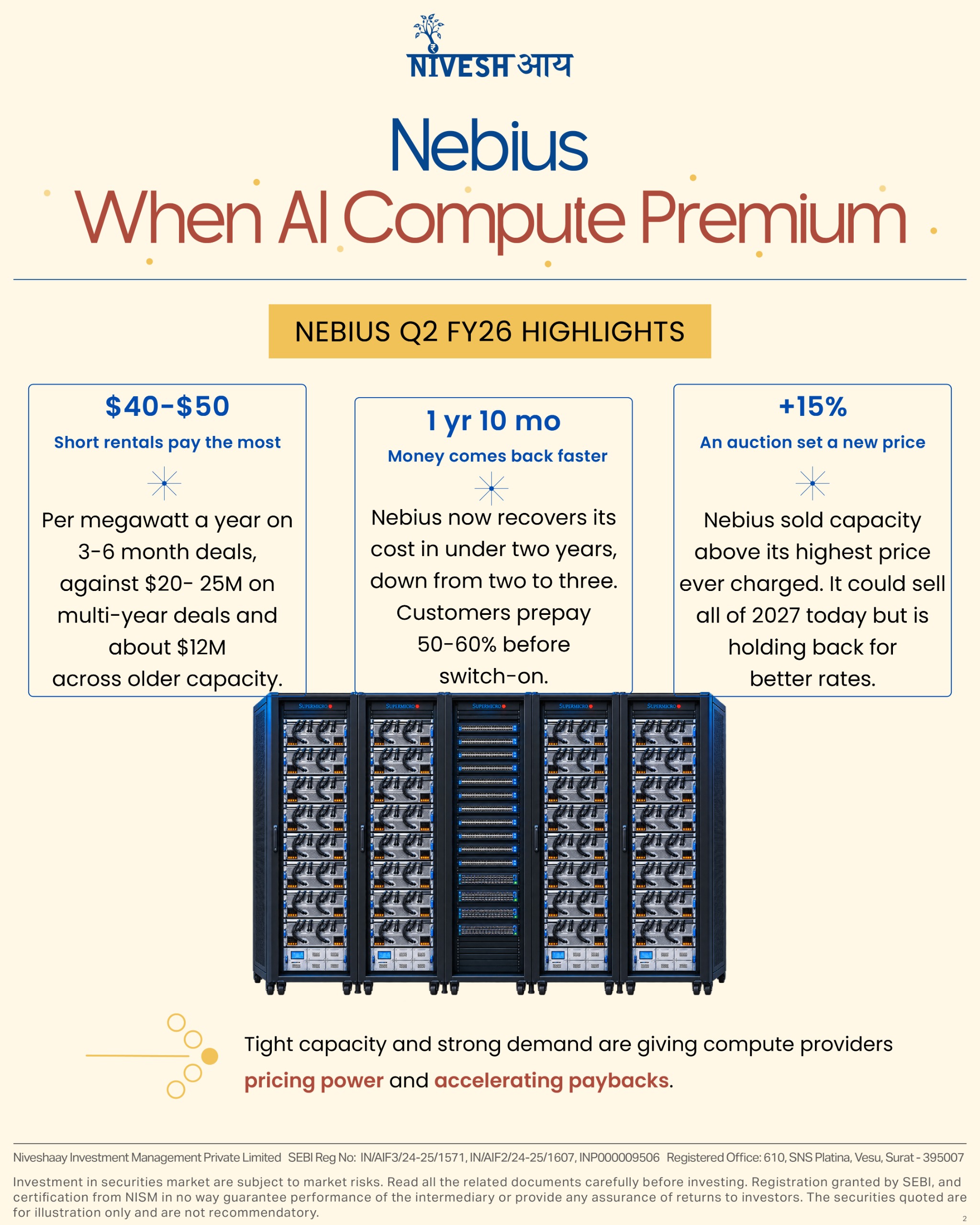
Nebius builds capacity before it has customers, then sells close to switch-on to catch the going rate. It says it could sell all of its 2027 capacity today and is deliberately choosing not to. Short three-to-six-month rentals now fetch $40–50M per megawatt a year, against $20–25M on multi-year deals and about $12M across older capacity. Its money now comes back in under two years, down from two to three.
CoreWeave does close to the opposite — it sells years forward, then borrows against the contract. It has cut its cost of debt by three percentage points in a year, saving $1.1B annually. Its newer business, running models rather than renting chips, went from $1M to $100M in a single quarter.
Each company disclosed the numbers its own strategy makes look good. That itself is worth noticing.
The binding constraint is neither chips nor money. It is electricity — 4.2 GW contracted at CoreWeave today, 5 GW targeted at Nebius by December. And even switched-on power doesn’t earn immediately: commissioning a building, wiring the network, installing the clusters and onboarding customers takes months before the first invoice.
Worth holding alongside all of this: both companies are still loss-making, and between them they plan to spend $55–64B on construction this year against $15–17B of revenue. The economics only work if these prices hold.

 AIF Investor Charter


NIVESHAAY INVESTMENT ADVISORS
508, SNS Platina, Near Someshwara Enclave, Vesu, Surat, Gujarat-395007
(+91) 7859870559
research.smallcase@niveshaay.com (Equity Baskets)
NIVESHAAY INVESTMENT MANAGEMENT PRIVATE LIMITED
610, SNS Platina, Near Someshwara Enclave, Vesu, Surat, Gujarat-395007
(+91) 7836915478
contactaif@niveshaay.com (AIF)
SEBI Registration No. : INH000017338, IN/AIF3/24-25/1571, IN/AIF2/24-25/1607, INP000009506 | BASL Membership ID: 6276
Disclaimer:
Investment in Securities Market are subject to market risks. Read all related documents carefully before investing.
Registration granted by SEBI and certification from NISM in no way guarantee performance of the intermediary or provide any assurance of returns to investors.
The securities quoted are for illustration only and are not recommendatory
NIVESHAAY INVESTMENT ADVISORS © . All Rights Reserved., NIVESHAAY INVESTMENT MANAGEMENT PRIVATE LIMITED © . All Rights Reserved.Smart ODR