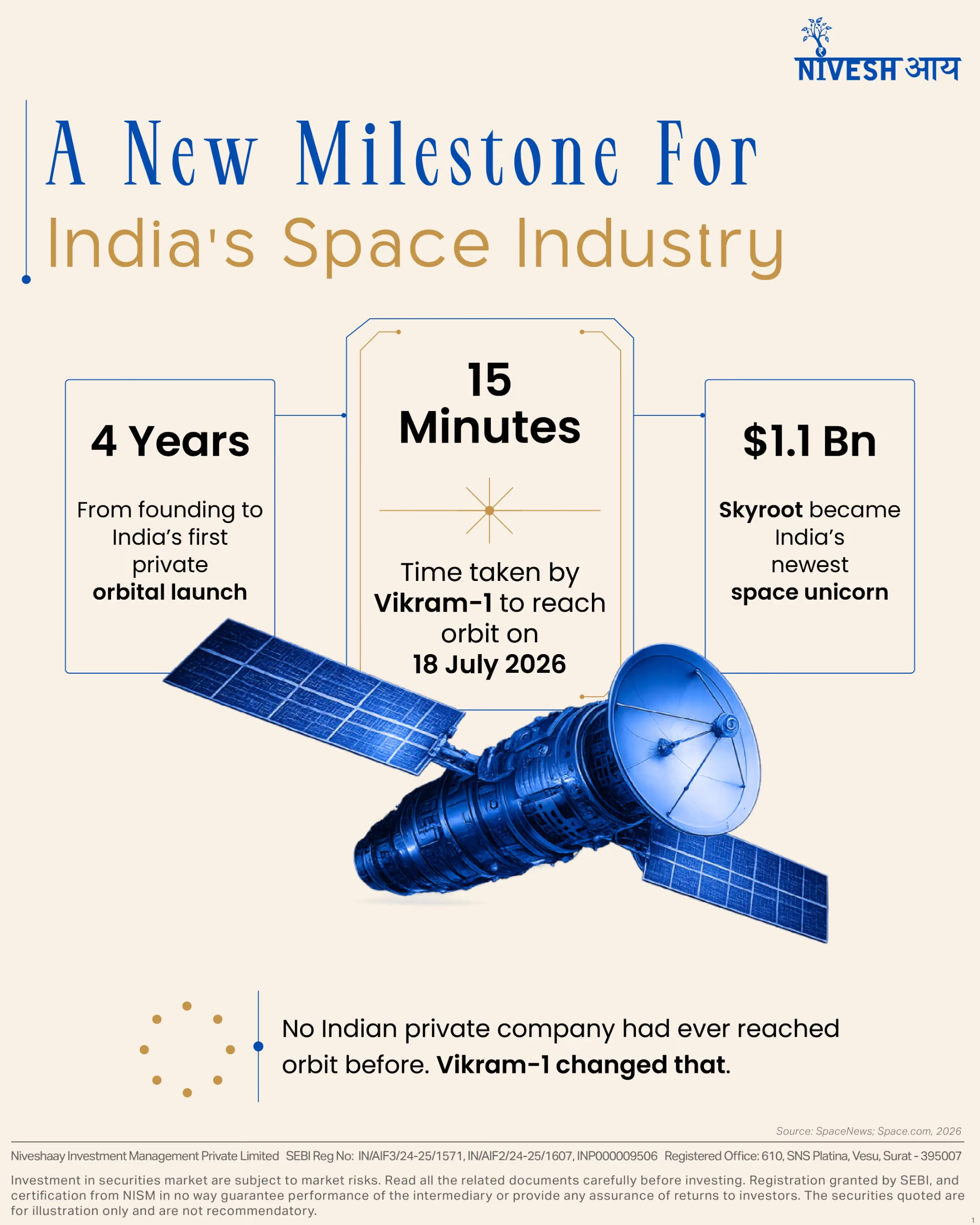
On July 18, 2026, a rocket built entirely by a private Indian company lifted off from Srihari Kota and reached orbit. No Indian company had done this before. Skyroot Aerospace's Vikram-1 carried two small satellites to a 450-kilometre orbit, fifteen minutes after liftoff. The mission was named Aagaman - Sanskrit for arrival.
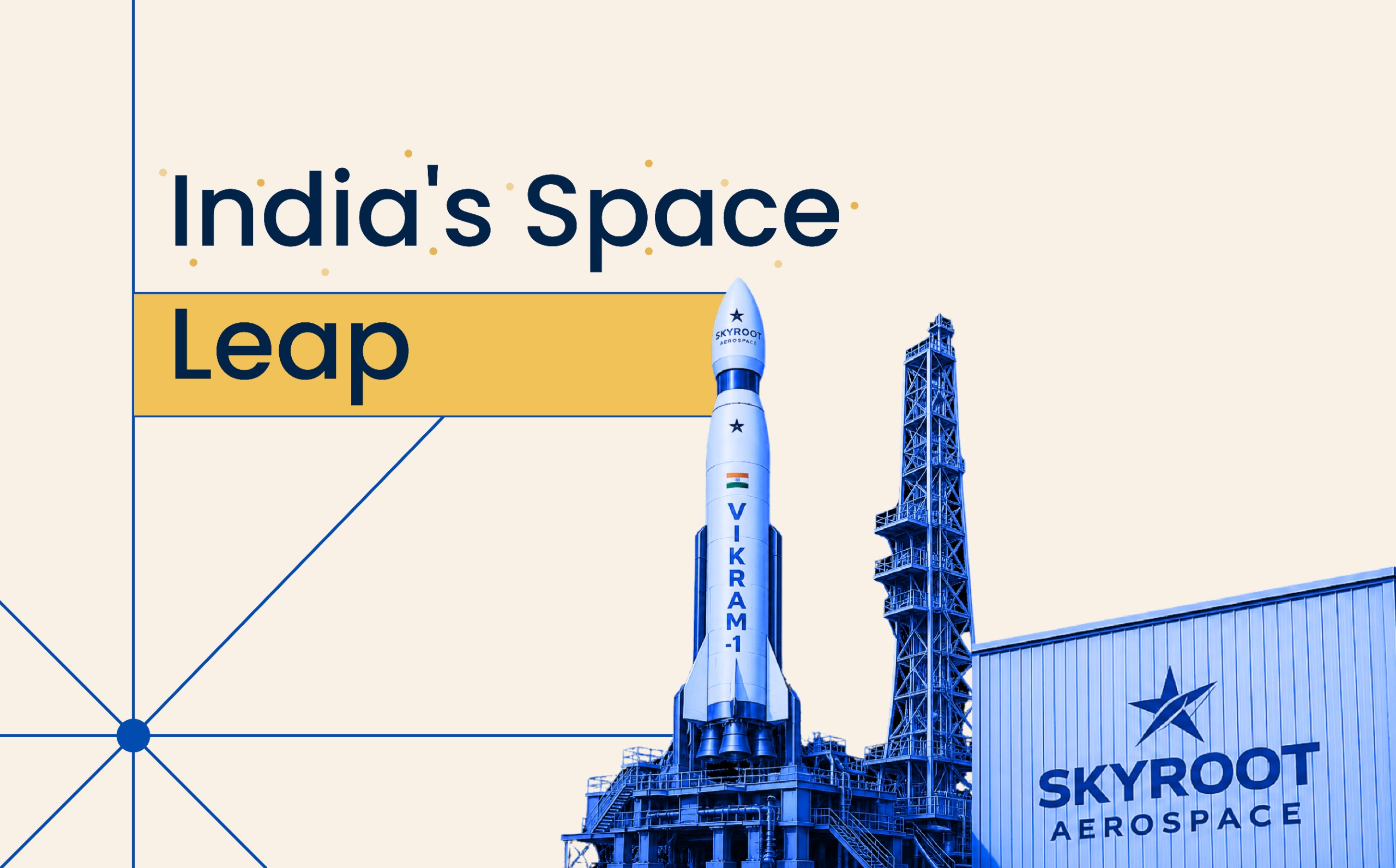
On July 18, 2026, a rocket built entirely by a private Indian company lifted off from Srihari Kota and reached orbit. No Indian company had done this before.
Skyroot Aerospace’s Vikram-1 carried two small satellites to a 450-kilometre orbit, fifteen minutes after liftoff. The mission was named Aagaman – Sanskrit for arrival.
A four-year-old startup has now done what ISRO spent six decades building toward.
Skyroot is also India’s newest unicorn, valued at $1.1 billion, up from zero in under four years. This piece looks at what the launch means, who else is building around it, and what still has to happen before one good flight becomes an industry.
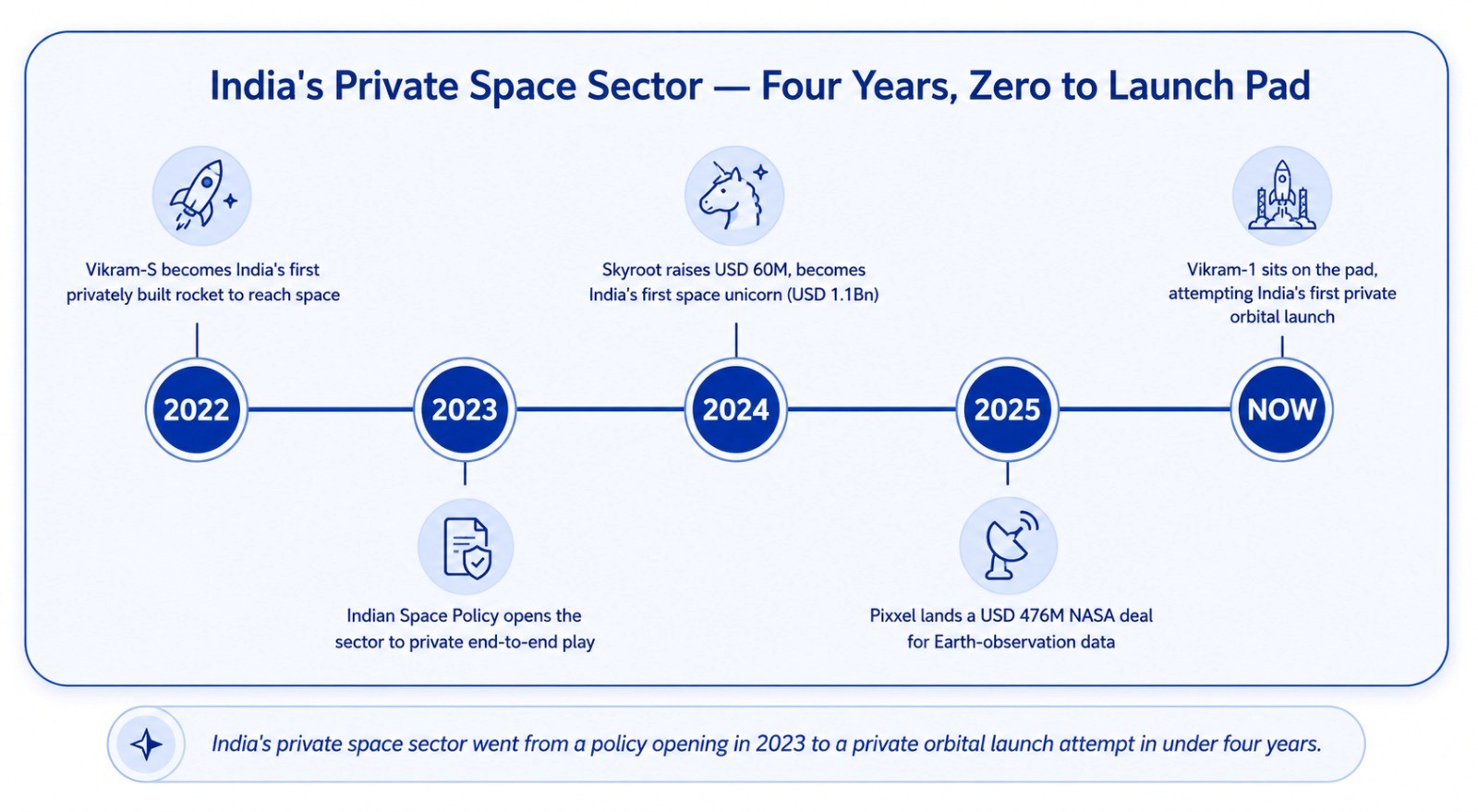
Three years ago, India’s Space Policy of 2023 opened a door that hadn’t existed before: private companies could build, launch, operate, and sell what they see from orbit – not just supply components to a single state operator.
Vikram-1 is the first flight to actually walk through it.
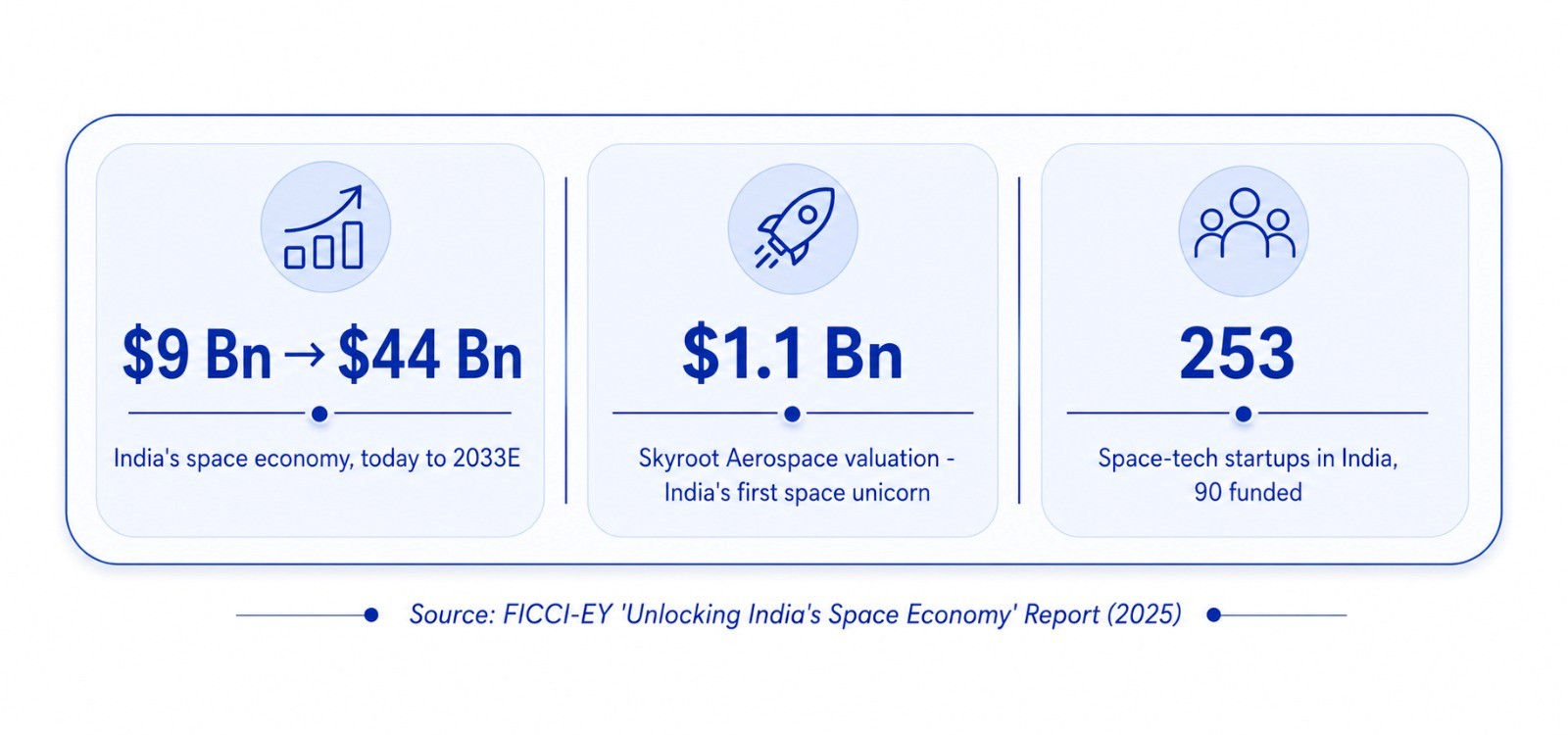
Before the launch detail, here is who is converting that opening into hardware, contracts, and revenue.
Skyroot Aerospace: India’s first space unicorn
Pixxel: The data business already working
Agnikul Cosmos: The engineering-first bet
Centum Electronics: The revenue-generating anchor most people miss
The timing added weight to the moment. ISRO’s own PSLV had suffered two consecutive launch failures of its own – in May 2025 and again in January 2026 – and only concluded its investigation into the second one in early July 2026, days before Vikram-1 flew.
For the first time, India’s private and state space programmes were being watched side by side under very different pressure. This time, the private attempt was the one that worked.
One regulatory gap is still worth flagging: India’s Space Activities Bill – which would give IN-SPACe’s authority a legislative foundation under India’s Outer Space Treaty obligations – had still not passed Parliament as of July 2026.
Every other major spacefaring nation passed this kind of law before opening its sector to private launch. A successful Vikram-1 flight is likely to add pressure on Parliament to close that gap.
Skyroot, Pixxel, Agnikul, and Centum are the headline names. The ecosystem around them is what makes this an industry rather than four lucky companies:
There’s also a consumer-facing thread. Jio and Airtel both signed distribution deals with Starlink in March 2025, and regulators cleared Starlink to operate commercially by mid-2025.
Reports now suggest Mukesh Ambani is evaluating a rival LEO constellation of his own – a genuine India-vs-India contest for low Earth orbit connectivity, not just India-vs-SpaceX.
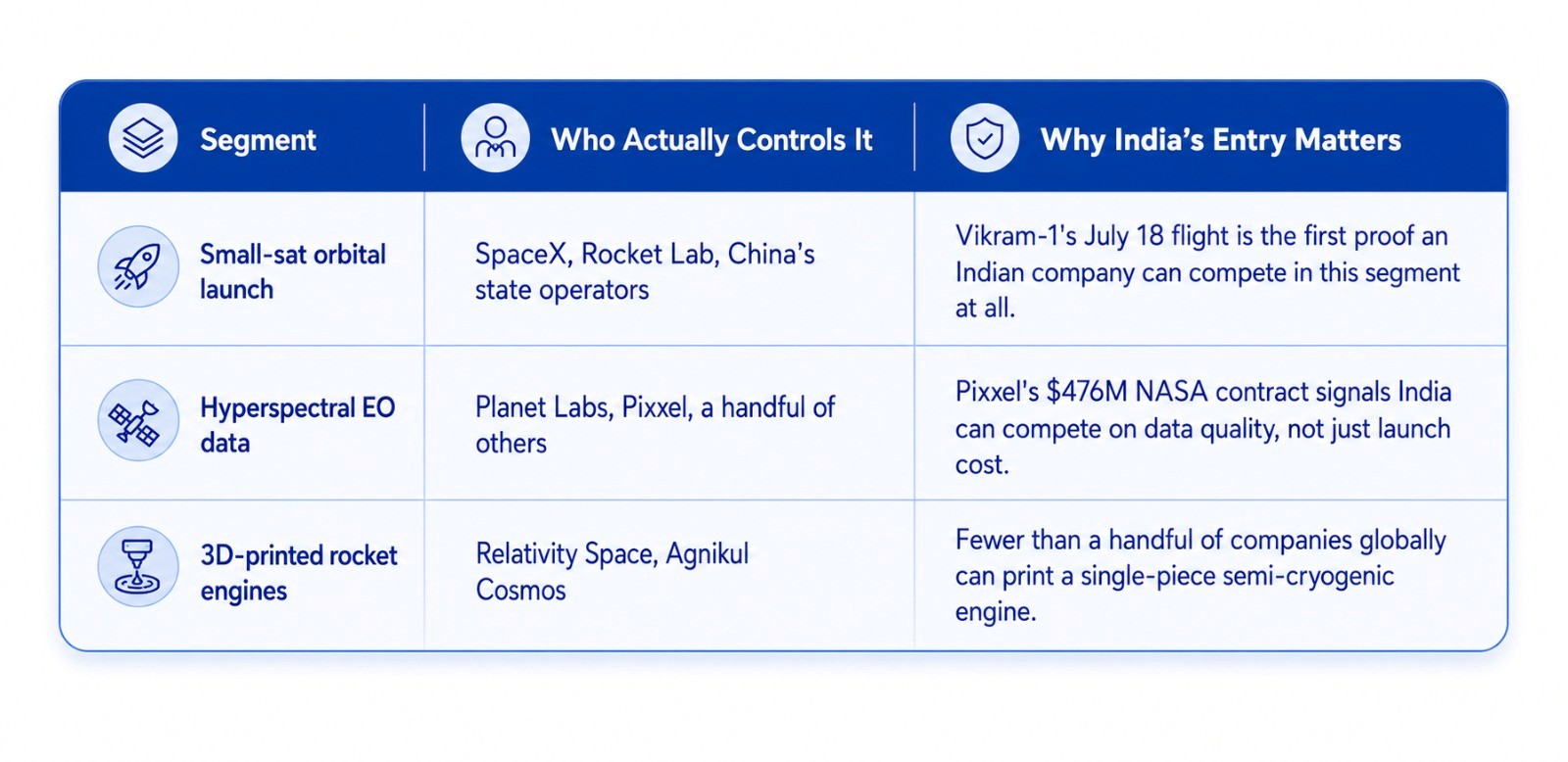
Orbital launch remains a scarcity business globally, which is exactly why an Indian entrant matters:
Plotted by what they actually build, and whether they’re already earning from it:
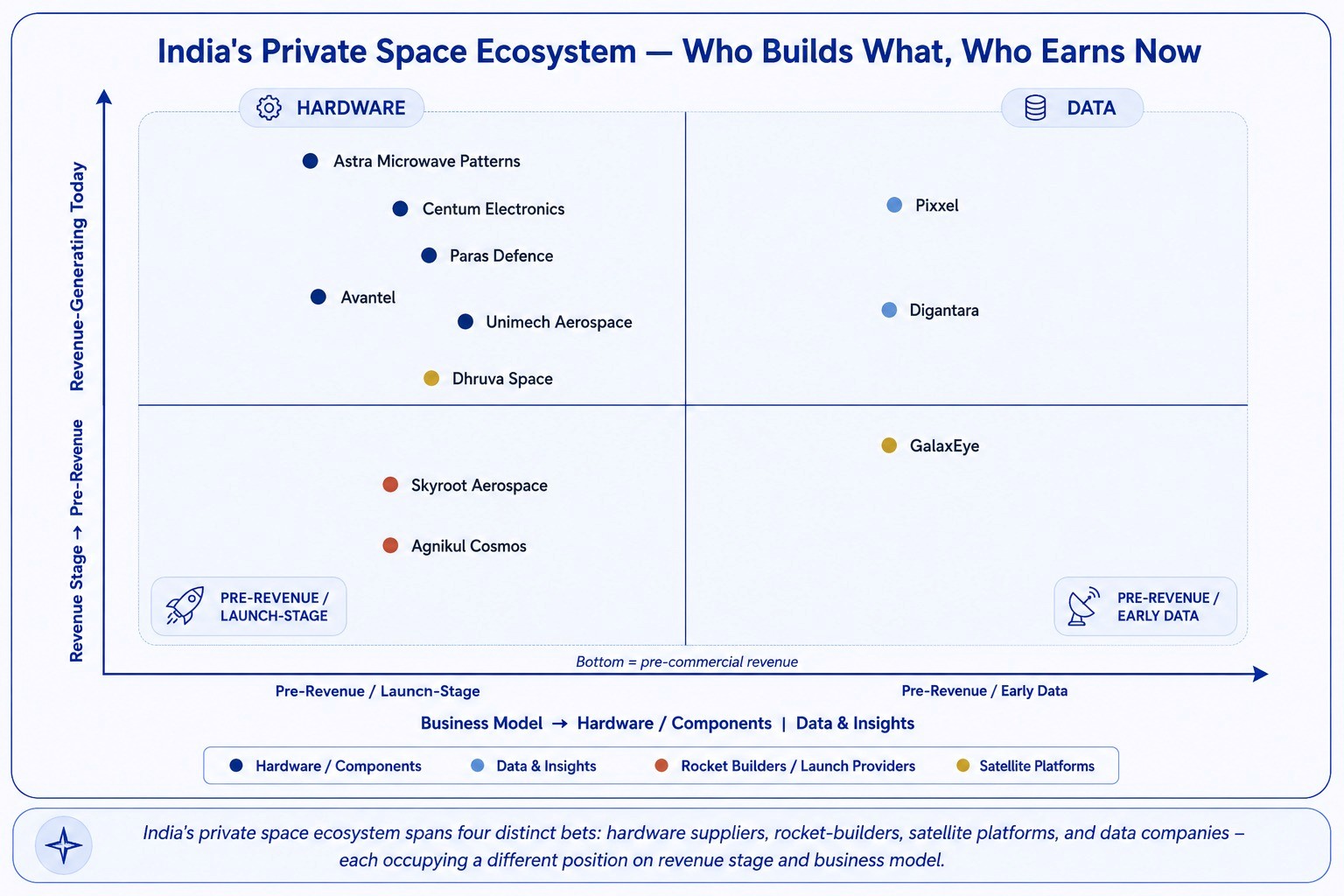
Analysts have noted that India’s emerging ecosystem is arguably more specialised than SpaceX’s own model: rockets, satellites, propulsion, and debris-tracking are each being built by a different company, betting on a different layer.
Skyroot leads on capital raised, but funding size does not equal revenue – Centum and Pixxel are the two closest to real cash flow.
It’s worth being honest about what one flight does, and doesn’t, prove.
The next few launches – not this one – will show whether India’s private space sector is a genuine industry, or one very good flight.
India went from zero private orbital launch capability to a $1.1 billion space unicorn in under four years – and on July 18, 2026, Vikram-1 showed that valuation wasn’t the only real thing about it. Pixxel’s $476M NASA contract already proved the data side of this industry works. Vikram-1 has now shown the launch side can too