







Blue Water, Big Ambition: Indian Naval Surge
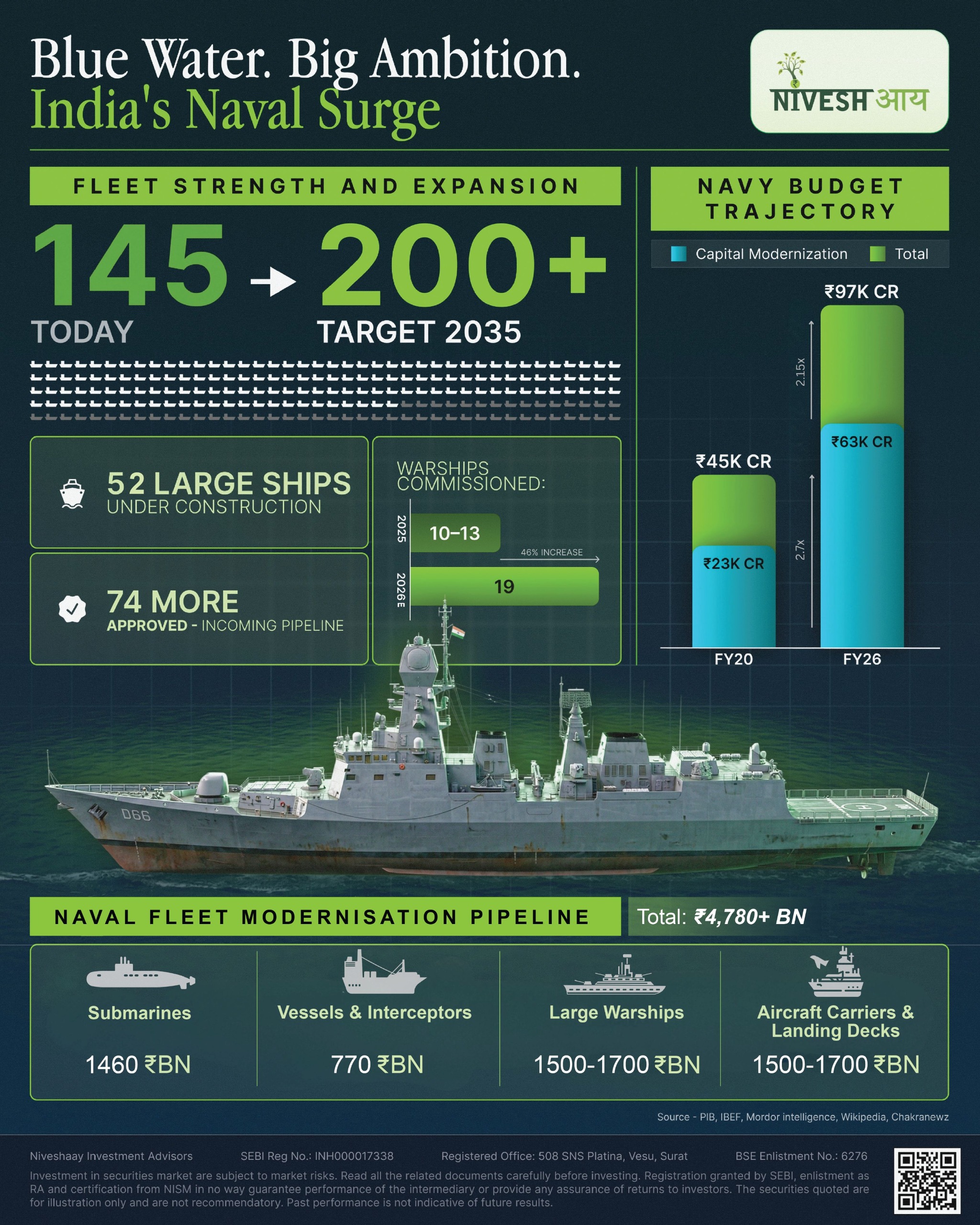
As geopolitical competition intensifies across global sea lanes, maritime dominance is becoming a strategic priority for major economies.
Chokepoints like the Strait of Hormuz — through which a significant share of global oil flows — underscore how naval strength directly shapes energy security and trade stability.
India is emerging as one of the most consequential players in this shift.
Following the commissioning of INS Tamal, India has signalled a decisive pivot from foreign procurement toward indigenous shipbuilding capability.
This is not a temporary policy adjustment — it reflects a structural transition in how India intends to build and sustain its naval power.
The numbers reinforce this direction. India’s naval budget has grown from ₹45,000 crore in FY20 to ₹97,000 crore in FY26 more than doubling in six years.
A modernisation pipeline exceeding ₹4,780 billion is now underway, spanning new vessels, advanced systems, and supporting infrastructure.
For investors, this signals more than a defence sector trade.
Naval shipbuilding is a long-cycle industrial theme, capital-intensive, policy-backed, and underpinned by a deep ecosystem of ancillary suppliers, component manufacturers, and engineering services.
The strategic case for India’s maritime self-reliance is clear. The investment case is building alongside it.
For details you can visit our website here:
📌https://niveshaay.smallcase.com/
Explore our Blog section here:
📌https://niveshaay.com/blog-type/deep-dives/

 AIF Investor Charter


NIVESHAAY INVESTMENT ADVISORS
508, SNS Platina, Near Someshwara Enclave, Vesu, Surat, Gujarat-395007
(+91) 7859870559
research.smallcase@niveshaay.com (Equity Baskets)
NIVESHAAY INVESTMENT MANAGEMENT PRIVATE LIMITED
610, SNS Platina, Near Someshwara Enclave, Vesu, Surat, Gujarat-395007
(+91) 7836915478
contactaif@niveshaay.com (AIF)
SEBI Registration No. : INH000017338, IN/AIF3/24-25/1571, IN/AIF2/24-25/1607, INP000009506 | BASL Membership ID: 6276
Disclaimer:
Investment in Securities Market are subject to market risks. Read all related documents carefully before investing.
Registration granted by SEBI and certification from NISM in no way guarantee performance of the intermediary or provide any assurance of returns to investors.
The securities quoted are for illustration only and are not recommendatory
NIVESHAAY INVESTMENT ADVISORS © . All Rights Reserved., NIVESHAAY INVESTMENT MANAGEMENT PRIVATE LIMITED © . All Rights Reserved.Smart ODR