







India's Capex Cycle is Turning
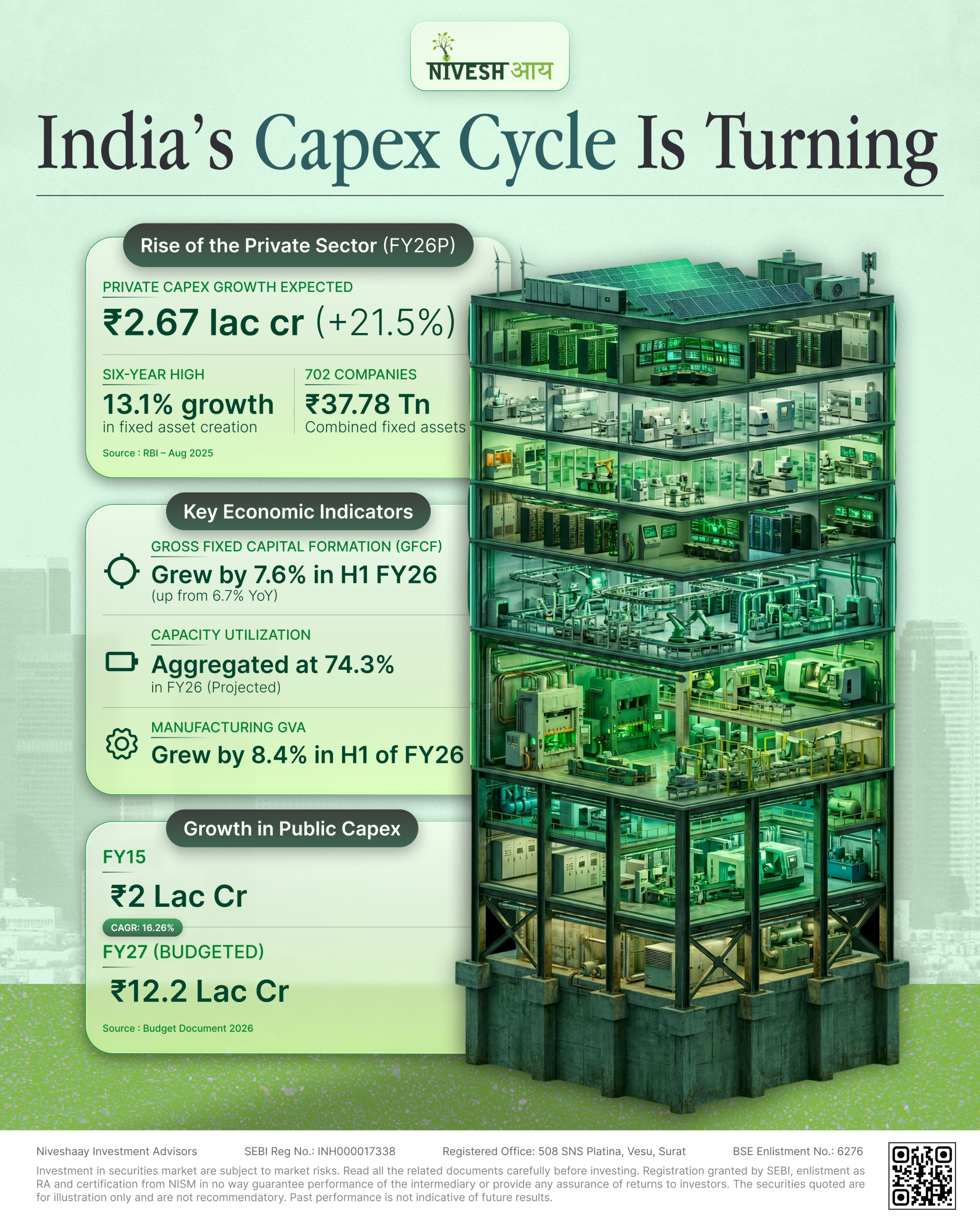
The Big Pivot: India’s Capex Cycle Shifts into Top Gear
For years, the Indian private sector capex cycle was “just around the corner.” Today, the data suggests it has finally arrived, but with a twist that every investor needs to understand.
The Lead: A Six-Year High
According to a recent Business Standard article, fixed asset creation by leading listed firms hit a six-year high of 13.1% in H1FY26. This isn’t just a statistical blip—it’s a fundamental shift. While the government has been the sole engine of growth for the last few years, the baton is finally being passed to the private sector. The combined fixed assets of 702 top companies have climbed to ₹37.78 trillion, spearheaded by Power, Cement, Automobiles, and Metals.
The Insight: It’s Not Just “Building Factories”
While the headline numbers look like a classic “industrial” boom, the Modern capex is becoming tech-heavy and efficiency-driven. Asset Light to Asset Right: It’s no longer just about massive “brownfield” expansions. Companies are investing in automation, digitalization, and green energy transitions to lower their long-term cost of production.
Data centers, semiconductors, and Renewables are leading the incremental investment surge, while traditional giants like Steel and Cement are tracking domestic demand growth.
Why This Matters for Your Portfolio
A capex cycle usually leads to a “multiplier effect.” When a cement major expands, it creates a tailwind for industrial machinery, logistics, and power stocks.
We are moving from a “Policy-led” cycle to an “Execution-led” cycle. For Investors, this signals a transition from defensive plays to growth-oriented cyclicals. The companies winning today aren’t just those spending the most, but those spending smartest—integrating technology to stay competitive in a global supply chain. With clean balance sheets and rising demand, India Inc. is no longer waiting for the future; they are building it.

 AIF Investor Charter


NIVESHAAY INVESTMENT ADVISORS
508, SNS Platina, Near Someshwara Enclave, Vesu, Surat, Gujarat-395007
(+91) 7859870559
research.smallcase@niveshaay.com (Equity Baskets)
NIVESHAAY INVESTMENT MANAGEMENT PRIVATE LIMITED
610, SNS Platina, Near Someshwara Enclave, Vesu, Surat, Gujarat-395007
(+91) 7836915478
contactaif@niveshaay.com (AIF)
SEBI Registration No. : INH000017338, IN/AIF3/24-25/1571, IN/AIF2/24-25/1607, INP000009506 | BASL Membership ID: 6276
Disclaimer:
Investment in Securities Market are subject to market risks. Read all related documents carefully before investing.
Registration granted by SEBI and certification from NISM in no way guarantee performance of the intermediary or provide any assurance of returns to investors.
The securities quoted are for illustration only and are not recommendatory
NIVESHAAY INVESTMENT ADVISORS © . All Rights Reserved., NIVESHAAY INVESTMENT MANAGEMENT PRIVATE LIMITED © . All Rights Reserved.Smart ODR