







India Defence Technology: Sovereignty in the Making

Think about the wars your grandparents knew. Two sides, drawn up on opposing lines. Victory belonged to whoever sent more men, held more territory, and absorbed more punishment. Then came the Second World War, tanks rolled across borders, aircraft controlled the skies, and industrial output became as decisive as troop strength.
By the time your parents were young, the equation had shifted again. Missiles could travel thousands of kilometres before a soldier ever left the barracks. Nuclear arsenals rewrote the rules of deterrence entirely.
And now? The generation growing up today is watching the rules rewritten once more, only faster, and far more fundamentally.
$20,000 drone forces adversaries to exhaust $4 million interceptors in response, draining defender resources and making the cost of protection far greater than the cost of attack. What was once a niche capability is now reshaping the economics, geography, and outcome of modern conflict. Indigenous long-range missile systems like Project Kusha are redefining how nations defend their skies.
Nationwide multi-tiered shields like Mission Sudarshan Chakra are drawing a protective arc across entire countries. Quantum-secured networks are making communications interception-proof. And these are among the more prominent expressions of a transformation that runs far deeper and wider across India’s entire defence ecosystem.
Dominance is no longer decided solely by troop strength or firepower, but by the speed of decision-making, the precision of targeting, and the depth of technological integration across every domain: air, land, sea, space, and cyberspace.
India, long categorised as a mass-based military with heavy dependence on foreign procurement, is making a move most retail investors haven’t fully priced in yet, quietly but purposefully building a defence architecture that mirrors, and in select domains challenges, the ambitions of far larger military economies.
This blog unpacks some of those capabilities, the numbers behind them, and why this structural shift matters for investors with a long-term view.
1) DRONES: INDIA’S EXPANDING ARSENAL IN UNMANNED WARFARE
- “Iran’s Missile Math: A $20,000 drone. A $4 Million bill for the enemy.” In this kind of fight, the attacker doesn’t need to win the sky. It just needs to make the sky unaffordable.
- The Middle East conflicts rewrote the rulebook on modern warfare. Iran’s Shahed-136, Russia’s Geran, and America’s LUCAS drones demonstrated that unmanned systems- cheap, numerous, and relentless, could fundamentally alter the economics of conflict, forcing the world’s most well-equipped militaries to rethink how they defend their skies. The numbers behind these platforms tell the story starkly:
- Operational range: 1,000 to 2,500 km
- Endurance: 5 to 10 hours
- Payload capacity: 30 to 50 kg
Three structural shifts emerged from these conflicts that every defence-focused investor must understand:
- The economics tilted against defenders. Every cheap drone intercepted depletes expensive missile stocks, creating an economic war of attrition where the cost of defence far outpaces the cost of attack, and no defender can sustain that equation indefinitely.
- The production gap widened. Russia’s actual output has reached 404 Geran drones per day as of January 2026, with a stated target of 1,000 per day actively being pursued. Lockheed Martin, under a new seven-year agreement with the US Department of Defense, is working to increase Patriot interceptor production from 600 to 2,000 annually — a target it won’t reach until 2030. The gap between drones launched and missiles available to intercept them keeps widening, with no near-term resolution in sight.
- Geography became irrelevant. The UAE reported more than 2200 drones launched towards its territory by Iran as of 10th April 2026, demonstrating that distance and borders offer no guaranteed protection in an era of long-range unmanned systems.
This is how modern drone warfare looks today, asymmetric, economically disruptive, and geographically unbounded. But India is not limiting its strength in this domain to low-cost strike drones alone.
Across loitering munitions, tactical surveillance UAVs, and counter-drone systems, India is building a broad, indigenous drone ecosystem, with a growing number of private and public sector companies committing serious industrial capability to every layer of it.
What is taking shape is not a response to a single threat but a deliberate, multi-layered build-out of sovereign drone capability that spans the full spectrum of modern unmanned warfare.
A) The Loitering Munitions Layer
Loitering munitions drones that hover over a target area and strike with precision on command represent the broadest and most diverse industrial participation in India’s drone ecosystem.
Unlike conventional strike drones that follow a pre-set path, loitering munitions give commanders the ability to observe, decide, and strike in real time, making them one of the most tactically flexible weapons in modern warfare.
- Solar Industries Ltd, one of the world’s leading manufacturers of explosives and ammunition, has extended its expertise into this space through the Nagastra family, with 480 Nagastra-1 units already supplied to the Indian Army, and Nagastra-2 and Nagastra-3 currently in development, the latter targeting the Medium Range Precision Kill System capability.
- Tata Advanced Systems Ltd is developing the ALS-250, a long-range loitering munition with a 250 km reach and high-altitude capability, currently in its pre-induction stage.
- Bharat Electronics Ltd is building an AI-enabled precision loitering munition through entirely indigenous development, embedding artificial intelligence directly into the targeting and strike decision cycle.
- Dynamatic Technologies Ltd has introduced the Dynauton KAATIL, India’s first jet-powered loitering munition, reaching speeds of 600 kph over an 80 km range, with zero Chinese components, currently at the pre-induction stage.
B) The Surveillance Layer
Modern drone warfare is not won by strike platforms alone. Knowing where the threat is, tracking how it moves, and delivering that intelligence to decision-makers faster than the adversary can act, that is equally decisive. India’s tactical surveillance UAV ecosystem is being built with precisely this urgency in mind.
Some of the most prominent names in India’s defence industry are actively building and deploying surveillance drone capabilities, each bringing a distinct edge to this critical segment and representing only a fraction of the growing number of Indian companies converging on this space:
IdeaForge Technology Ltd, India’s leading UAV manufacturer, has built its position here through two battle-tested platforms that have already earned the Indian Army’s confidence in the most demanding conditions:
- The ZOLT Tactical UAV: It is engineered to keep operating even when the enemy is actively jamming GPS signals think of it as a drone that finds its way and completes its mission even when the enemy is trying to blind it.
- The SWITCH V2: It is a drone that takes off vertically like a helicopter but cruises efficiently like a fixed-wing aircraft combining the flexibility of vertical takeoff with the endurance of a fixed-wing platform, built for India’s most rugged terrains.
Tata Advanced Systems Ltd is adding depth to India’s indigenous surveillance capability through the IVTOL 20, which is currently in its pre-induction stage.
IVOTL 20 is a vertical take-off and landing surveillance drone designed specifically for India’s high-altitude border frontiers, engineered to operate where conventional surveillance assets struggle to function.
C) The Counter-Drone Layer
- Every offensive drone capability India builds raises an equally urgent question on the defensive side, what happens when hostile drones come for India?
From low-cost FPV drones carrying explosives to coordinated swarm attacks designed to overwhelm air defences, the counter-drone challenge is no longer a peripheral concern. It is a frontline priority.
- Counter-drone systems or C-UAS (Counter Unmanned Aerial Systems) in defence terminology, broadly fall into two categories: Soft Kill and Hard Kill.
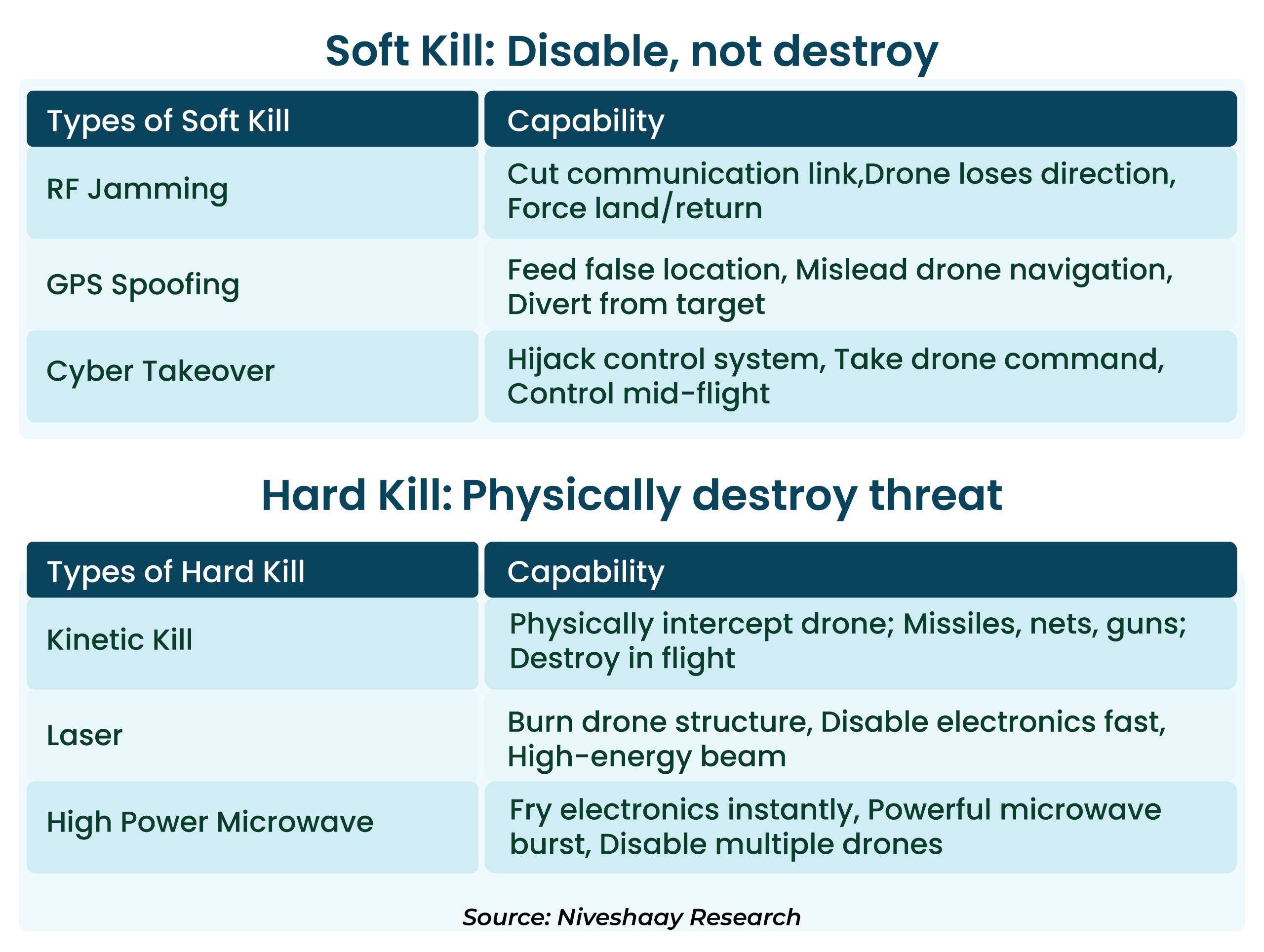
The following are some of the recent developments by Indian companies across both Soft Kill and Hard Kill segments, reflecting a deliberate and accelerating push to build credible, indigenous counter-drone solutions from the ground up:
1 ) Zen Technologies Ltd:
- Naval Anti-Drone System (Hard & Soft Kill) : Proposed for fast attack craft and patrol vessels, this layered system gives compact maritime platforms the ability to detect, disrupt, and physically neutralise hostile drones at sea, combining RF/GNSS jamming and cyber takeover on the Soft Kill side with RCWS-Parashu weapon stations, directed-energy lasers, and net-based capture on the Hard Kill side.
- AI-Powered C-UAS (North Tech Symposium 2026) (Hard & Soft Kill) : Capable of simultaneously tracking over 100 drones, detecting threats beyond 15 km, and neutralising swarm attacks through an integrated architecture combining electronic warfare, indigenous radar, remote-controlled guns, and loitering interceptors.
2) Paras Defence & Space Technologies Ltd:
- RayStrike-9 Laser Weapon System (Hard Kill) — A high-power laser weapon system ranging from 3kW to 9kW, integrating AI-assisted targeting to physically neutralise hostile drones through directed energy. It is expected to be ready for field trials by 2027.
- Handheld Drone Jammer (Soft Kill) — A compact portable jammer designed for rapid deployment by soldiers and security operatives — disrupting RF links and control signals of hostile drones across border zones, VIP protection, and urban security environments.
Every layer of offensive capability being constructed is matched by an equally deliberate effort to build the defensive architecture that protects India from the same threats it is learning to deploy.
Across strike platforms, loitering munitions, surveillance UAVs, and counter-drone systems India is building a sovereign, full-spectrum drone industry with indigenous conviction at its core.
The Government of India has now institutionalised this momentum through Mission Drone Shakti — a ₹1,600 to ₹1,800 crore scheme over five years with one clear goal: to eliminate dependence on Chinese drone components and build every part that goes inside a drone, right here in India.
2) GHATAK UCAV: INDIA’S STEALTH ANSWER TO MODERN AIR WARFARE
In a battlefield increasingly shaped by stealth, autonomy and long-range precision, India needs platforms that can strike deep without exposing pilots to hostile air defences.
The Ghatak UCAV is being developed for exactly that role a 13-ton flying-wing unmanned combat aircraft built for contested airspace, backed by a government-cleared programme budget of ₹39,000 crore.
With its low-observable design, internal weapons bay and AI-driven mission capability, Ghatak marks India’s move from conventional airpower to next-generation autonomous strike warfare.
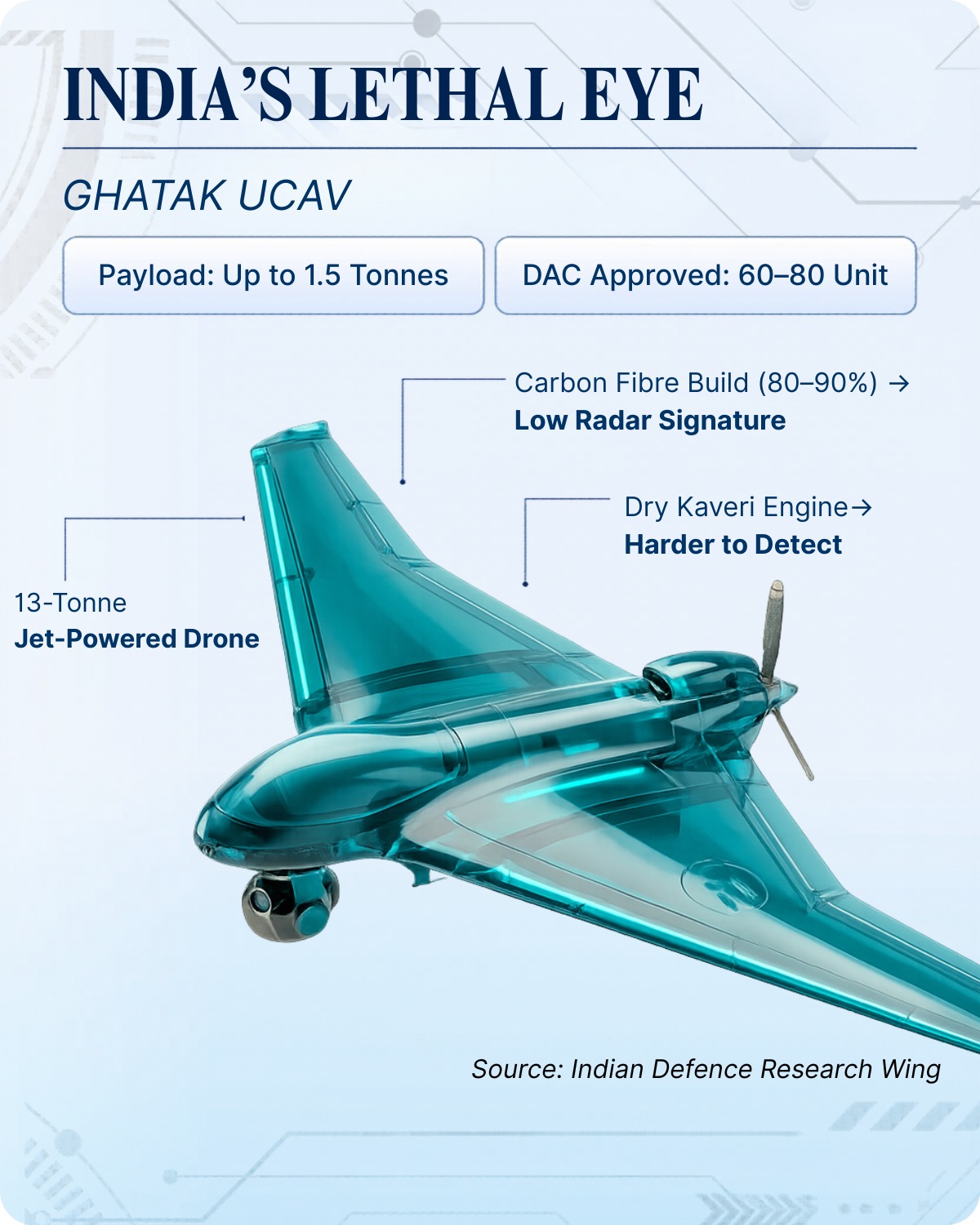
Three things set it apart:
- Home-grown engine. Powered by the Kaveri engine, built entirely in India – The Ghatak eliminates dependence on foreign propulsion technology; a milestone India has pursued for decades.
- Stealth by design. Its carbon composite airframe absorbs radar waves, making it nearly invisible to enemy detection systems before it reaches its target.
- Hidden weapons bays. Munitions are stored internally, which means the drone arrives at its target before the enemy even registers the threat.
Ghatak is proof that India’s defence ambition has finally caught up with its technological capability.
3) PROJECT KUSHA: BUILDING INDIA’S LONG-RANGE AIR DEFENCE SHIELD
Every drone and missile capability India builds on the offensive side raises an equally urgent question on the defensive side: who is protecting Indian airspace from the same threat? That is precisely the gap that Project Kusha is designed to close.
For context, India’s most advanced long-range air defence asset today is the S-400 Triumf System, procured from Russia under a $5.43 billion deal signed in 2018. It is a capable system but it is also a foreign one. That means logistical dependencies, geopolitical strings, and zero control over software, integration pathways, or future upgrades.
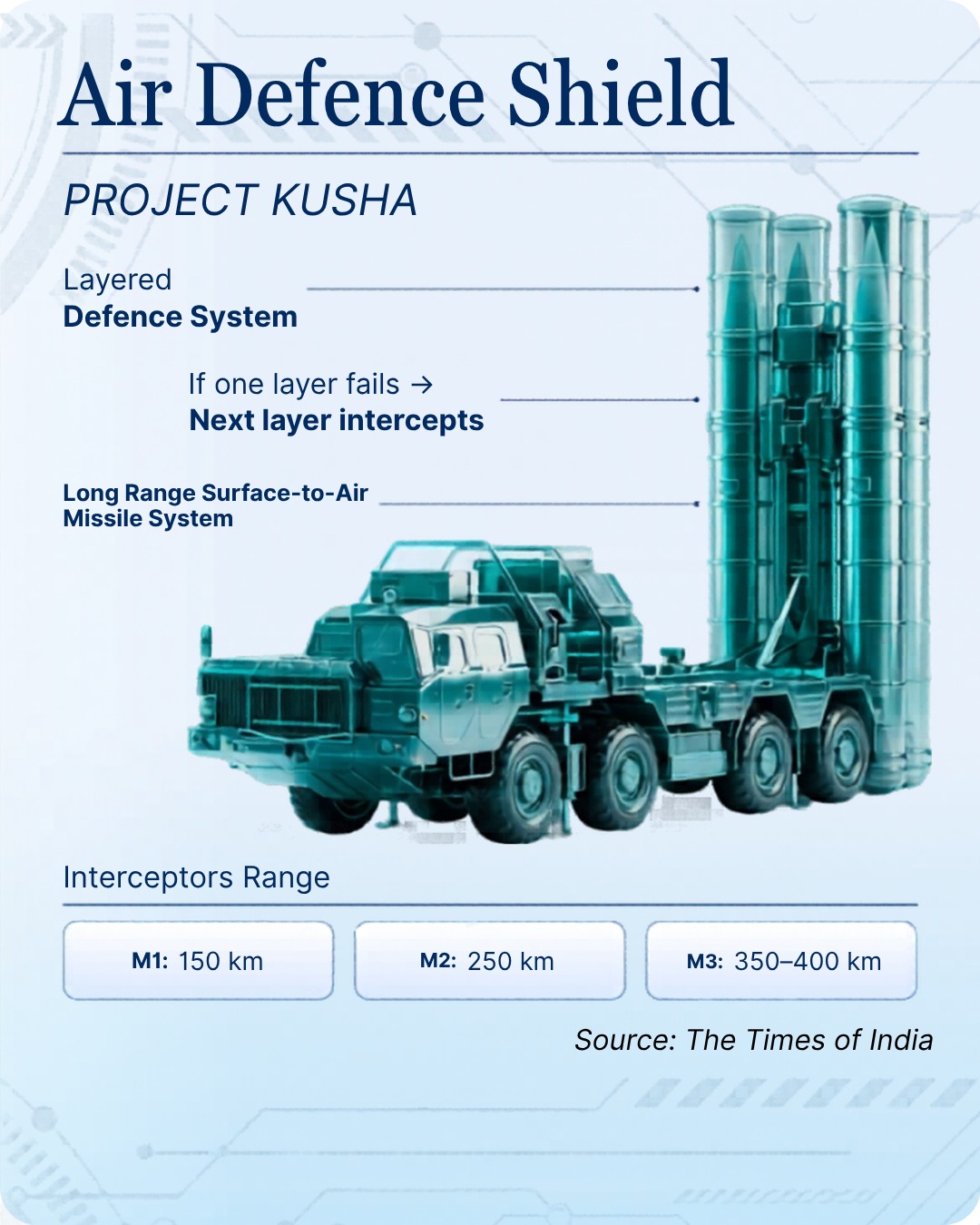
Project Kusha is India’s indigenous alternative, a layered, long-range surface-to-air missile system built around three interceptor variants, each calibrated to a different threat range:
- M1 Interceptor: 150 km engagement range
- M2 Interceptor: 250 km engagement range
- M3 Interceptor: 350–400 km engagement range
The logic of this tiered design is both elegant and critical. The layered structure ensures that even if one layer is saturated or breached, subsequent layers can engage the target, thereby increasing overall kill probability.
No single point of failure.
No single point of foreign dependence.
And because it is built entirely within India’s own ecosystem, Project Kusha provides full control over software, integration, and future upgrades and integrates seamlessly into India’s Integrated Air Command and Control System.
For investors, this translates into a programme that generates sustained demand across radar systems, propulsion technology, command software, and electronics manufacturing, all increasingly served by domestic players.
4) MISSION SUDARSHAN CHAKRA: MOTHER OF ALL DEFENCE SYSTEMS
Project Kusha addresses the threat in the sky. But modern warfare rarely arrives from a single direction- missiles, drone swarms, cyber-attacks, and strikes on critical infrastructure can arrive simultaneously across multiple fronts. Mission Sudarshan Chakra is built for precisely that reality, a unified, nationwide shield that integrates every layer of India’s defence into one coordinated system.
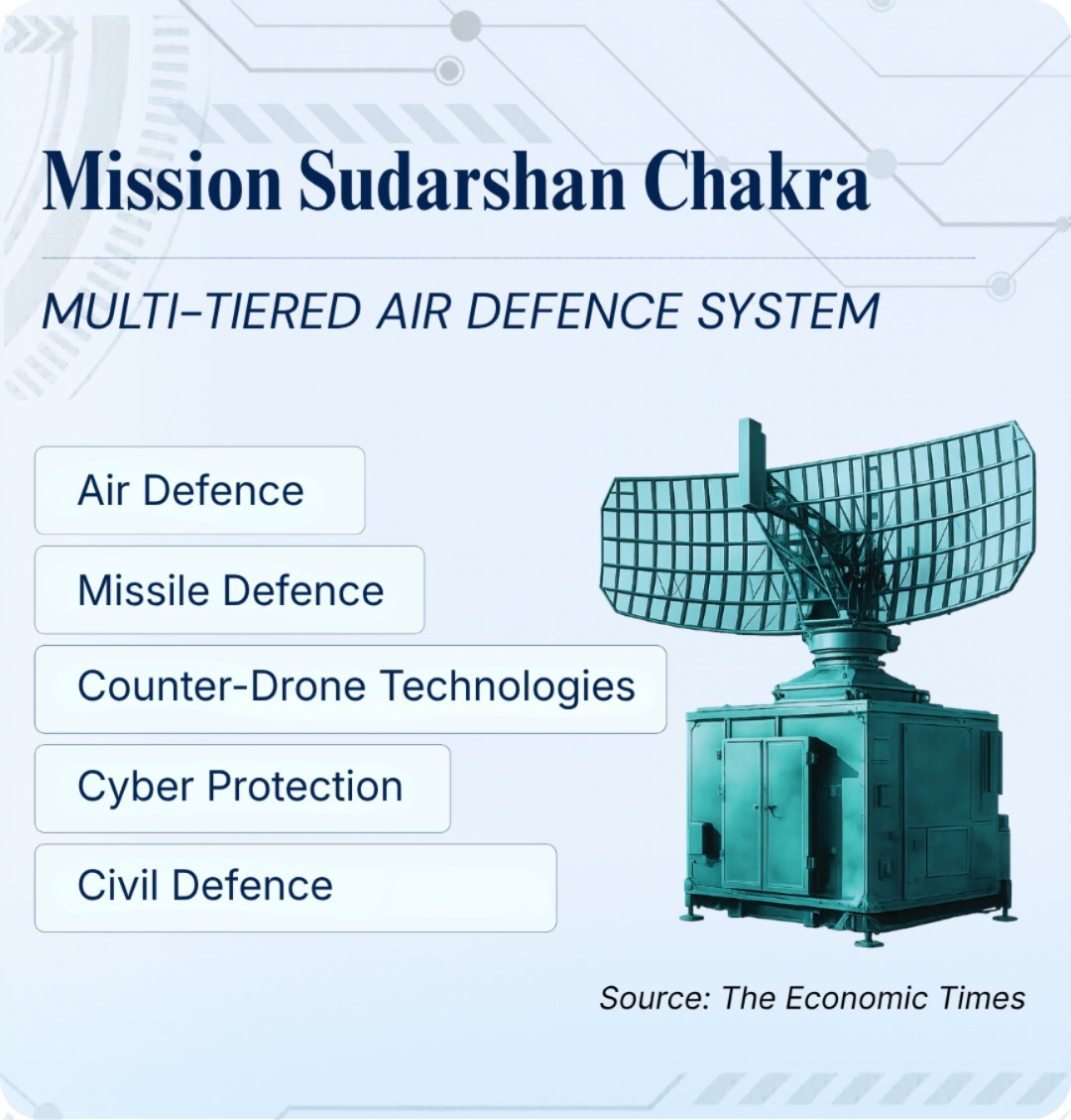
Announced in August 2025 and drawing its name from the weapon of Lord Krishna, the Sudarshan Chakra Program is India’s most ambitious defence initiative to date, a nationwide defence shield targeting full operational capability by 2035. Its scope goes far beyond what any single system can accomplish.
Providing layered protection for strategic assets and civilian infrastructure while ensuring strategic autonomy through full indigenisation of R&D and manufacturing.
Beyond interception, it will also offer precision counterstrike capacities and anti-cyber warfare measures to neutralise digital threats including hacking and phishing at a national scale.
To appreciate the scale of this ambition, consider the two global benchmarks India is measured against:
1) Israel’s Iron Dome : The 90% Standard
- Highly effective against UAVs, rockets, and short-range missiles.
- Operates at an interception rate of approximately 90% widely cited as the benchmark Sudarshan Chakra is designed to meet or exceed.
2) The United States’ Golden Dome : The Next Frontier
- A ground, sea and space-based missile defence system estimated to cost US$ 1.2 trillion to build and maintain over the next 20 years.
- Combines space-based surveillance, detection, and tracking of hypersonic and ballistic missiles, with the ability to intercept them in space.
- India’s Sudarshan Chakra sits in this company, not as an imitation of either system, but as a sovereign, full-spectrum architecture designed around India’s own strategic reality.
5) QUANTUM COMMUNICATION: WHERE EXCELLENCE LIES IN THE MARGINS
A) Imagine an Indian Navy submarine, deep underwater, in the middle of a critical wartime operation. It intercepts vital intelligence — but the communication channel back to the control room is compromised, delayed, or worse, decoded by the enemy. In that moment, the advantage doesn’t belong to the side with the bigger fleet.
It belongs to the side with the faster, more secure line of communication. “What makes quantum communication a game-changer is precisely this — if an enemy ever attempts to intercept or decode that communication, the data itself changes and the breach is immediately detected, making undetected eavesdropping physically impossible”.
In modern warfare, that margin — of speed and security — is often the difference between a mission succeeded and a mission lost. That is precisely the problem quantum communication is built to solve.
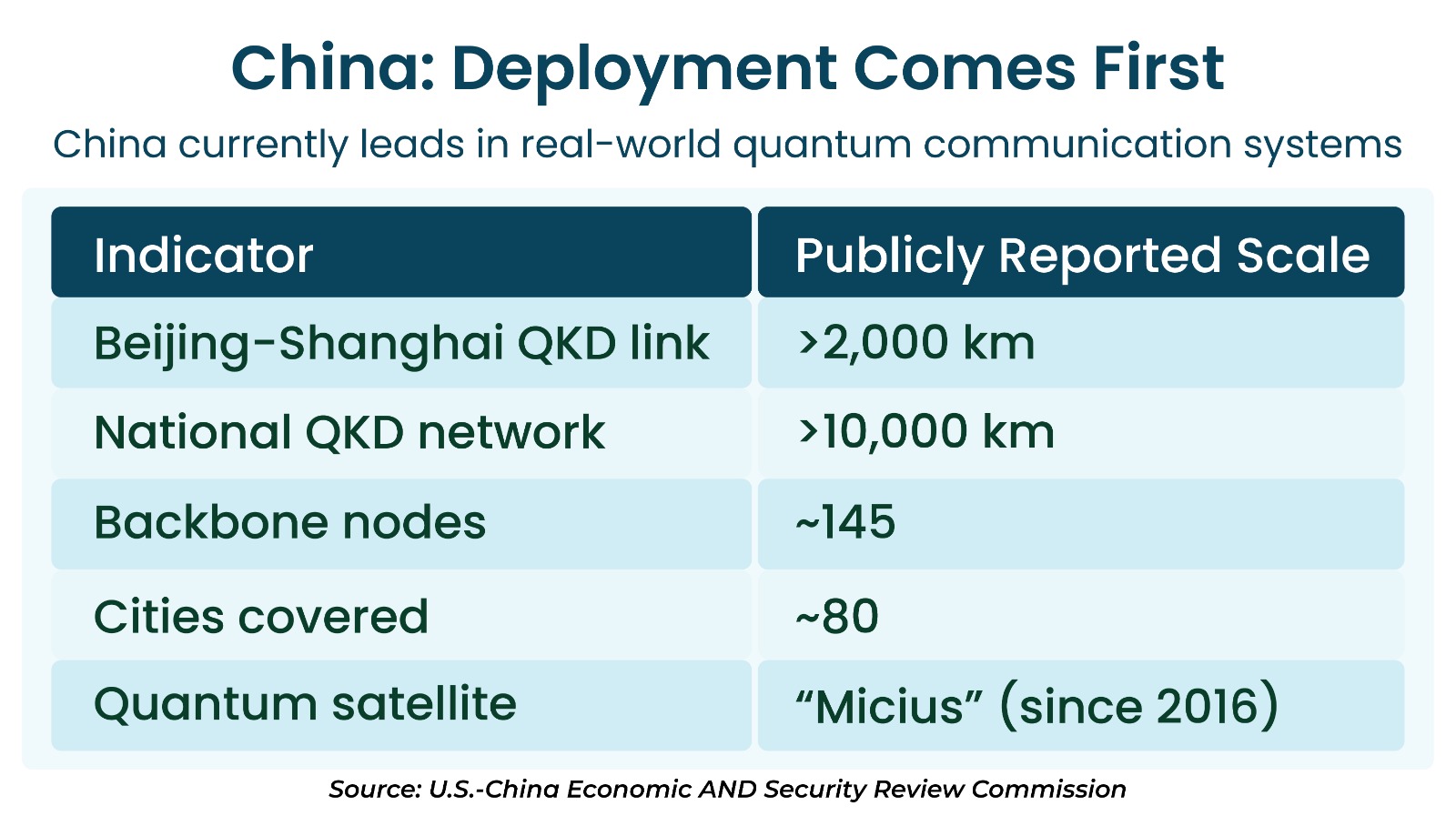
B) China currently leads in real-world quantum communication deployment, giving it an edge in narrow but sensitive regions where early warning and unbreakable secure links define operational advantage. India is closing that gap faster than most anticipated.
C) India’s National Quantum Mission (NQM) has an ambitious mandate: satellite-based secure quantum communications between ground stations spanning 2,000 kilometres domestically, long-distance quantum-secured channels with partner nations, and inter-city Quantum Key Distribution (QKD) networks.
In January 2026, the mission gained further strategic weight when India unveiled its Military Quantum Mission Policy Framework, embedding four critical pillars of quantum technology across its armed services:
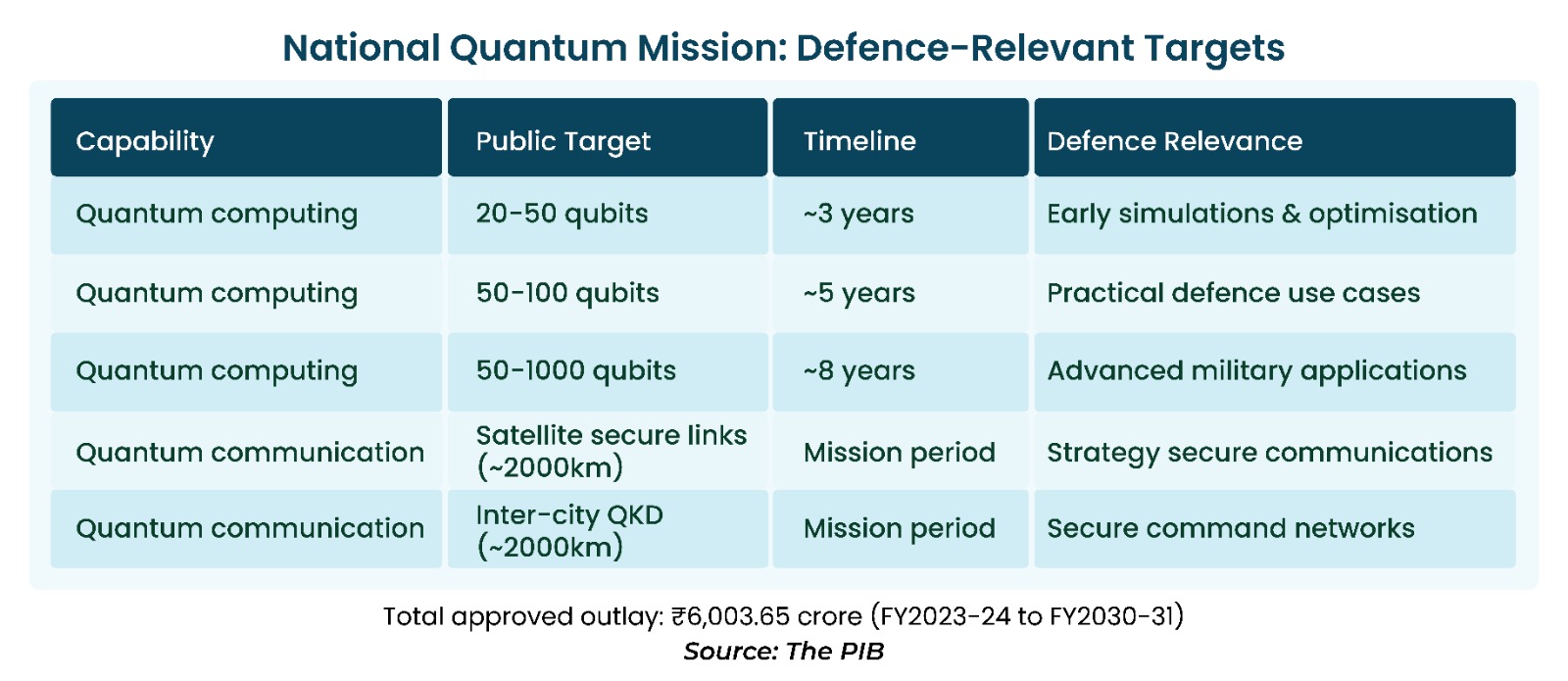
What has made headlines is not merely the ambition but the pace of execution. India achieved a 1,000-kilometre quantum communication network in under two years — a feat originally projected to take eight years. This milestone puts India firmly on course to realise its full 2,000-km vision well ahead of schedule.
D) The implications reach far beyond a laboratory record. This technology delivers interception-proof communication for defence operations, financial systems, and critical national infrastructure — domains where a security breach is not a compliance issue but a national emergency. What makes it even more powerful is its versatility — engineered to function across underwater and underground environments, extending India’s strategic reach into some of the most operationally challenging terrains.
6) SBS-3: BUILDING INDIA’S REAL-TIME EYES ACROSS BORDERS
- Think of SBS-3 as India’s CCTV network — but instead of covering a building, it covers the entire nation, its borders, and its oceans, from space. Just as a security camera network makes it nearly impossible for an intruder to move undetected, SBS-3 creates a persistent, real-time watch over everything that matters strategically.
- The programme involves building and launching 52 dedicated surveillance satellites over the next decade, 21 by ISRO and 31 by Indian private aerospace companies, marking the largest private contribution to any Indian military space programme.
What it watches and how:
- The constellation tracks troop movements, missile deployments, naval vessels, and maritime activity across India’s borders and oceans.
- It is engineered to operate through clouds, at night, and in adverse weather conditions, ensuring no surveillance gap regardless of the environment.
- It covers critical zones including the Line of Control and Line of Actual Control, delivering real-time situational awareness to India’s armed forces.
In modern warfare, the side that sees first, decides first. SBS-3 ensures India builds those eyes itself.
7) SKY IS THE LIMIT: INDIA’S BROADER DEFENCE PIPELINE
The capabilities discussed above represent India’s headline programmes, but the pipeline runs deeper. Two additional systems deserve attention from any investor building a view on India’s long-term defence trajectory:
QRSAM — Intercepting Every Threat, From Every Direction
- Developed by DRDO in collaboration with BEL.
- Dual radar configuration delivering full 360-degree coverage.
- Designed for simultaneous detection, tracking, and engagement of multiple aerial targets, giving frontline formations mobile, all-weather air defence.
BRAHMOS-II: INDIA’S LEAP INTO HYPERSONIC WARFARE
BrahMos-II is the next leap, a hypersonic weapon being developed jointly by BrahMos Aerospace and DRDO, designed to operate in a domain where very few nations have ever ventured.
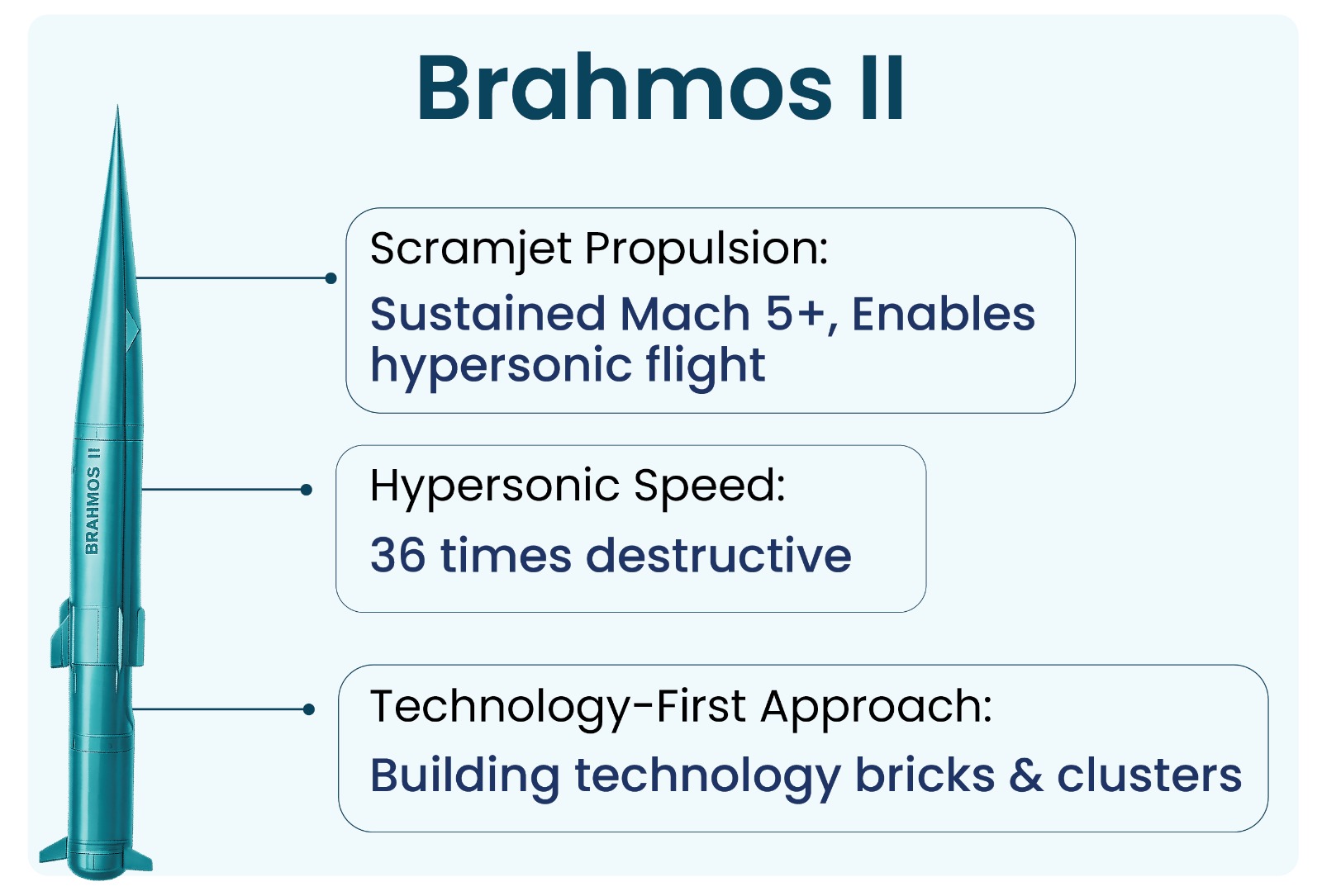
What makes BrahMos-II fundamentally different:
- Scramjet Propulsion: Powered by an air-breathing scramjet engine, enabling sustained flight at Mach 5 and above.
- Hypersonic Speed: At Mach 5+, it generates nearly 36 times the destructive force of an object striking at Mach 1, making kinetic energy alone a lethal weapon.
- Technology-First Approach: BrahMos Aerospace is building “Technology Bricks” and “Technology Clusters” with DRDO, laying the foundational groundwork for the niche technologies this programme demands.
Once developed, BrahMos-II would place India in an elite and exclusive club, where only Russia and China currently hold operational hypersonic cruise missile capability, while the United States, France, Japan, and Australia remain in active development.
For a nation that has historically been a consumer of frontier defence technology, crossing into this league would mark a defining moment in India’s strategic journey.
BUILDING THE ARSENAL WITHIN: THE INVESTOR’S LENS
Step back and look at what India is assembling:
• A sovereign drone industry : spanning offensive strike platforms, loitering munitions, surveillance UAVs, and counter-drone systems
• Project Kusha : layered interceptor shields built entirely within India’s own ecosystem
• Mission Sudarshan Chakra : a nationwide, multi-domain defence umbrella covering air, missile, cyber, and civil defence
• SBS-3 : space-based surveillance watching every border, in real time, through any weather
• Quantum-secured communications : interception-proof links that no adversary can crack
• BrahMos-II : a hypersonic missile programme that would place India in an elite global league
A pattern becomes unmistakable: technology is no longer a supplementary element of India’s defence posture. It is the foundation of it.
Each programme discussed in this blog reflects a deliberate pivot, away from foreign procurement and imported platforms, toward sovereign capabilities engineered for India’s specific threat environment and strategic priorities. That is not a policy trend.
It is a structural economic shift, one that creates a multi-decade procurement pipeline flowing directly into domestic manufacturers, system integrators, electronics companies, and deep-tech startups.
For retail investors, the context is worth holding global uncertainty, geopolitical tensions, supply chain disruptions, and escalating conflicts are making defence self-reliance not just a strategic goal but a commercial imperative.
The Defence Forces Vision 2047 institutionalises this momentum, creating a future-ready military through dedicated Space, Cyber, and Drone Forces and anchoring it to a clear policy roadmap and sustained capital allocation.
As the trajectory of indigenisation accelerates, India is not merely closing the technological gap. It is building a sovereign, technology-driven arsenal one that is purposeful, indigenous, and built for the battles of tomorrow. For the patient investor, that is a story worth tracking from the very beginning.

 AIF Investor Charter


NIVESHAAY INVESTMENT ADVISORS
508, SNS Platina, Near Someshwara Enclave, Vesu, Surat, Gujarat-395007
(+91) 7859870559
research.smallcase@niveshaay.com (Equity Baskets)
NIVESHAAY INVESTMENT MANAGEMENT PRIVATE LIMITED
610, SNS Platina, Near Someshwara Enclave, Vesu, Surat, Gujarat-395007
(+91) 7836915478
contactaif@niveshaay.com (AIF)
SEBI Registration No. : INH000017338, IN/AIF3/24-25/1571, IN/AIF2/24-25/1607, INP000009506 | BASL Membership ID: 6276
Disclaimer:
Investment in Securities Market are subject to market risks. Read all related documents carefully before investing.
Registration granted by SEBI and certification from NISM in no way guarantee performance of the intermediary or provide any assurance of returns to investors.
The securities quoted are for illustration only and are not recommendatory
NIVESHAAY INVESTMENT ADVISORS © . All Rights Reserved., NIVESHAAY INVESTMENT MANAGEMENT PRIVATE LIMITED © . All Rights Reserved.Smart ODR