







Beyond EMS: India's Electronics Value Chain
For most of the last decade, India’s electronics industry meant assembly: importing components, printed circuit boards, displays, camera modules, chips, and putting them together into a finished phone, television, or appliance.
This activity is called Electronics Manufacturing Services, or EMS, and it became one of India’s genuine industrial successes.
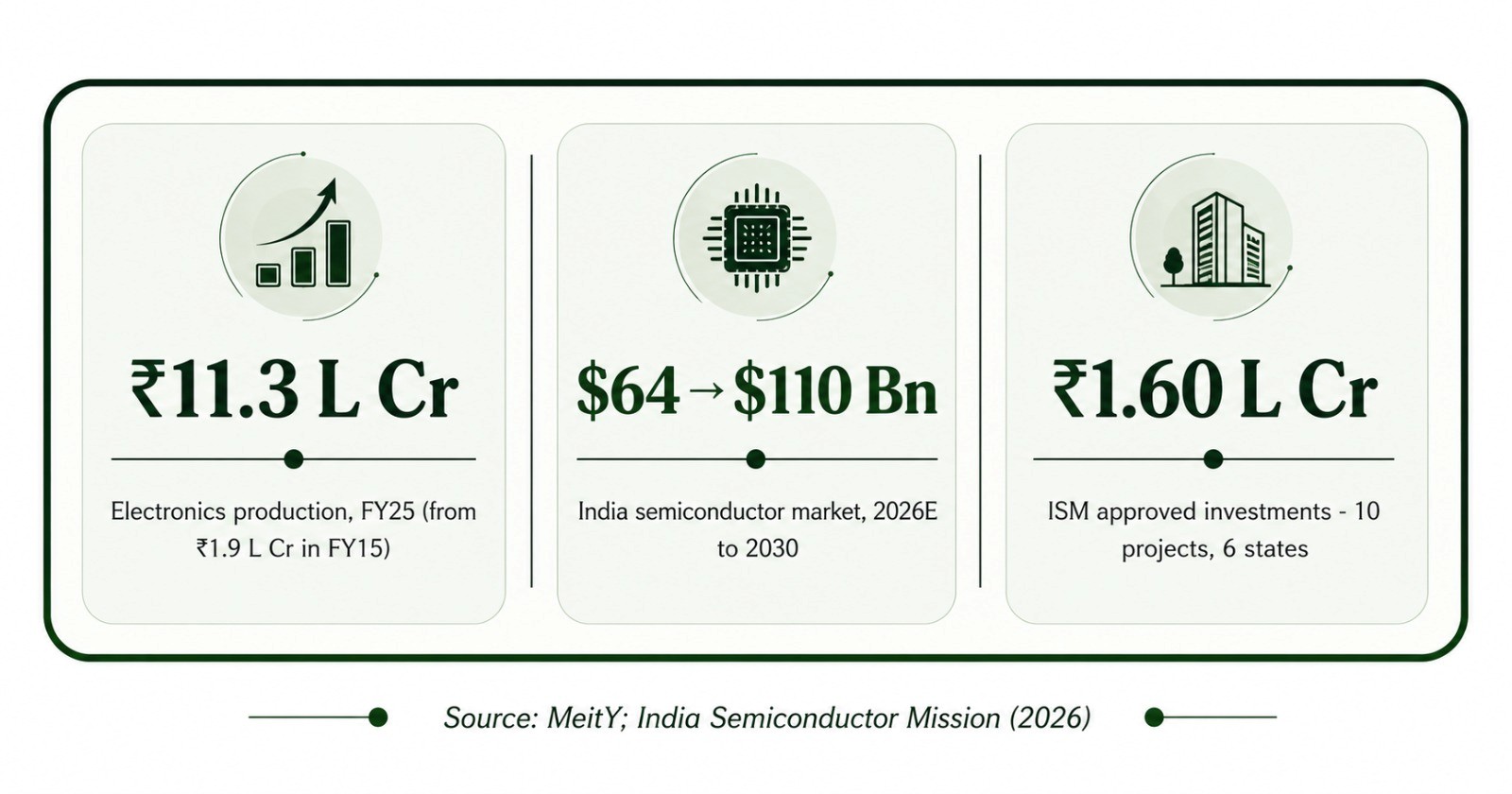
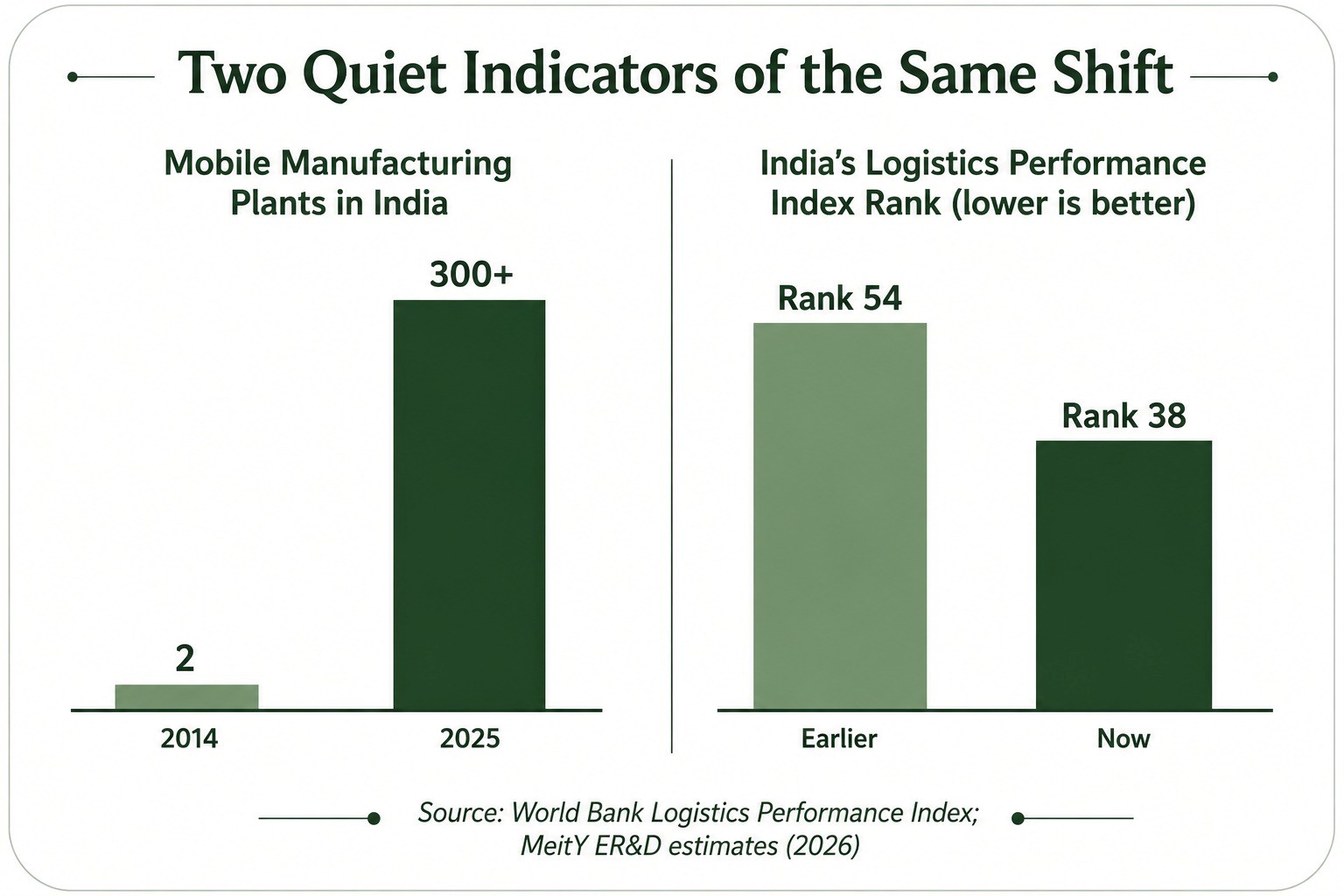
Electronics production grew six times in a decade, from ₹1.9 lakh crore in FY15 to ₹11.3 lakh crore in FY25. Mobile phone manufacturing alone went from two plants in 2014 to more than 300 today.
But assembly sits at the lower-margin end of the supply chain. The company doing the assembling earns a thin return on each device; the larger part of the value sits upstream, in the components and the chips themselves.
For India’s electronics industry to grow beyond an assembly base, it needed to build backward into that value chain. That shift is now underway.
The Component Gap
The clearest evidence of how far assembly had outpaced component manufacturing is a single figure: more than 90% of the printed circuit boards used in Indian electronic products are still imported, mostly from China, Taiwan, and South Korea.
A printed circuit board is not a minor part – it is the base almost every other electronic component sits on. For a country producing ₹11.3 lakh crore of electronics a year to import nearly all its PCBs says less about a weakness and more about how much of the value chain still sits outside the country.
This is the gap the Electronics Component Manufacturing Scheme is built to close.
- Outlay raised to ₹40,000 crore in Budget 2026, up from ₹22,919 crore.
- Scope covers eleven component categories, including PCBs, capacitors, display modules, and camera modules.
- 46 companies approved so far, including Samsung Display.
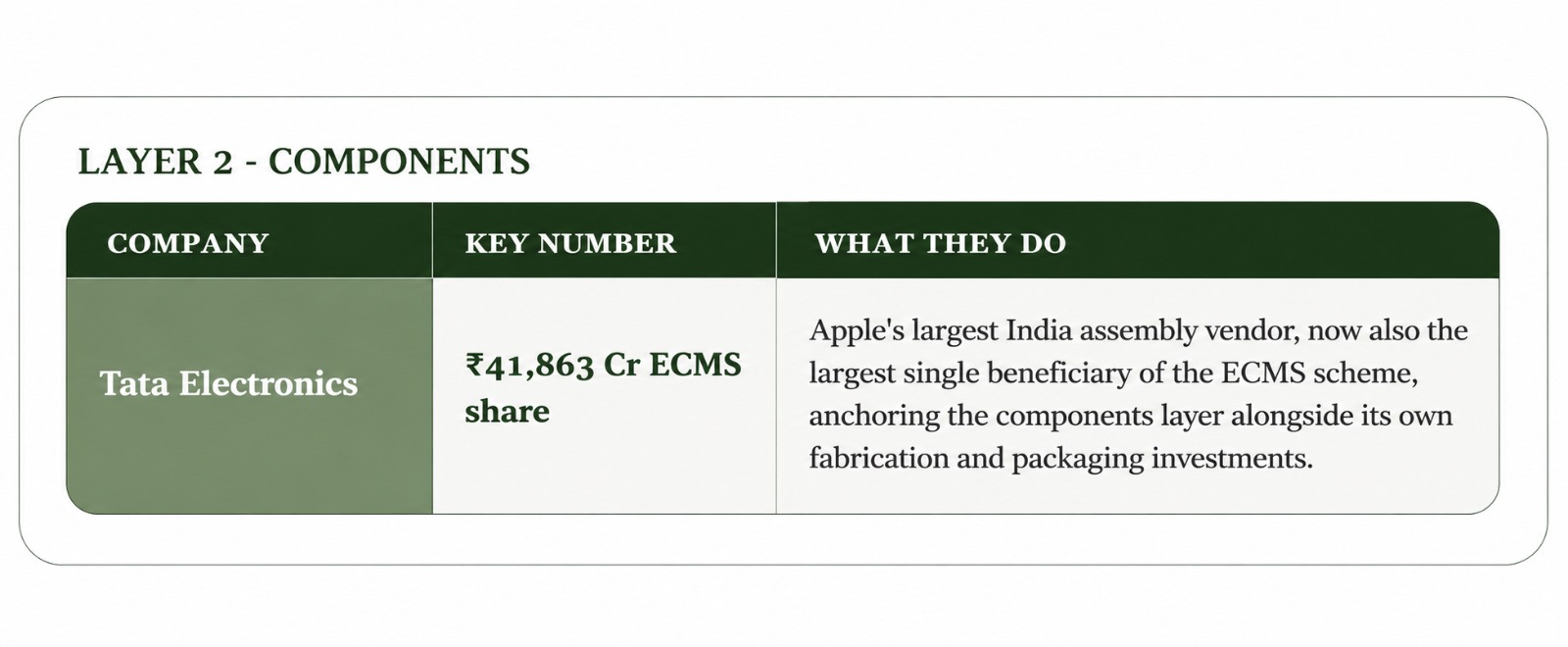
- ₹41,863 crore already committed to Apple’s anchor vendor network in India – Tata Electronics, Foxconn’s Yuzhan unit, Motherson, Hindalco, and TDK.
A relationship that began with assembling Apple’s phones is now extending into manufacturing the components those phones are built from.
Semiconductors: Starting With Assembly, Test, and Packaging
Components are one layer of backward integration. Semiconductors are a deeper one, and considerably harder to enter – chip manufacturing is more precise, more capital-intensive, and slower to qualify than assembling a finished device.
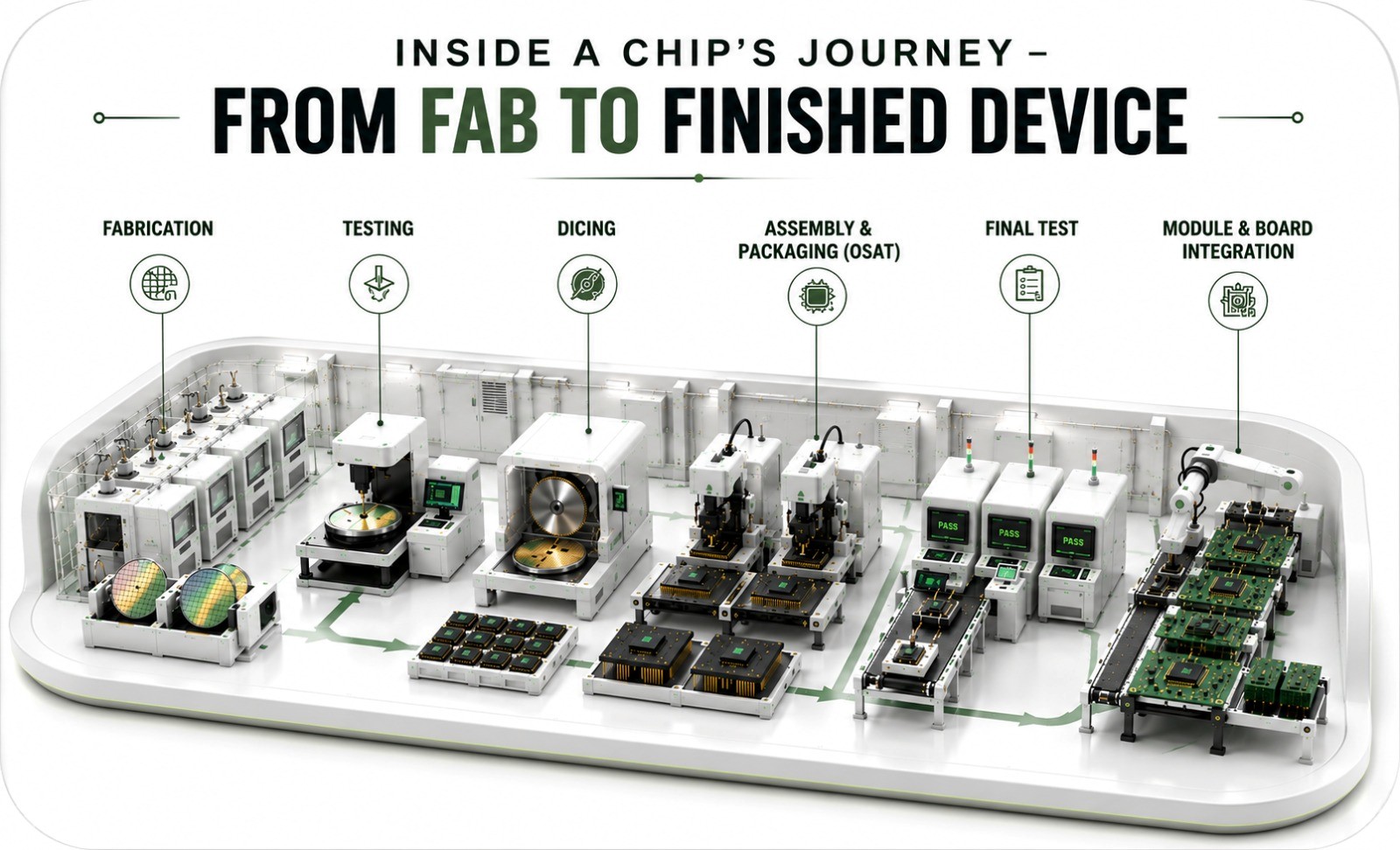
India’s entry point into this layer has not been full chip fabrication. It has been assembly, testing, and packaging, an activity the industry calls OSAT: a chip is fabricated on a silicon wafer inside a cleanroom, then cut apart, mounted, wire-bonded, and sealed into the package that ends up inside a phone or a car.
It is where India’s semiconductor mission chose to begin, because it needs less capital than a fabrication plant and can be brought online faster.
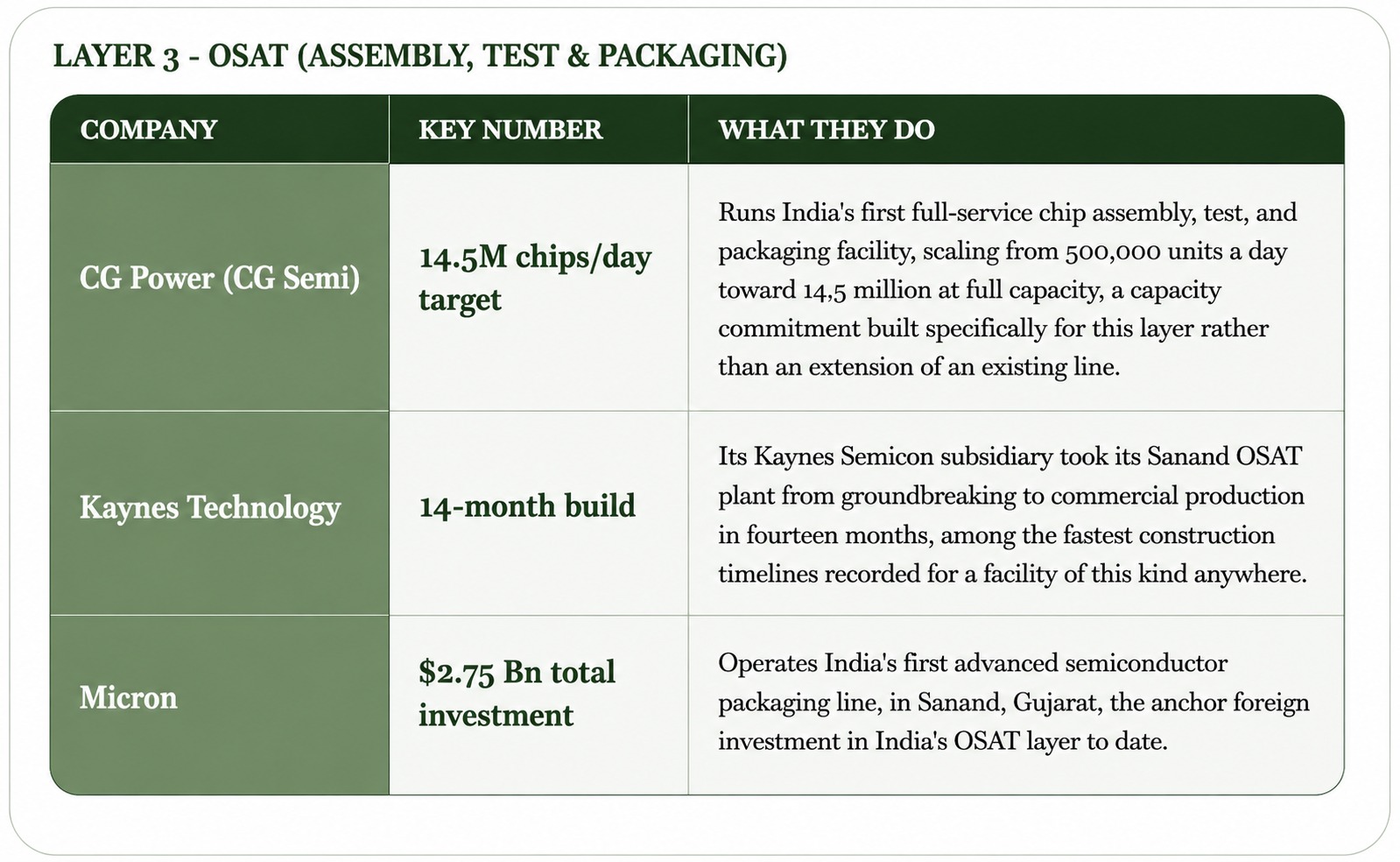
Micron, Sanand, Gujarat began partial production in early 2025, India’s first advanced semiconductor packaging line, backed by roughly $825 million of its total $2.75 billion India investment.
Kaynes Semicon, also in Sanand, built its OSAT facility from groundbreaking to commercial production in 14 months, a genuinely fast timeline for anything resembling a chip plant.
CG Power’s OSAT line, running since August 2025, already processes 500,000 chip units a day, with a roadmap toward 14.5 million a day at full capacity.
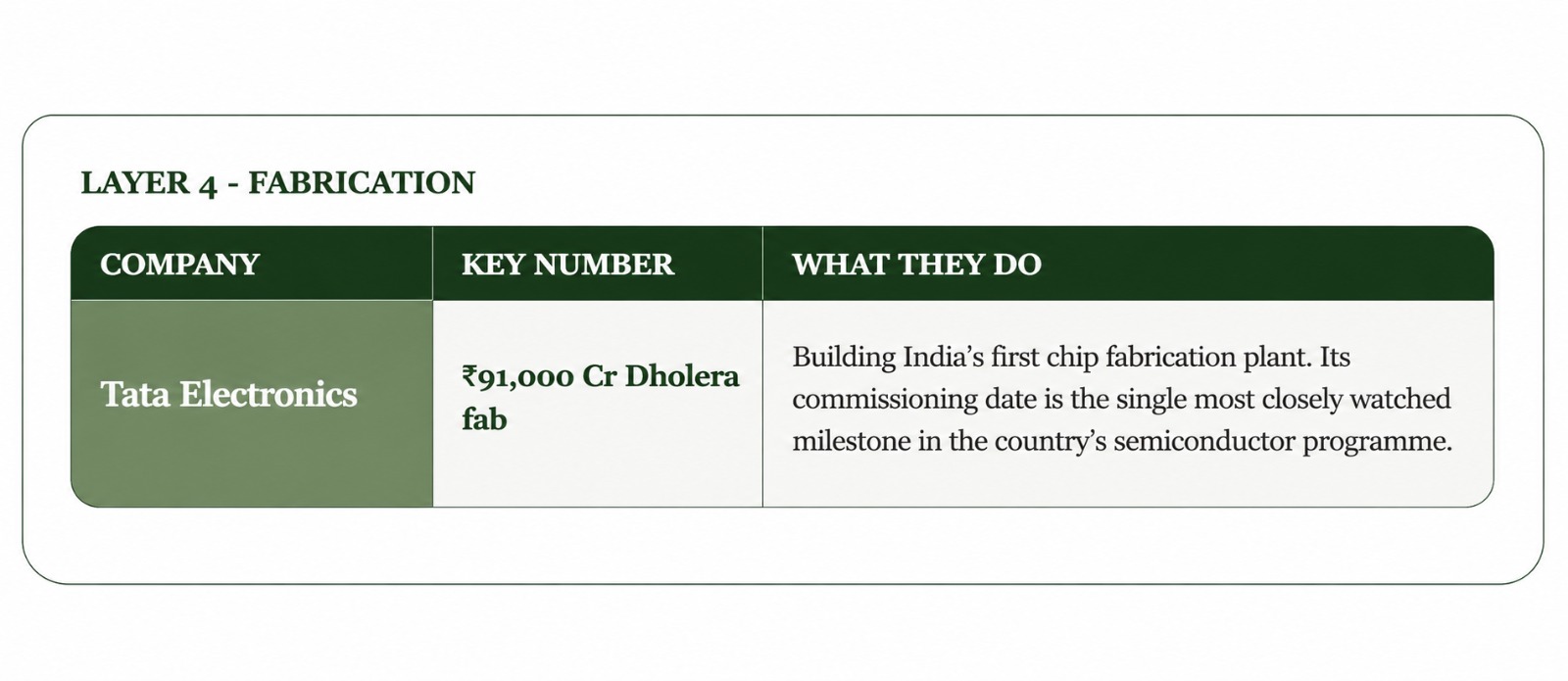
Fabrication itself, the stage before OSAT, is the layer India is only now entering. Tata Electronics planned facility in Dholera, Gujarat, is intended to be India’s first chip fabrication plant, and its commissioning date is the single most closely watched milestone in the country’s semiconductor programme.
Tata is separately building an OSAT facility in Assam, giving the same company a position at both the fabrication and packaging ends of the process.
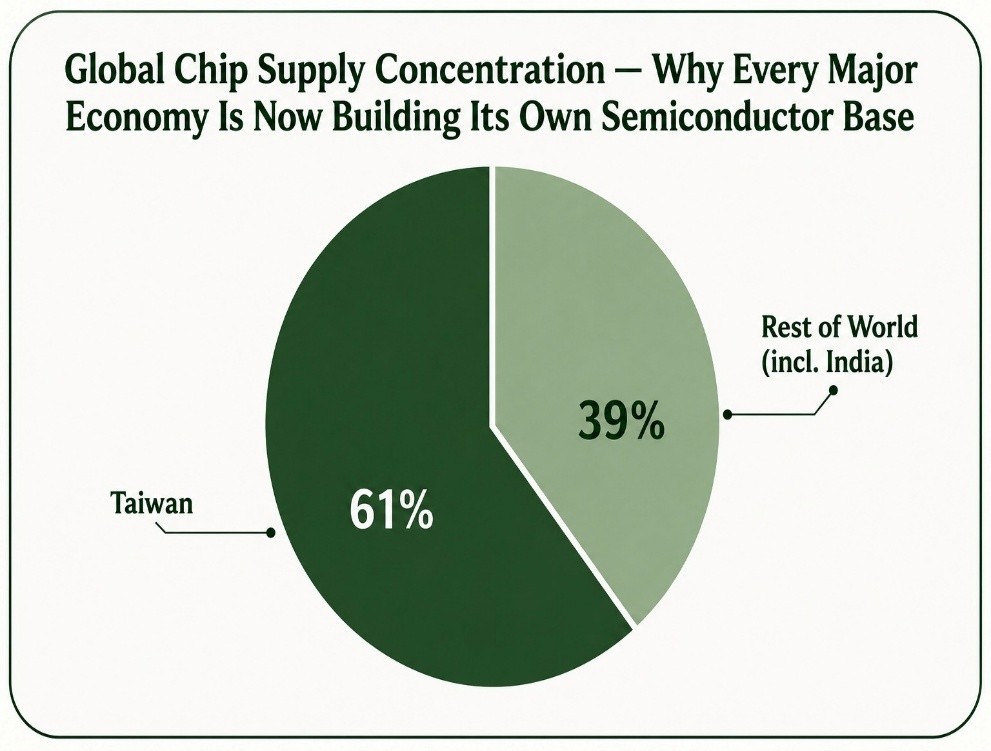
Taiwan alone produces more than 60% of the world’s chips. That concentration is a large part of why the US CHIPS Act ($52 billion), the EU Chips Act, and India’s own Semiconductor Mission (₹76,000 crore) have all emerged within a similar window – every major economy is building some form of domestic capacity, and India’s programme is one part of that wider reconfiguration.
Design: A Separate, Earlier, and Higher-Value Stage
Fabrication and packaging are the manufacturing end of the semiconductor chain. Design sits earlier and separately – deciding what a chip does before it is fabricated – and is generally the highest-margin part of the industry, since it does not require owning a factory.
India’s Design Linked Incentive scheme backs this stage directly: a performance-linked incentive of 4 to 6% of net sales turnover for five years, capped at ₹30 crore per applicant, plus subsidised access to EDA design software and fabrication slots. Since 2022 it has committed ₹234 crore across 22 companies, against a total project cost of ₹690 crore.
- 16 startup tape-outs completed, and 6 chips fabricated at advanced nodes, including 12 nanometres.
- DLI-backed startups have collectively attracted close to ₹430 crore in venture capital, on top of the government support itself.
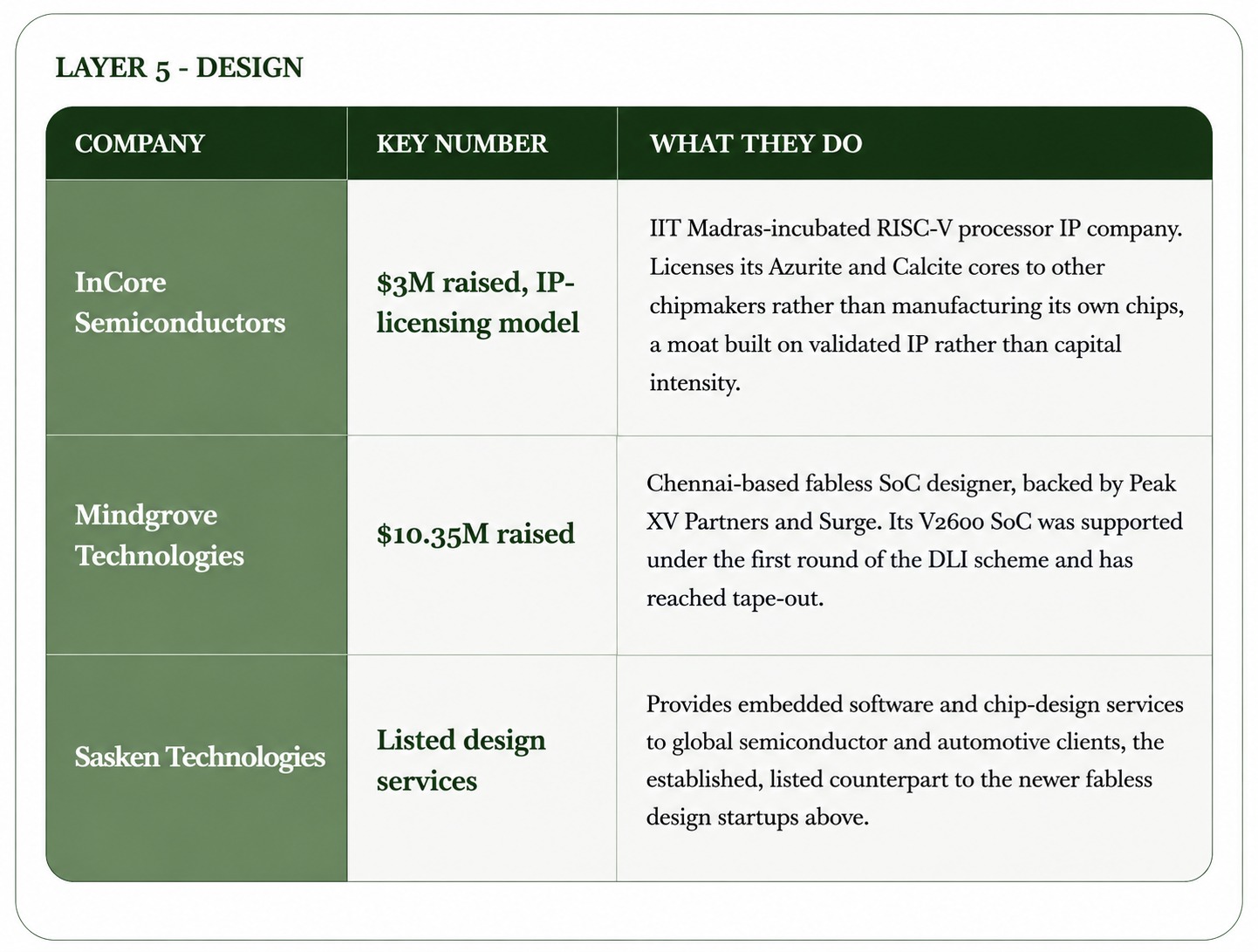
InCore Semiconductors, incubated at IIT Madras, licenses its RISC-V processor cores, Azurite and Calcite, to other chipmakers rather than manufacturing chips itself, a moat built on validated IP rather than capital. It has raised $3 million from Peak XV Partners.
Mindgrove Technologies, also Chennai-based, had its V2600 SoC supported under the first round of DLI and has raised $10.35 million to date, including backing from Peak XV Partners and Surge, and has reached tape-out.
Both companies show the same pattern: real capital, real tape-outs, and an IP-first or licensing model that does not require owning a fabrication plant to compete.
The Policy Architecture Behind the Shift
None of these layers, components, OSAT, fabrication, design, were built in isolation. Behind them sits a set of decisions made across roughly the last eighteen months.
- India Semiconductor Mission (₹76,000 Cr) – covers half the fiscal cost of fabs, assembly and test facilities, compound semiconductors, and chip design; ten projects approved across six states so far.
- ISM 2.0 – sets explicit targets for 3-nanometre and 2-nanometre process nodes, alongside equipment, materials, design IP, and R&D centres for the coming decade.
- NITI Aayog Semiconductor Roadmap (May 2026) – India’s first comprehensive national roadmap, setting a path toward becoming a top semiconductor nation by 2035.
- US-India TRUST Initiative – formalises semiconductors and critical minerals as a specific area of bilateral cooperation, giving the domestic programme an external co-investment channel.
Private capital has started to move alongside the policy. In 2026, a coalition of Accel, Blume, Celesta, Premji Invest, Qualcomm Ventures, and Kalaari, with NVIDIA advising, committed more than a billion dollars to India’s deep-tech ecosystem, the first-time capital at this scale has aligned specifically with the semiconductor and EMS timeline.
Where Individual Companies Sit in This Shift
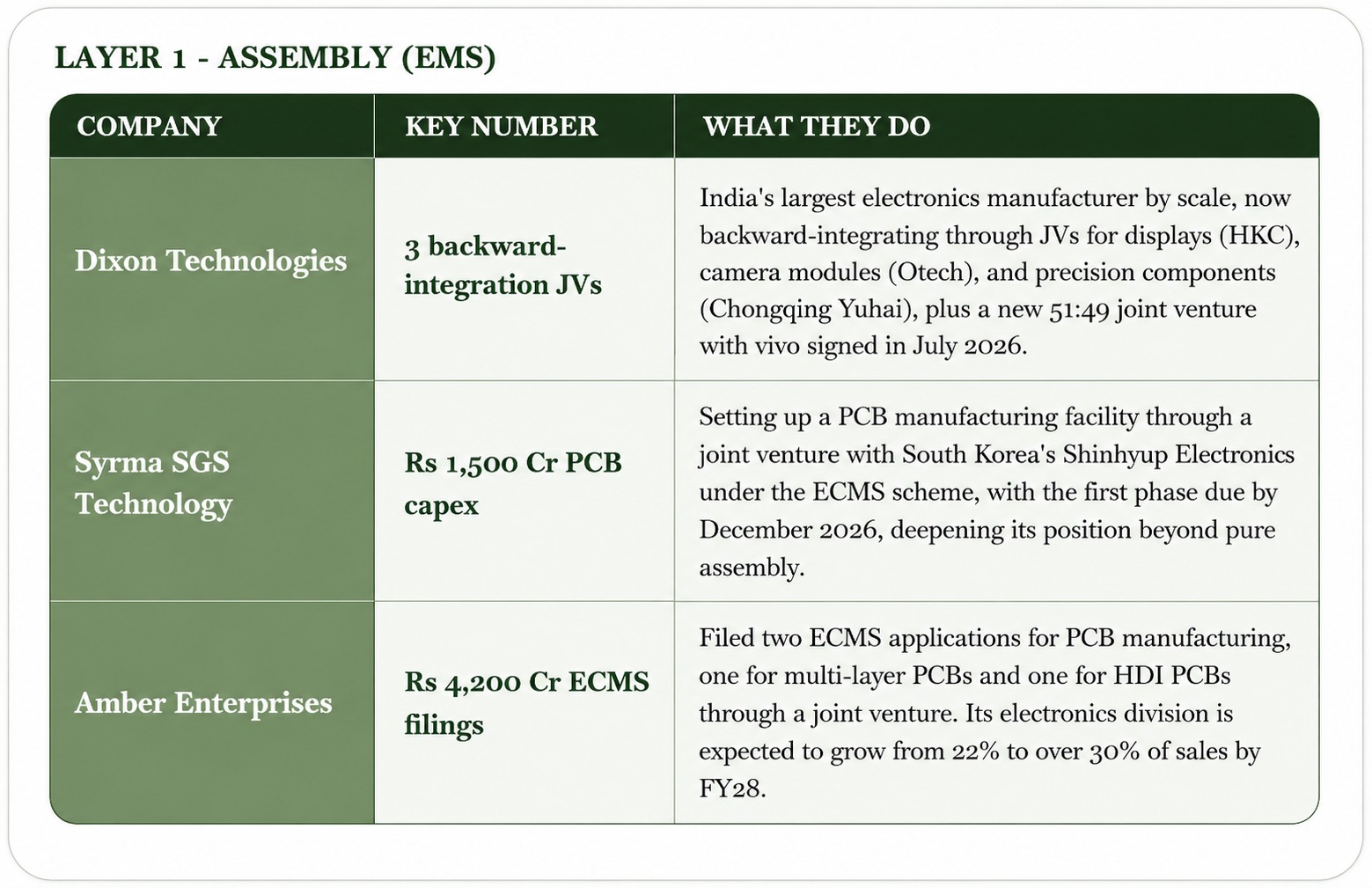
The move from assembly toward components, packaging, and design is visible company by company. Grouping them by the layer they operate in makes the shift easier to see than any single company profile would.
Each company below is included for a specific reason: a genuine capital commitment, a manufacturing capability, or a technical position that is difficult for a competitor to simply replicate. Companies without a clear structural story of this kind are left out, rather than filled in for the sake of completeness.
Why This Matters Beyond Electronics
Electronics is rarely the final product a customer buys. It is almost always a component inside someone else’s, which is what makes this shift matter well past its own sector.
- Defence – every platform requires precision electronics assemblies and, increasingly, indigenous chips.
- Space – every ISRO mission, including Chandrayaan, PSLV, and GSLV, depends on space-grade electronics manufactured to exacting tolerances.
- Telecom – networking equipment, 5G device chipsets, and optical components all sit downstream of this same manufacturing base.
- EV & Electrification – battery management systems, power electronics, and smart meters are each, in their own right, EMS products.
Smart meters make the point concretely: 5.08 crore have been deployed from a near-zero base only a few years ago, and each one is an electronics product built on the same manufacturing base described throughout this piece.
A Few Other Indicators Worth Noting
Three other measures show the same shift from the EMS side of the industry, in exports and infrastructure rather than in chips.
- Mobile phone exports reached roughly ₹2 lakh crore in FY25, up from a starting point close to zero a decade earlier.
- India’s rank on the World Bank’s Logistics Performance Index has moved from 54 to 38, a meaningful improvement in the physical movement of goods that electronics manufacturing depends on as much as any other industry.
- India’s engineering, research, and development market, the embedded software and design services layer, is projected to reach $100 billion by FY30, roughly double its current size.
Milestones Worth Tracking
- Tata’s Dholera fab commissioning – The most closely watched event in India’s semiconductor programme, since it would mark the country’s first operational chip fabrication plant rather than a packaging or assembly facility.
- Micron’s Gujarat ramp – How quickly partial production scales, and which customers qualify its output.
- ECMS disbursement – How much of the ₹40,000 crore allocation, approved for 46 companies, converts into deployed capital rather than committed capital.
- DLI tape-out to production conversion – Whether the 16 completed tape-outs, including Mindgrove’s, convert into shipping, revenue-generating products.
KEY INSIGHT : The companies doing EMS work five years ago are, in several cases, the same companies now building components, packaging chips, or funding chip design, Kaynes and Tata Electronics among them.
What has changed is not the industry’s starting point, but the layer of the value chain it is choosing to compete in next, with policy, private capital, and individual company decisions now pointed in the same direction at the same time.
None of this replaces the assembly industry India already built. It sits on top of it, extending a manufacturing base that took a decade to reach ₹11.3 lakh crore into the components, packaging, and design layers that base did not previously include.

 AIF Investor Charter


NIVESHAAY INVESTMENT ADVISORS
508, SNS Platina, Near Someshwara Enclave, Vesu, Surat, Gujarat-395007
(+91) 7859870559
research.smallcase@niveshaay.com (Equity Baskets)
NIVESHAAY INVESTMENT MANAGEMENT PRIVATE LIMITED
610, SNS Platina, Near Someshwara Enclave, Vesu, Surat, Gujarat-395007
(+91) 7836915478
contactaif@niveshaay.com (AIF)
SEBI Registration No. : INH000017338, IN/AIF3/24-25/1571, IN/AIF2/24-25/1607, INP000009506 | BASL Membership ID: 6276
Disclaimer:
Investment in Securities Market are subject to market risks. Read all related documents carefully before investing.
Registration granted by SEBI and certification from NISM in no way guarantee performance of the intermediary or provide any assurance of returns to investors.
The securities quoted are for illustration only and are not recommendatory
NIVESHAAY INVESTMENT ADVISORS © . All Rights Reserved., NIVESHAAY INVESTMENT MANAGEMENT PRIVATE LIMITED © . All Rights Reserved.Smart ODR