Inside India's AI compute race: $67.5B in bets, a 3% data centre gap, and the chips deciding who wins.
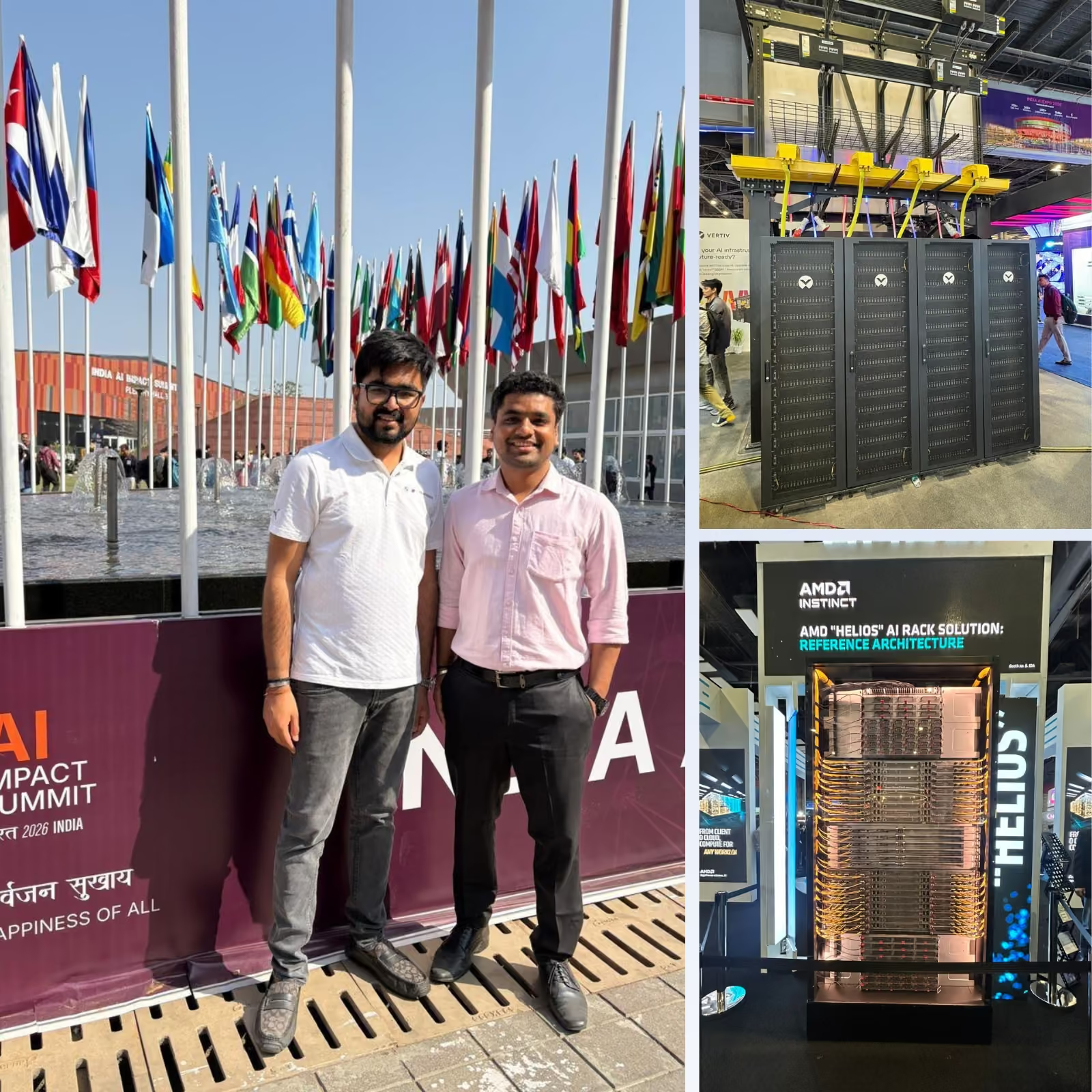
Big tech’s top executives just paid ₹15–30 lakh a night for hotel suites in Delhi.
Not for a wedding. Not for a cricket final.
For an AI summit.
That is what a seat at India’s AI table costs right now – and it’s still cheaper than what they’re paying for the thing they actually came for.
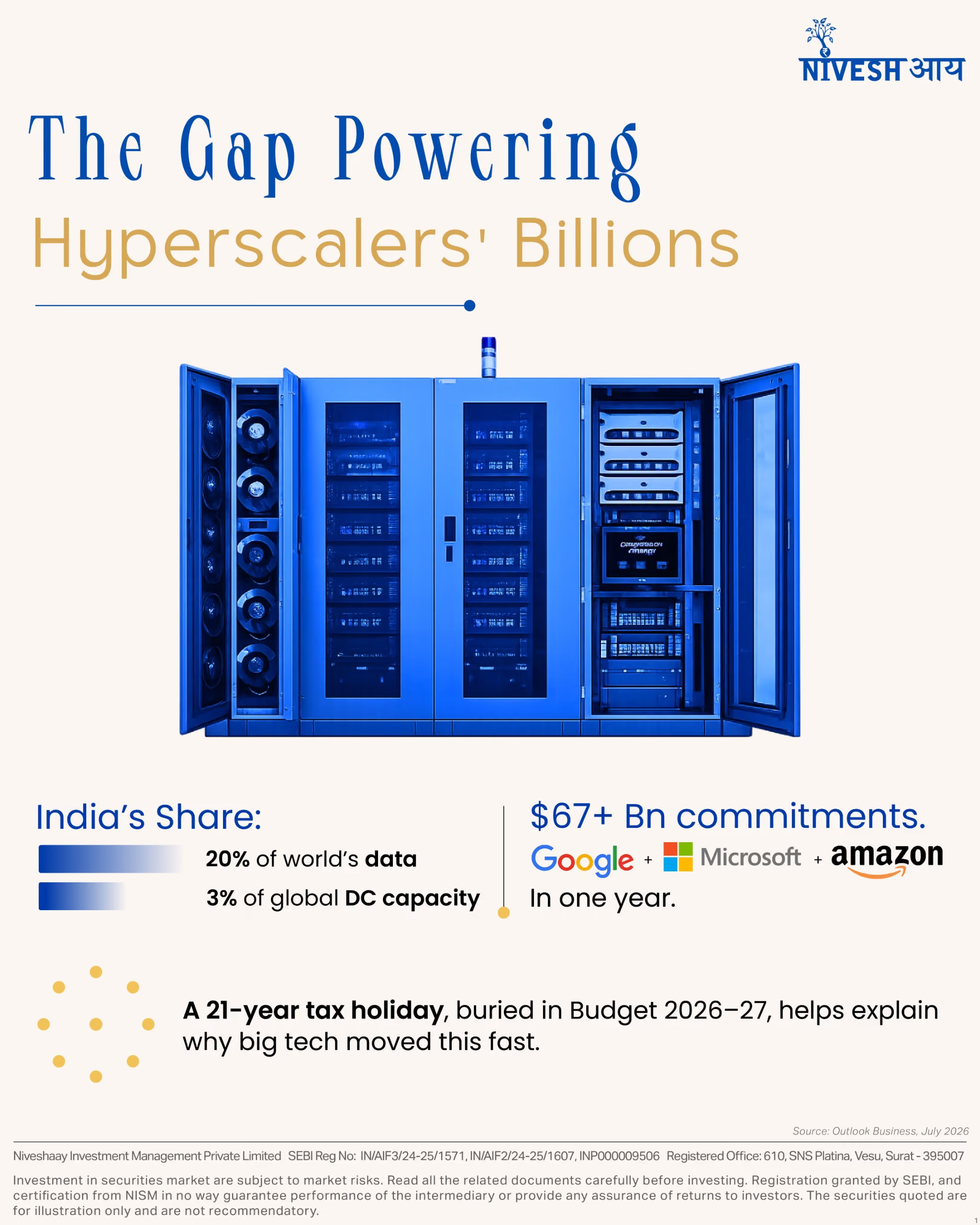
India generates roughly a fifth of the world’s data.
It hosts barely 3% of the world’s data centre capacity.
Sit with that gap for a second – because everything in this piece is an attempt to close it.
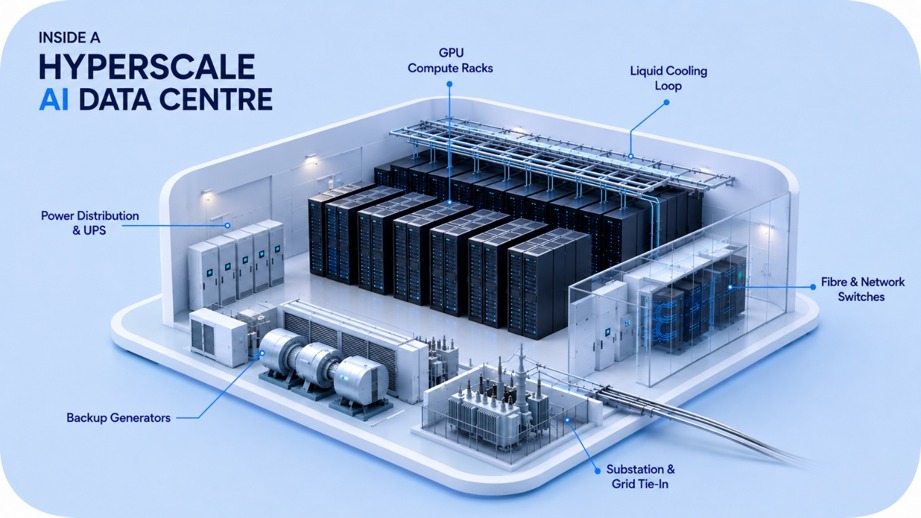
A data centre used to be a warehouse. Somewhere to park information until someone needed it. Now it computes, reasons, and answers.
Every AI query – yours, mine, a hospital’s, a bank’s – begins with something unglamorous: a server, in a rack, cooled by something, drawing power from a grid built to support it.
The intelligence is invisible. The infrastructure underneath it is not. And India is building that infrastructure at a pace that makes it worth watching closely.
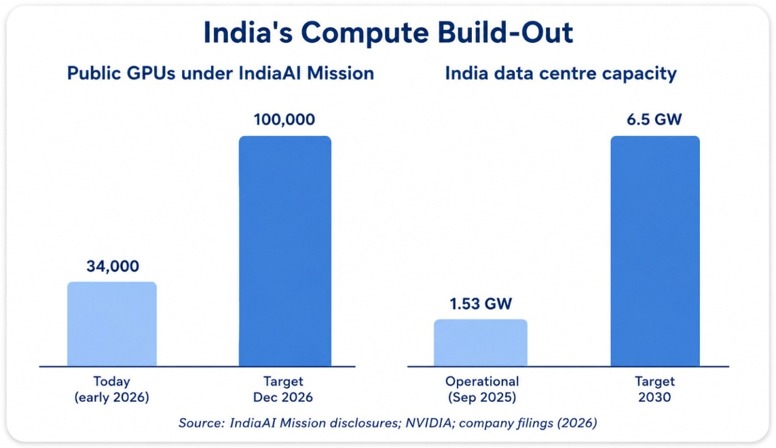
Two things are happening here, and it’s worth naming both before going further.
First: a data centre stopped being real estate and became a compute factory. Every AI query now needs a physical chain – GPU, rack, cooling, grid – that simply didn’t exist as an investable category five years ago. That’s not an upgrade to old infrastructure. It’s a new one.
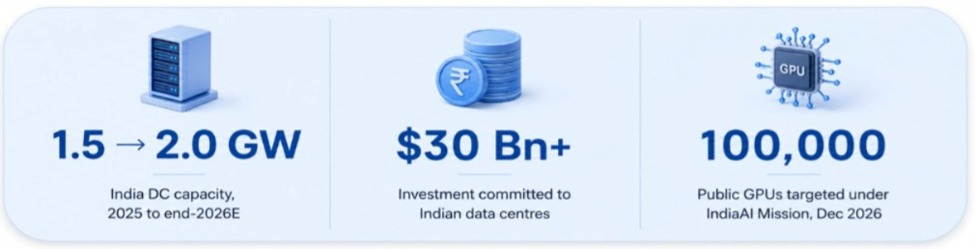
Second: The admission price was set specifically for India – it wasn’t simply copied from another country. India AI’s GPU access runs at ₹65 an hour – roughly 42% below market – a rate built around India’s own enterprise cost base, not adapted from a Silicon Valley number that assumed a wealthier buyer.
A genuine technology shift, priced for the market it’s actually built for. Everything below is what that combination is producing on the ground.
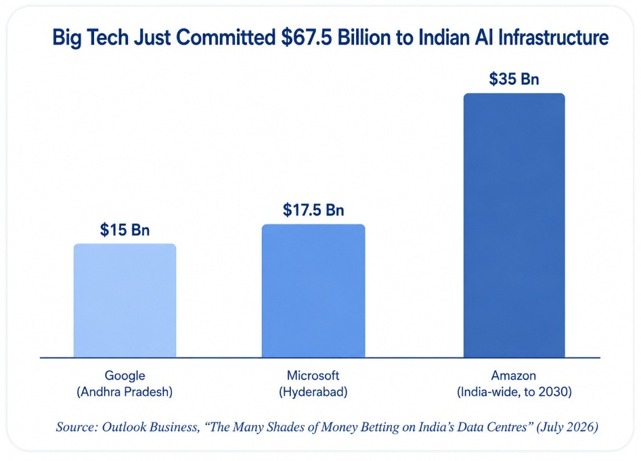
Google, Microsoft, and Amazon didn’t just announce projects in India this year. They wrote cheques for them:
That’s $67.5 billion in disclosed commitments from three companies alone, inside a single year.
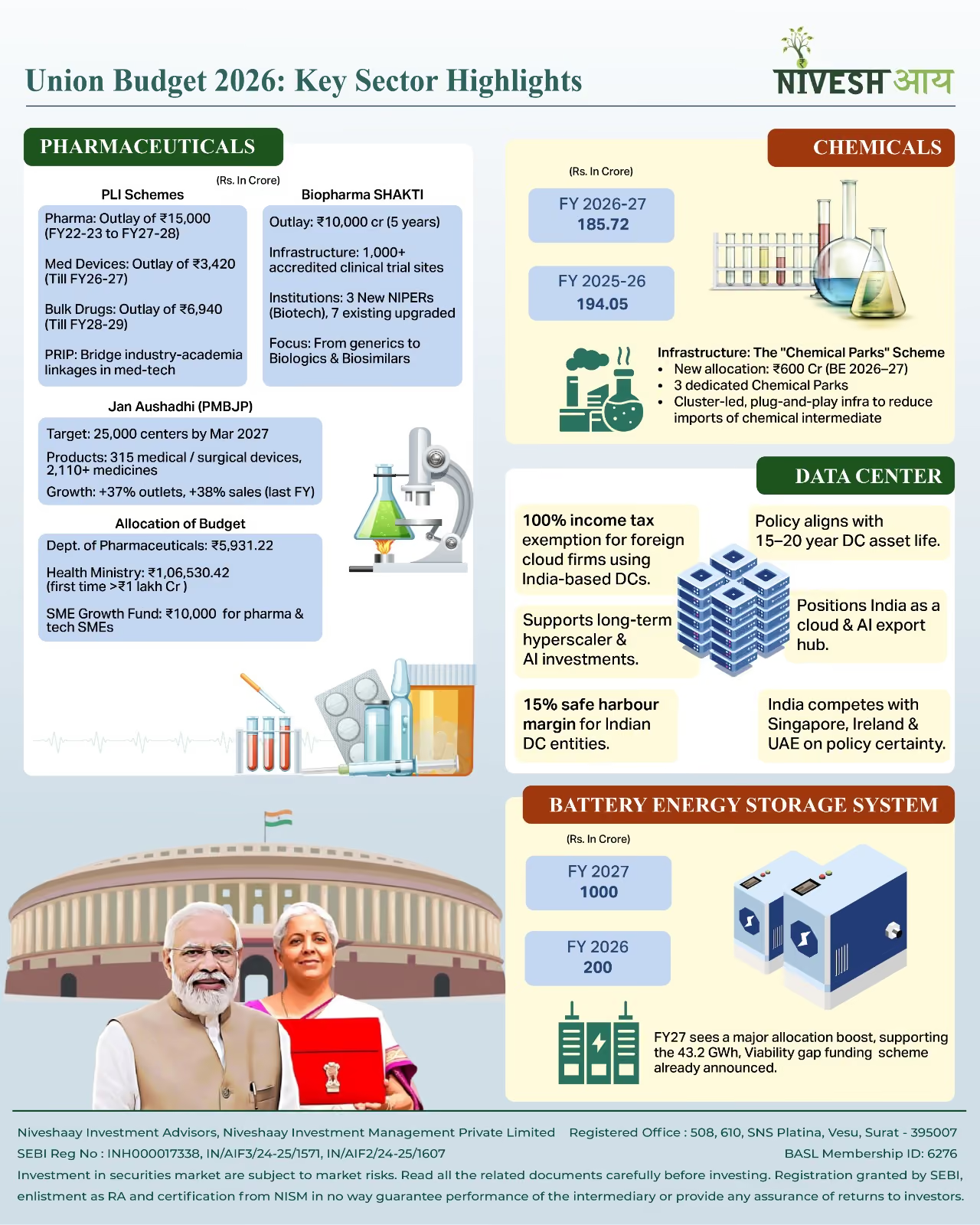
And here’s the part almost nobody wrote about: buried inside Budget 2026-27, with zero fanfare, was a 21-year tax holiday – running all the way to 2047 – for foreign cloud providers building data centres in India.
It landed in the same week as two much bigger headline deals – a trade agreement with the EU, and a tariff deal with the US. Both ran away with the coverage. The tax holiday barely got a paragraph anywhere.
Big tech noticed anyway. Google, Amazon, Microsoft, and NVIDIA are the same four companies that reportedly booked those ₹15–30 lakh-a-night suites in Delhi, timed to a February AI summit – arriving within weeks of a policy most of the country never heard about.
This isn’t a speculative bet on future adoption, either.
An EY-CII survey of 200 enterprise leaders found 47% of Indian enterprises are already running AI in production – not pilots, live systems.
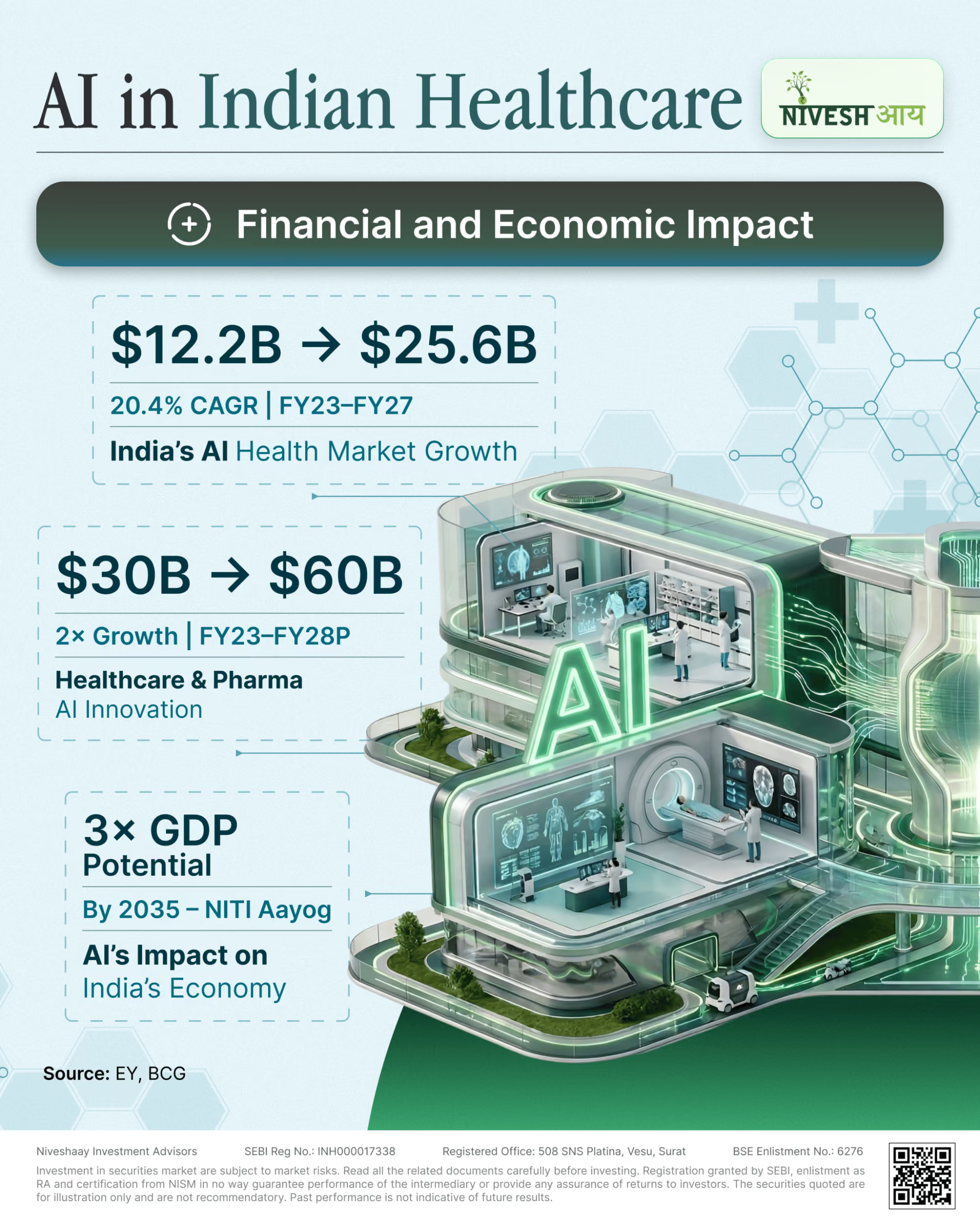
NITI Aayog estimates automation deployed at this scale could add $1.7 trillion to GDP by 2035.
A separate, broader dataset puts the adoption number even higher: Smallcase and Tickertape research pegs 87% of Indian enterprises as actively adopting AI solutions in some form – piloting, evaluating, or deploying.
The gap between that figure and the 47% production number is the gap between experimenting with AI and actually depending on it. Both point the same direction.
India’s own AI market is expected to reach $7-8 billion by the end of 2026, and roughly $35 billion by 2032 – a market that barely existed as a distinct category five years ago.
And the workforce pipeline is already being built to match: an IndiaAI Centre of Excellence in Education – ₹500 crore, 500-plus data labs across India’s technical training institutes – is already reaching roughly 1.5 lakh students, seeding the talent this entire compute build-out will eventually need.
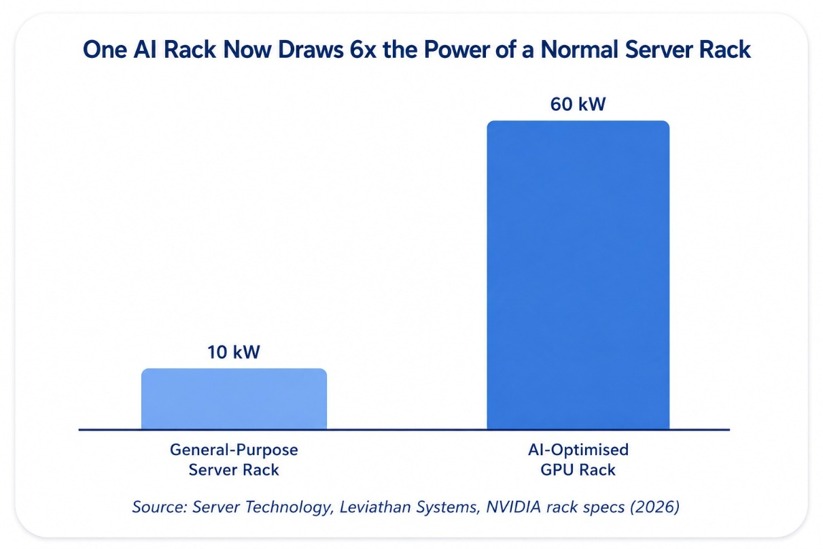
That single fact explains why the first box in the diagram above – the GPU rack – is now the most contested piece of real estate in Indian infrastructure. Six times the power draw means six times the cooling, six times the wiring, and a grid connection most sites simply don’t have yet.
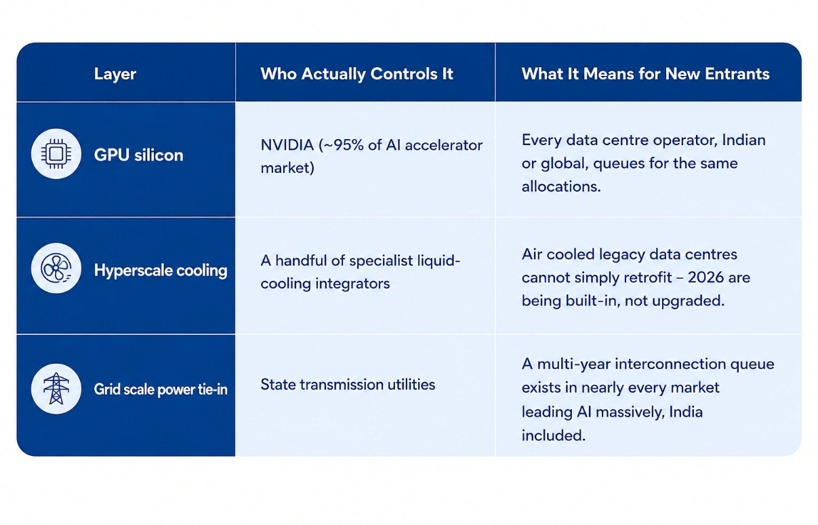
Everyone covers the GPU shortage. Almost nobody covers what’s actually choking the GPU supply.
TSMC’s CoWoS packaging – the process that bonds high-bandwidth memory onto the GPU chip itself – is booked solid through at least mid-2027.
SK Hynix supplies most of the HBM3e memory going into that process.
Neither constraint has anything to do with India. Both cap how fast anyone, anywhere, can get new-generation GPUs.
Which is exactly why India’s early, subsidised allocation matters more than the headline GPU count suggests – the country isn’t just short on chips like everyone else. It has a queue position other buyer don’t.
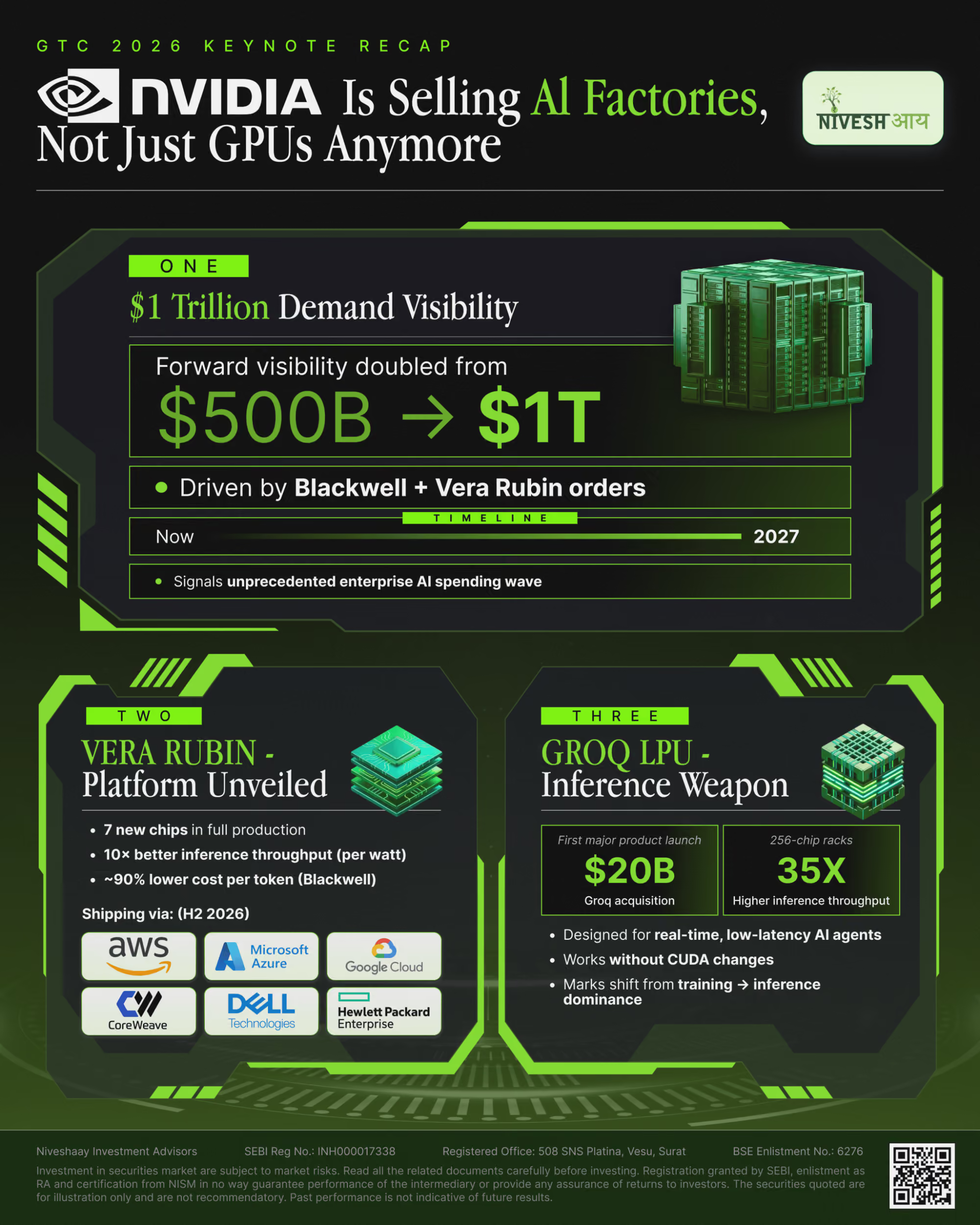
The shortage is now severe enough that NVIDIA is reportedly skipping new consumer gaming GPUs entirely in 2026 – the first time in three decades.
The reported reason: data-centre chips are significantly more profitable per gigabyte of memory than gaming cards, so every unit of scarce HBM memory gets routed there first.
When a company redirects its own flagship consumer product line to feed data-centre demand, that is a clearer signal of real scarcity than any market-research report.
For a decade, India’s data centre story was a real-estate story: land, power connections, and cooling towers in Mumbai and Chennai. AI has turned it into something closer to a heavy-industry story.
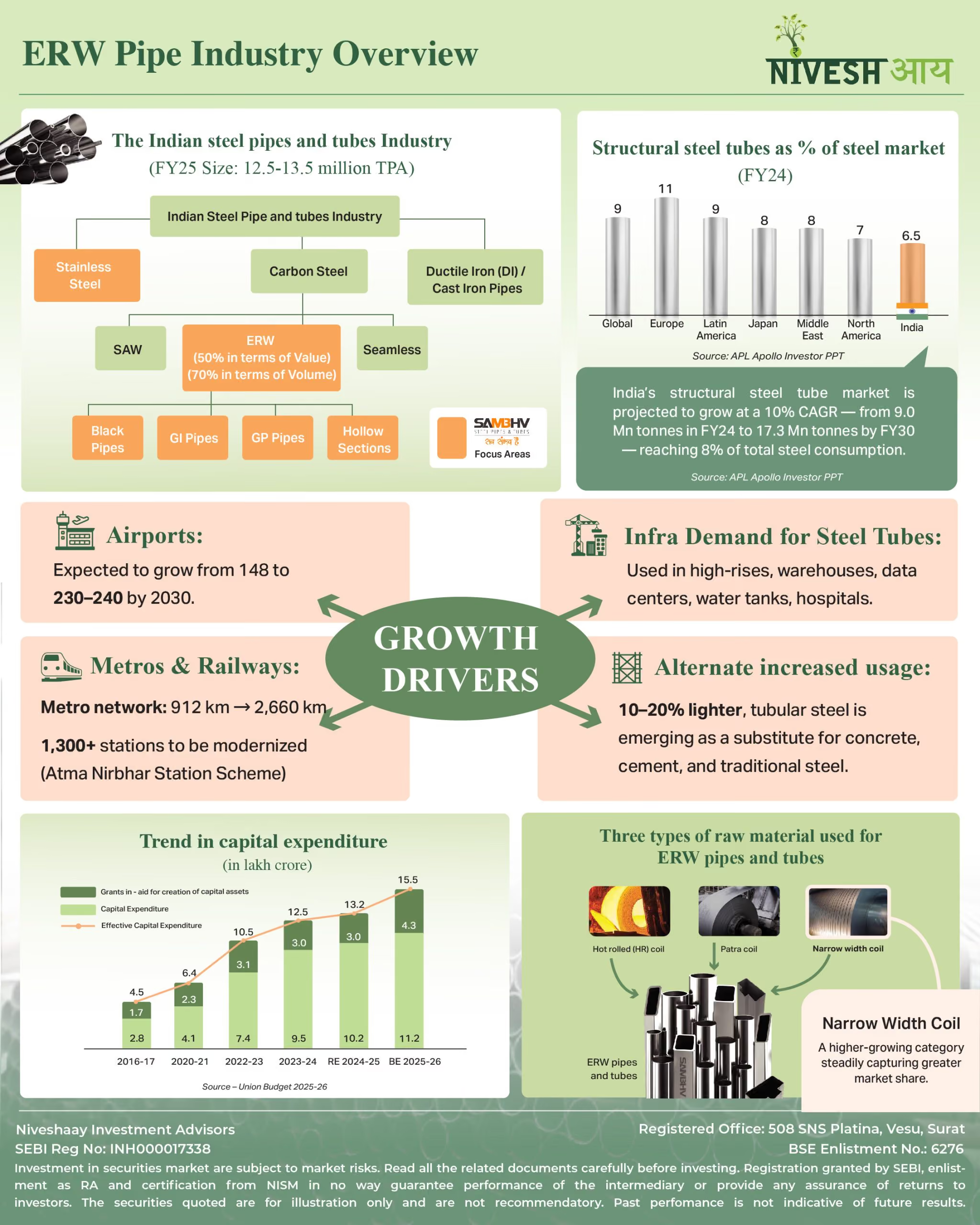
Vestian’s latest estimate puts India’s installed capacity at 1.7-2.0 GW by the end of 2026, backed by nearly $60+ billion in investment – and a construction pipeline of 700 MW already underway.
CBRE projects roughly 30% year-on-year capacity growth in 2026 alone, with base-case forecasts of 4-5 GW by 2030, and AI-accelerated scenarios reaching 8-9.2 GW.
KPMG’s 2026 analysis goes further: planned investment and AI/HPC demand could grow India’s data centre capacity by roughly 10x over the next decade.
That is not a typo. That is what happens when a warehouse becomes a power plant.
But cheap land and tax breaks don’t build sovereign AI on their own. That takes compute – and increasingly, a model to run on it.
Behind the compute build-out sits a second, quieter story – the model that actually runs on it, and who owns a piece of it. It breaks into three parts.
In February 2026, Sarvam open-sourced Sarvam-105B. A few specs worth knowing:
No global frontier model matches that depth of Indian-language coverage.
That language coverage is not an accident. It’s the product of Bhashini-v2, the real-time translation and voice layer sitting underneath Sarvam.
It’s already deployed inside two large government platforms:
Bhashini is the reason Sarvam’s language coverage translates into something people can actually use, not just a benchmark score.
The government’s involvement didn’t stop at funding GPUs.
Reports in mid-2026 suggested a structured 1-2% equity stake in Sarvam, taken through compulsorily convertible debentures.
Sovereign AI in India now has a capitalisation table attached to it – a genuinely unusual arrangement by global standards.
The urgency behind all three of these moves was underlined, not created, by a development entirely outside India’s control.
In June 2026, US export restrictions temporarily limited access to two of Anthropic’s newer models, Claude Fable 5 and Claude Mythos 5, before being lifted at the end of the month.
Whatever the specifics of any single episode, the lesson generalises: access to frontier compute and frontier models can be restricted at short notice, for reasons no importing country controls. That is precisely the exposure sovereign compute is built to remove.
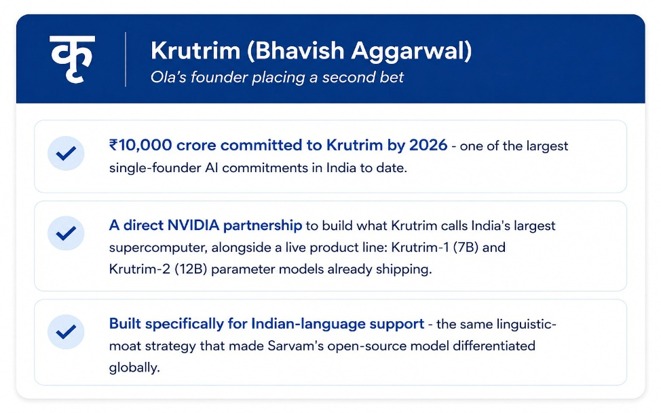
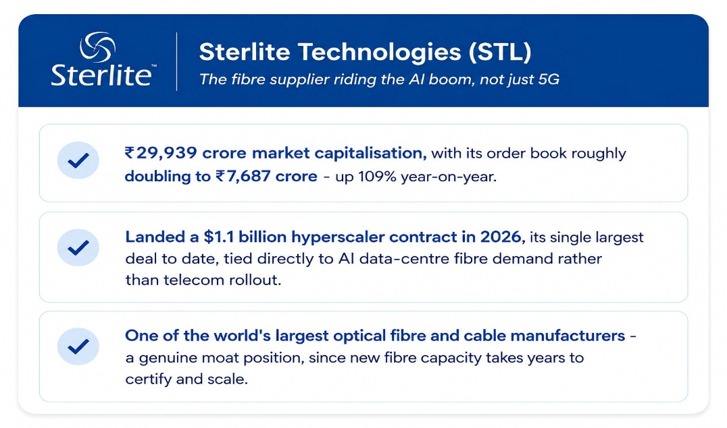
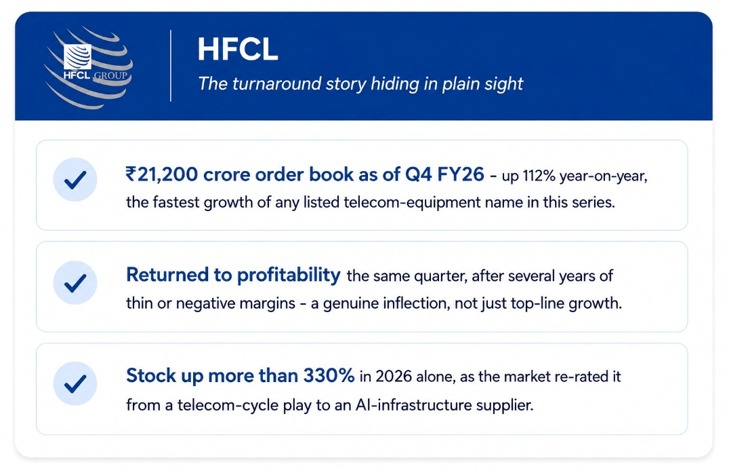
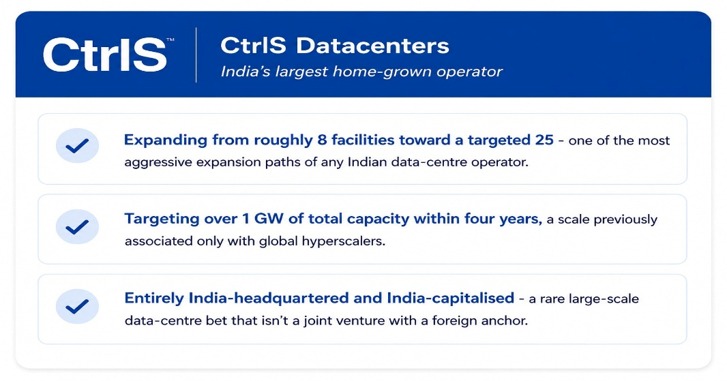
India’s industrial giants are entering the compute business directly, not just leasing it out.
A closer look at some companies actually converting this build-out into balance-sheet reality:
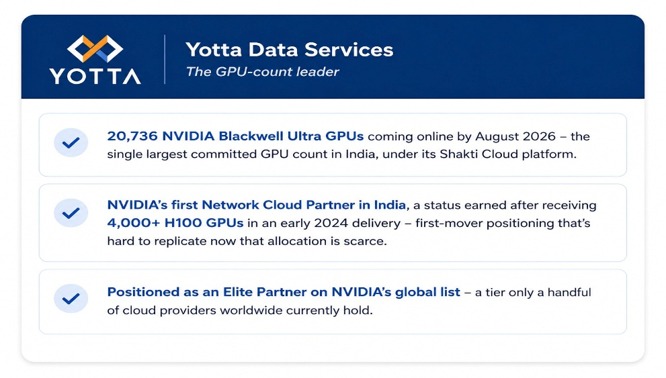
None of these matters if the underlying chips are scarce – and they are. NVIDIA’s own data-centre GPU shipments are booked out more than a year in advance globally; the constraint on India’s AI build-out isn’t capital, it’s allocation.
90% of India’s data centre capacity still sits in four metro clusters – Bengaluru, Chennai, Delhi NCR, Mumbai. Hyderabad and Pune are gaining ground, and Tier-2 cities like Ahmedabad, Kochi, Jaipur, and Visakhapatnam are next in line – operational capacity there is expected to cross 100 MW by the end of 2026.
“India’s AI capability is expanding at a pace of roughly 33% year-on-year in hiring, contributing nearly a fifth of global AI-related development activity – and that talent pool is expected to more than double by 2027.” – KPMG in India, 2026
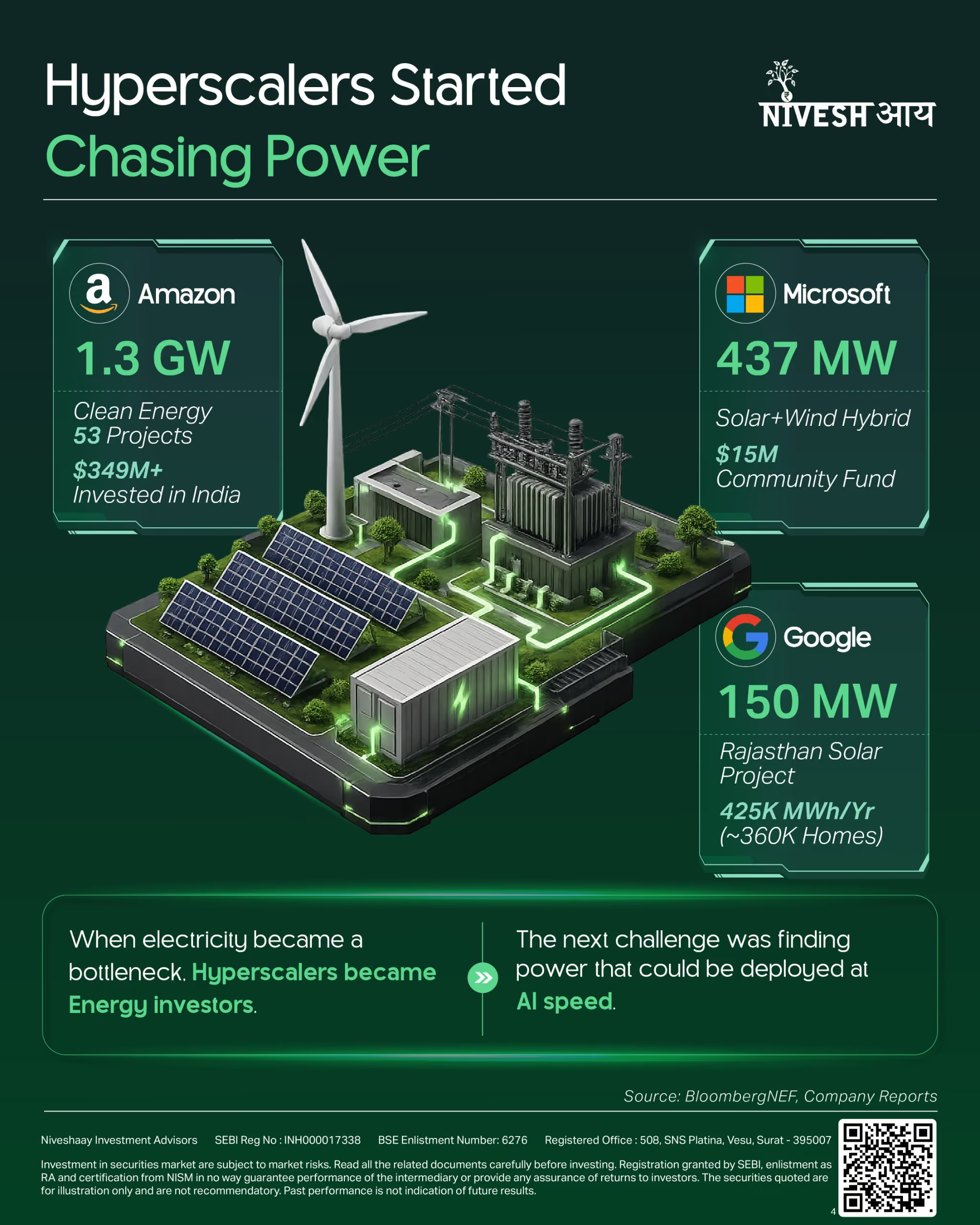
None of these scales without electricity.
Data centres are expected to consume 3-5% of India’s total grid load by 2030, and India has committed to roughly 500 GW of non-fossil power capacity by the same year.
That’s a real, credible pathway to sustainable power at scale – but a genuine execution risk if it slips.
Cooling is the quieter constraint. Indian data centres consumed an estimated 150 billion litres of water in 2025, a number projected to double by 2030.
Renewable sourcing and water strategy are becoming underwriting criteria for new projects, not afterthoughts.
Regulation is catching up too: the Digital Personal Data Protection Act’s Consent Manager registration opens in November 2026, with full compliance – breach notifications, impact assessments – mandatory from May 2027. Every enterprise processing Indian user data for AI will need to build for this deadline.
The gap between 20% of the world’s data and 3% of its data centre capacity is not a weakness to apologise for. It is the size of the market still sitting in front of every company in this chain – from the GPU cloud operators to the fibre suppliers to the cooling-systems firms nobody profiles.
The next twelve months – Vikram-scale GPU deployments, the first full year of the L&T-NVIDIA factory, and the DPDP Act’s compliance deadline – will show how much of that 10x KPMG is projecting actually lands on schedule.