







How India became the Medicine Factory of the world?
CHAPTER 1
The $1 Billion Problem
A new medicine now costs more than $1 billion to develop. That’s roughly ten times what it cost in the 1970s. And for every molecule that starts out in a lab, the odds it ever becomes an approved medicine are below 1 in 10,000.
That math doesn’t really behave like research. It behaves like insurance: you pay the premium for years, and you collect only on the one rare outcome that survives every hurdle.
Being good at discovering a drug and being good at manufacturing one are two different businesses, wearing the same industry’s name.
A pharma company’s real skill sits upstream – understanding biology, running trials, navigating regulators. Manufacturing that same drug at full scale, inside a tightly regulated factory, for years without a single deviation – that’s a completely different skill. Increasingly, drug companies don’t even try to be good at both.
That one decision – hand off the making of the molecule to someone else – is the seed of a nearly $200 billion industry. It’s the reason China became impossible to avoid. And it’s the reason India’s best manufacturers are far stickier businesses than most investors give them credit for.
CHAPTER 2
The Invisible Industry
Three overlapping acronyms describe this industry, and the difference between them matters:
- CRO – does the science. Discovery, lab testing, clinical trials.
- CDMO – does the making. Chemistry, manufacturing, quality control. Takes a drug from lab-scale to factory-scale.
- CRDMO – does both, under one roof – one relationship, one quality system, one team across a drug’s entire life.

Every arrow in that chain used to mean handing the project to a brand-new vendor – and every handover leaked time and institutional memory. Companies that do both jobs under one roof avoid that loss entirely. That’s why pharma now treats them as long-term partners who share development costs, not factories-for-hire who simply take orders.
CHAPTER 3
What CDMOs Actually Sell
A factory can be built in eighteen months. The regulatory trust that lets it make a medicine cannot be bought at any price.
A drug’s approval isn’t tied to the formula alone – it’s tied to one exact process, made in one exact factory. Once that approval exists, the manufacturer isn’t just renting out floor space. It’s selling something the drug company now depends on completely: a process that regulators have checked, filed, and inspected.
Five things compound that dependence, and they’re worth understanding one by one:
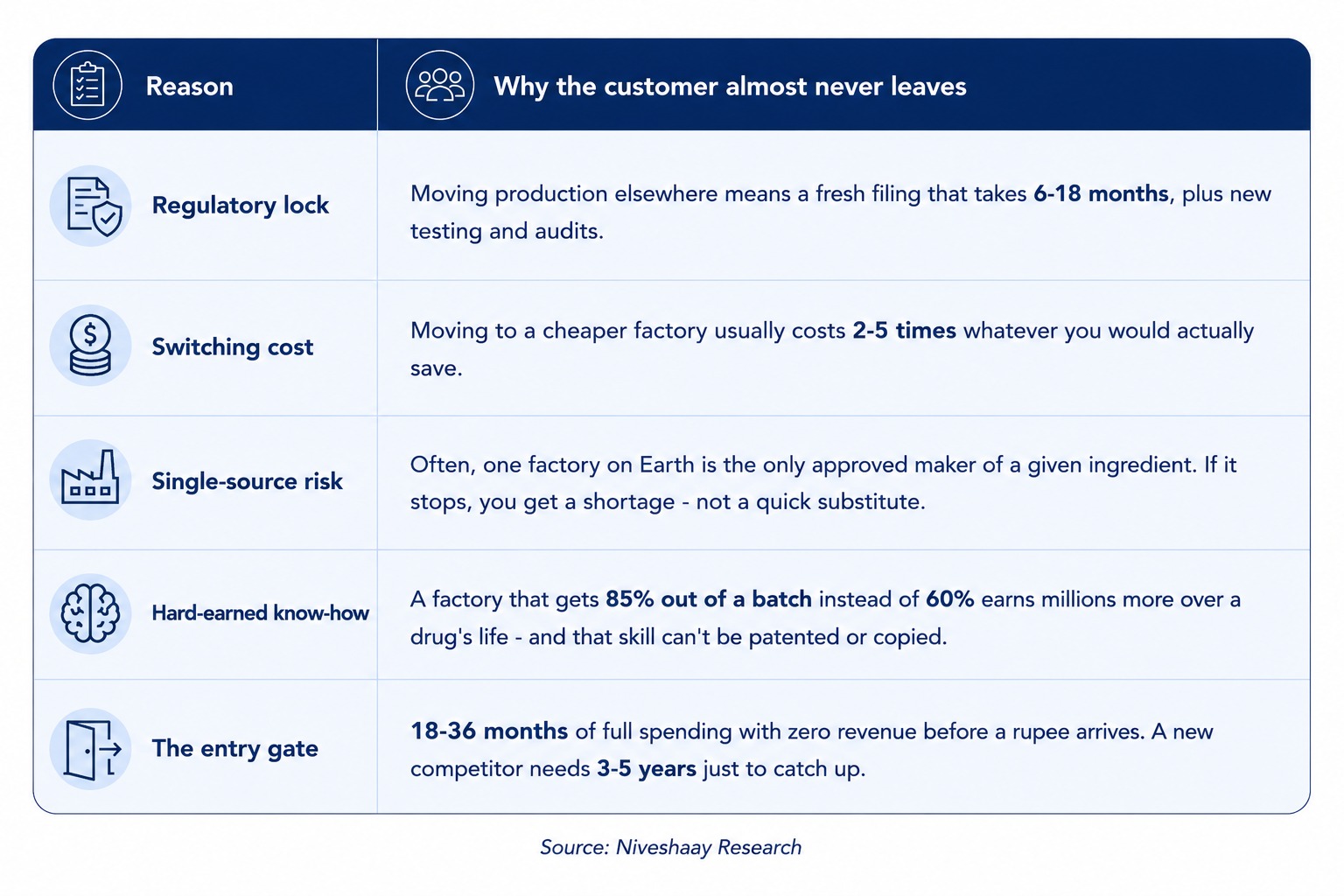
Clear that gate, and the economics flip. Once a factory is running at roughly 70% capacity, its costs are covered – and every order after that earns a 60-70%+ profit margin. The market prices this business as lumpy, capital-heavy manufacturing. It behaves more like owning 25-30 overlapping contracts that quietly keep paying out for as long as each drug’s patent lasts.
A useful comparison:
picture a precision aerospace supplier standing next to a pharma manufacturer. Same empty-factory-before-the-first-order problem. Same one-supplier-only risk. Same money spent before a single order land – because no customer ever moves into an empty facility. Boeing and Bayer, in this narrow sense, run the exact same playbook.
CHAPTER 4
How China Became the World’s Pharma Factory
The obvious answer – cheap labour – stopped being true years ago. China’s real edge is that it earned regulators’ trust faster than anyone else, through three deliberate moves made over roughly a decade:
- Infrastructure – government-funded biotech parks, clustered together and built for speed.
- Changed the rules – China’s own regulator let local trials run at the same time as global ones, instead of years behind them.
- Smart bets – Chinese manufacturers went after therapy types where Western capacity was thin – cell and gene therapy, oligonucleotides, cancer drugs.
The result: a $28 billion Chinese CRDMO market, with 30%+ of globally licensed drugs tracing some research origin back there. The real signal isn’t the size of that number. It’s the change in behaviour it caused.
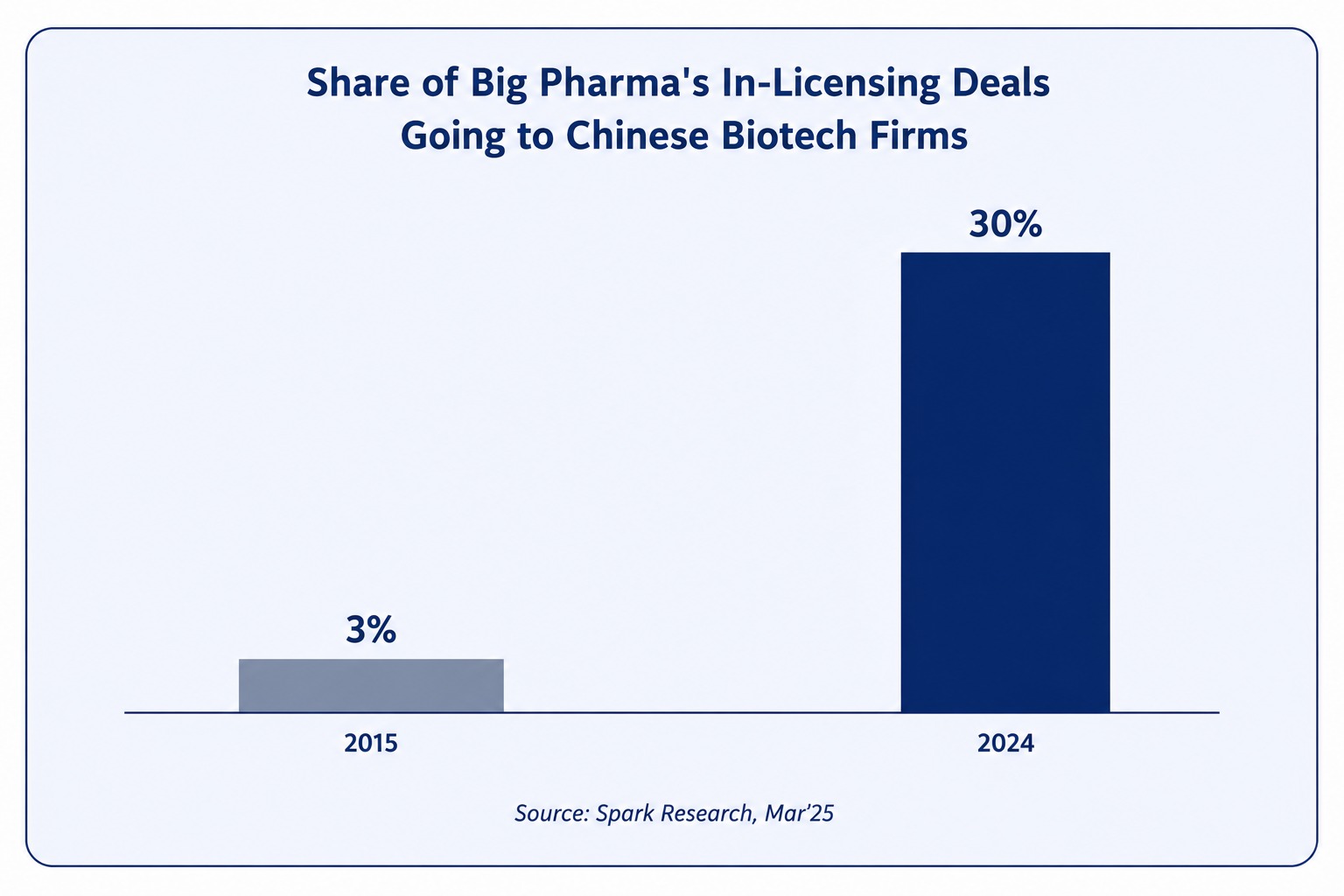
China didn’t win this business because it was low-cost. It won it because, molecule after molecule, it kept its word.
By 2024, big pharma companies were licensing Chinese-discovered drugs directly – skipping American investors altogether. Washington is now trying to legislate away a dependency that American pharma built on its own, simply because it worked.
CHAPTER 5
When Dependence Became a Risk
Depending heavily on one country’s supply chain was just how the industry worked – until COVID asked an uncomfortable question: what happens if the one factory making a critical ingredient can’t ship it?
The pandemic didn’t create that weak spot. It exposed one that had been building for years, and gave boardrooms a new shorthand: China+1. Not ‘leave China’ – its capacity is too large to replace – but ‘never be completely dependent on it again.’
This was never really a China story. It was a concentration-risk story that happened to be about China.
Which means the shift away from China was already quietly underway, years before Washington put anything into writing.
CHAPTER 6
Biosecure Accelerated the Shift. It Didn’t Start It.
The BIOSECURE Act is a US law that stops the American government from contracting with, or funding, a specific list of Chinese biotech companies. It’s the loudest confirmation of a shift already underway – not where the shift began. Its path to becoming law is also a lesson in how slowly geopolitics usually moves in pharma, right up until it briefly didn’t:
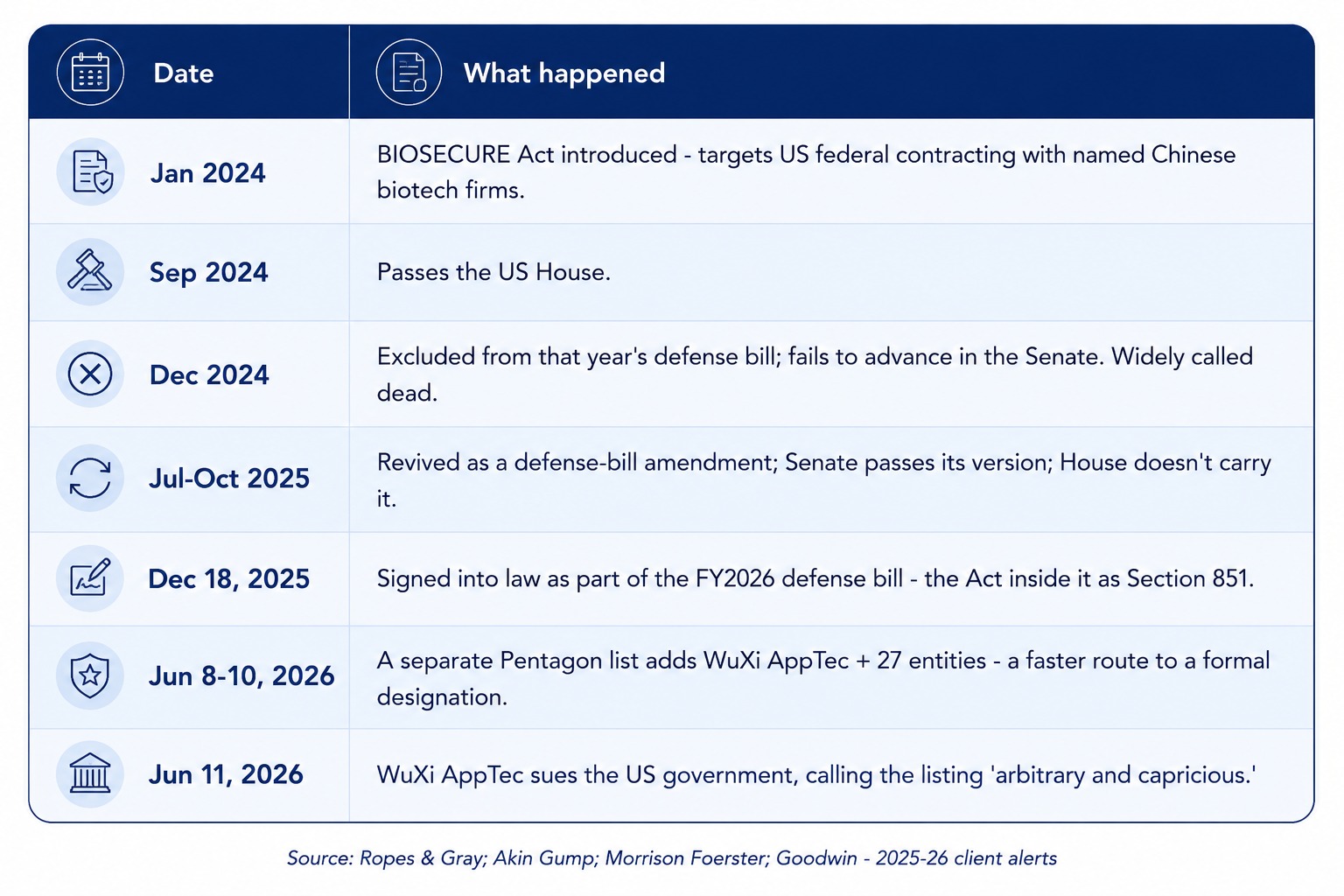
A company got listed, then sued the government – inside 72 hours. But what the law actually restricts is narrower than the headlines suggest: US federal agencies can’t buy from, contract with, or fund a company designated a ‘company of concern.’ It does not touch private, US-to-China commercial deals.
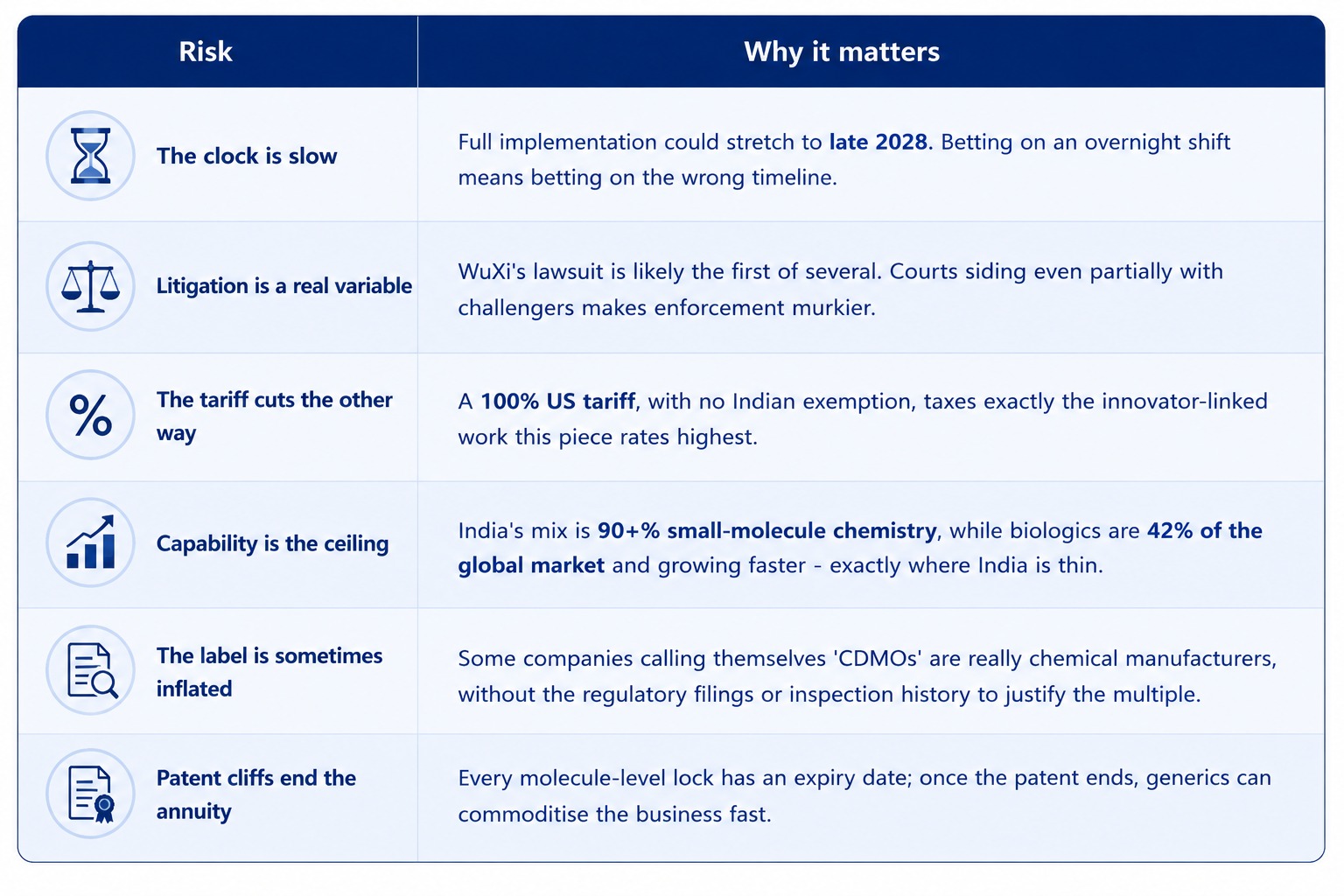
And the clock moves slowly – the government has a full year just to publish its list, and some restrictions won’t fully apply for almost 970 days after signing. Betting on an overnight shift means betting on the wrong timeline. Notably, WuXi Biologics wasn’t named at all – a caution against betting on business that hasn’t legally ‘spilled over’ yet.
CHAPTER 7
The Real Bottleneck
The scarce resource was never manufacturing capacity. It was qualified manufacturing capacity – and qualification cannot be rushed by writing a bigger cheque.
A factory only becomes a real business asset after clearing a sequence that simply cannot be compressed:
- The gate – safety audit → knowledge transfer → filing with the drug regulator → test production runs → final inspection.
- The cost – 18-36 months of full spending, with zero revenue, before the first paying order.
That is the real bottleneck behind every China+1 headline – not empty floor space, but the years it takes to turn that floor space into a factory regulators and customers actually trust. The companies best placed to benefit are, by definition, the ones who started walking through that gate the earliest.
CHAPTER 8
Why India Matters
This isn’t ‘India replaces China.’ China’s headcount in this industry is roughly 5 times India’s, and that gap won’t close in a few years. The more accurate, narrower claim: India is becoming one of a small number of credible alternatives, in a world that wants more than just one supplier.
The foundation
- Regulatory record – more US-approved drug plants than any country outside America.
- Talent – a STEM (science, tech, engineering, maths) graduate pool larger than the US and UK combined.
- Scale – 3,000+ pharma companies, 10,500+ factories, supplying roughly 45% of America’s generic medicines.
Track record – two decades of clean inspections in complex, high-difficulty chemistry.
The gap
The industry’s growth has been shifting toward biologics – medicines made from living cells rather than chemistry. That is exactly where India is thinnest.
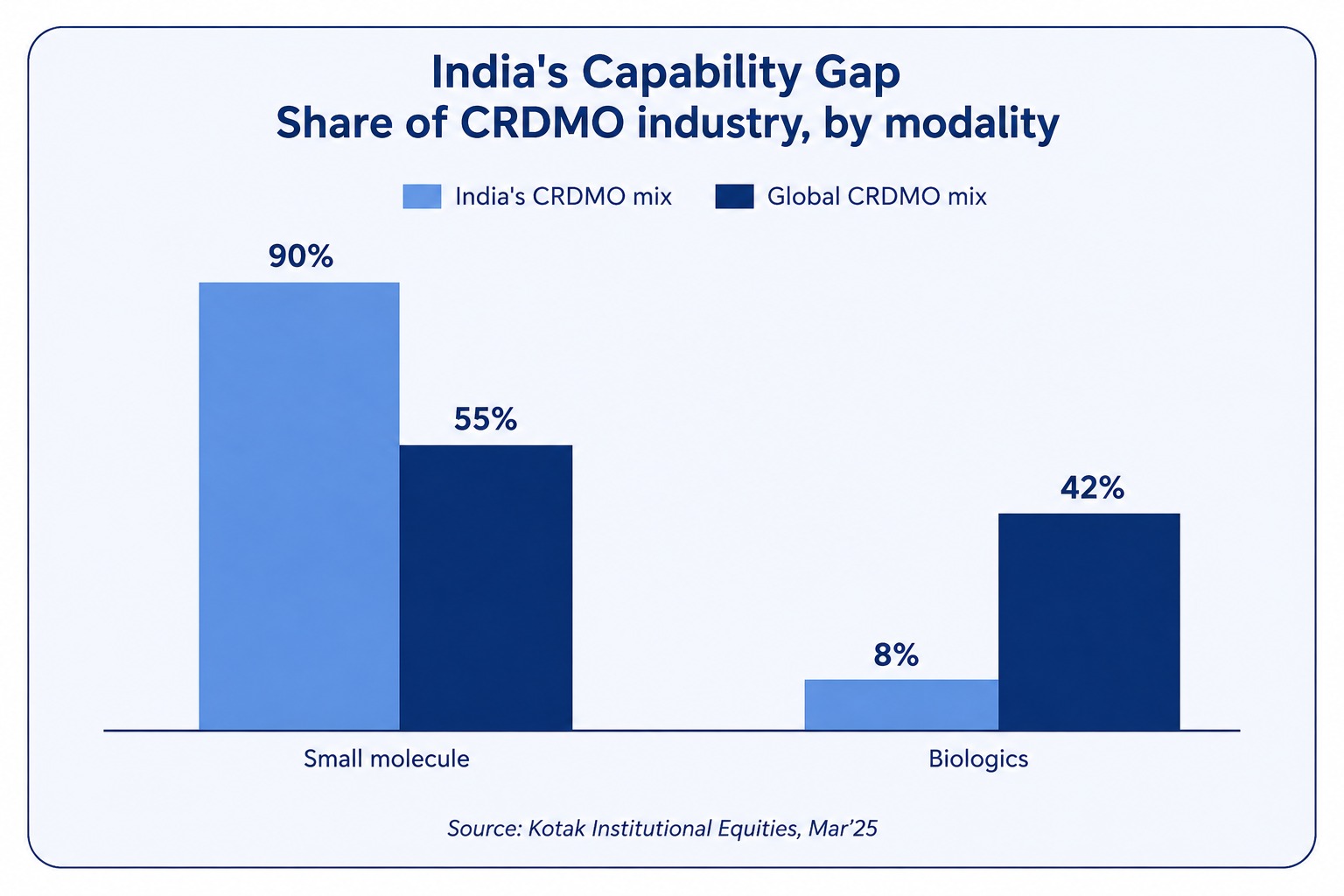
That gap is closing, partly through capital and partly through acquisitions – Suven Pharma buying NJ Bio for antibody-drug capability follows the same playbook WuXi AppTec itself used for fifteen years.
Who’s actually built this
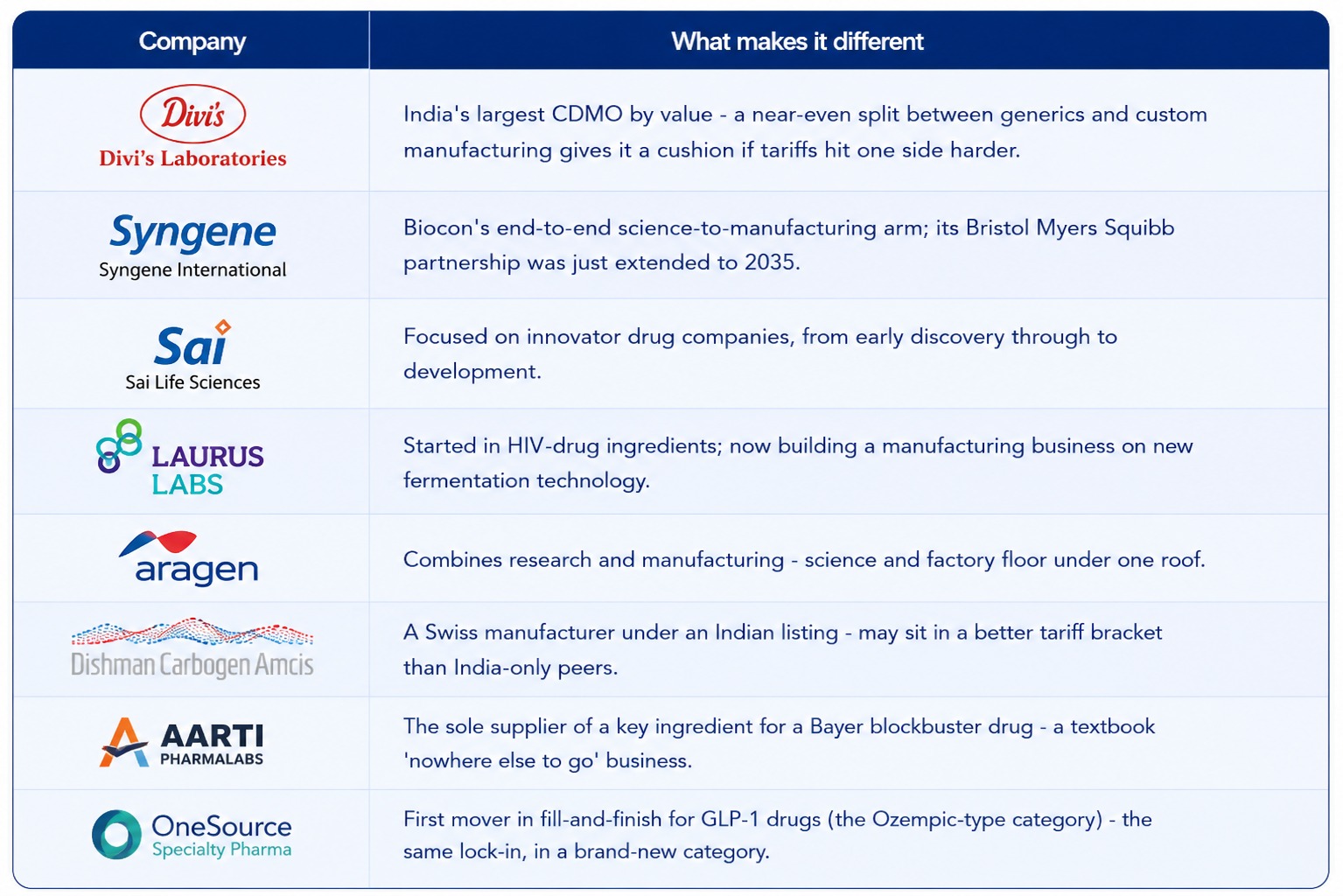
The global names sitting above all of them: Lonza, Samsung Biologics, Fujifilm Diosynth, Thermo Fisher, Siegfried – and, at the centre of the geopolitical story, WuXi.
The twist almost nobody is pricing in
In April 2026, a separate US tariff placed a 100% duty on patented-drug ingredients. The UK got 0%. The EU, Japan, Korea and Switzerland got 15%. India got no special treatment at all – grouped with China in the same 100% bucket.
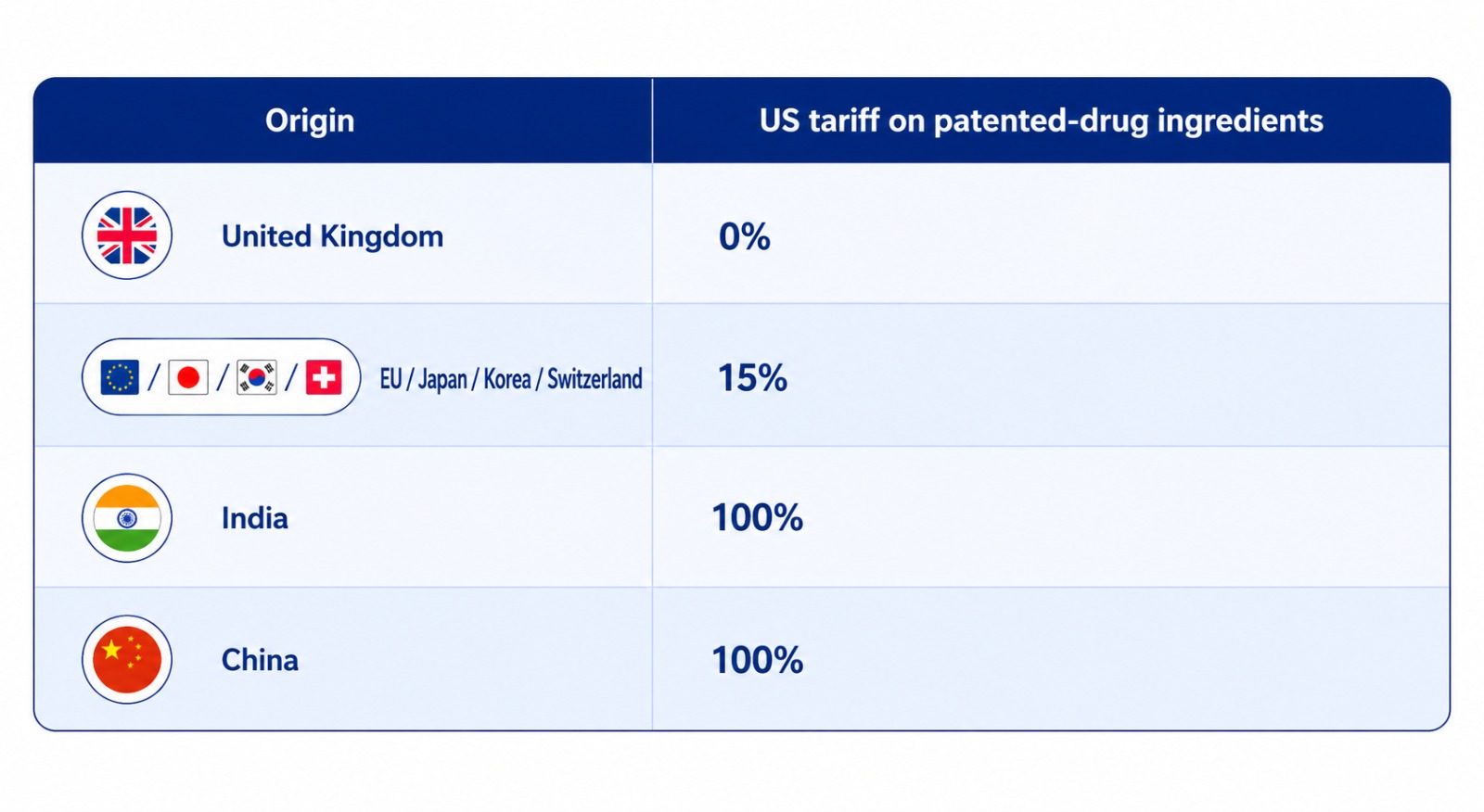
Right now, the market is pricing India’s deep pharma relationships as a tariff risk – exactly the kind of mismatch patient capital has learned to look through before.
India’s usual 20-30% cost advantage over Europe doesn’t close an 85-point tariff gap on its own. Generic medicines are excluded for now, protecting the bulk of India’s export book. And the innovator-linked work sitting exposed today is also the work most likely to get a negotiated exemption later, given how much both governments have riding on this relationship. Two signals from the same government – worth tracking separately.
CHAPTER 9
The Investment Thesis
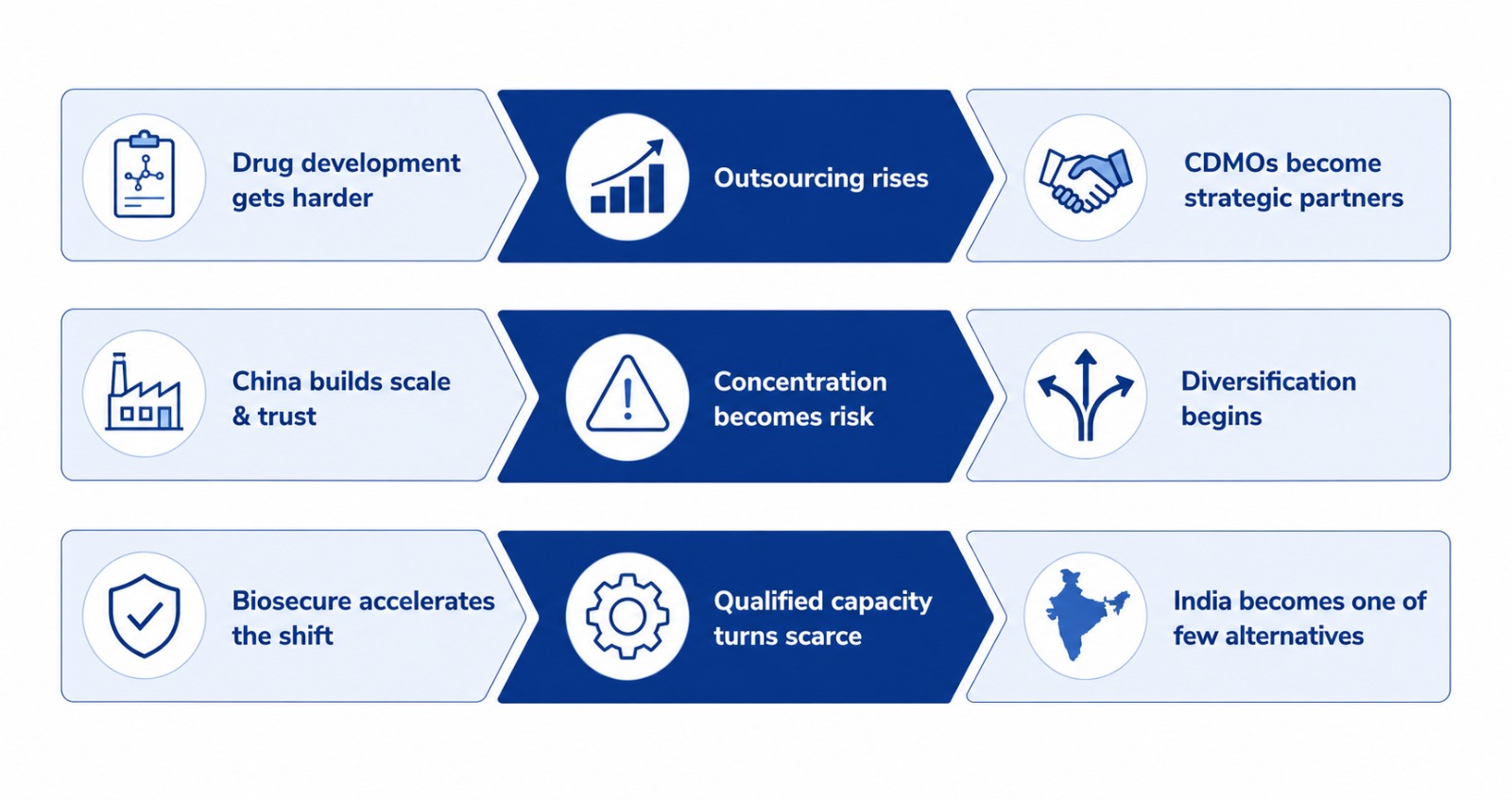
India’s own domestic engine supports this chain regardless of how Washington resolves either issue.
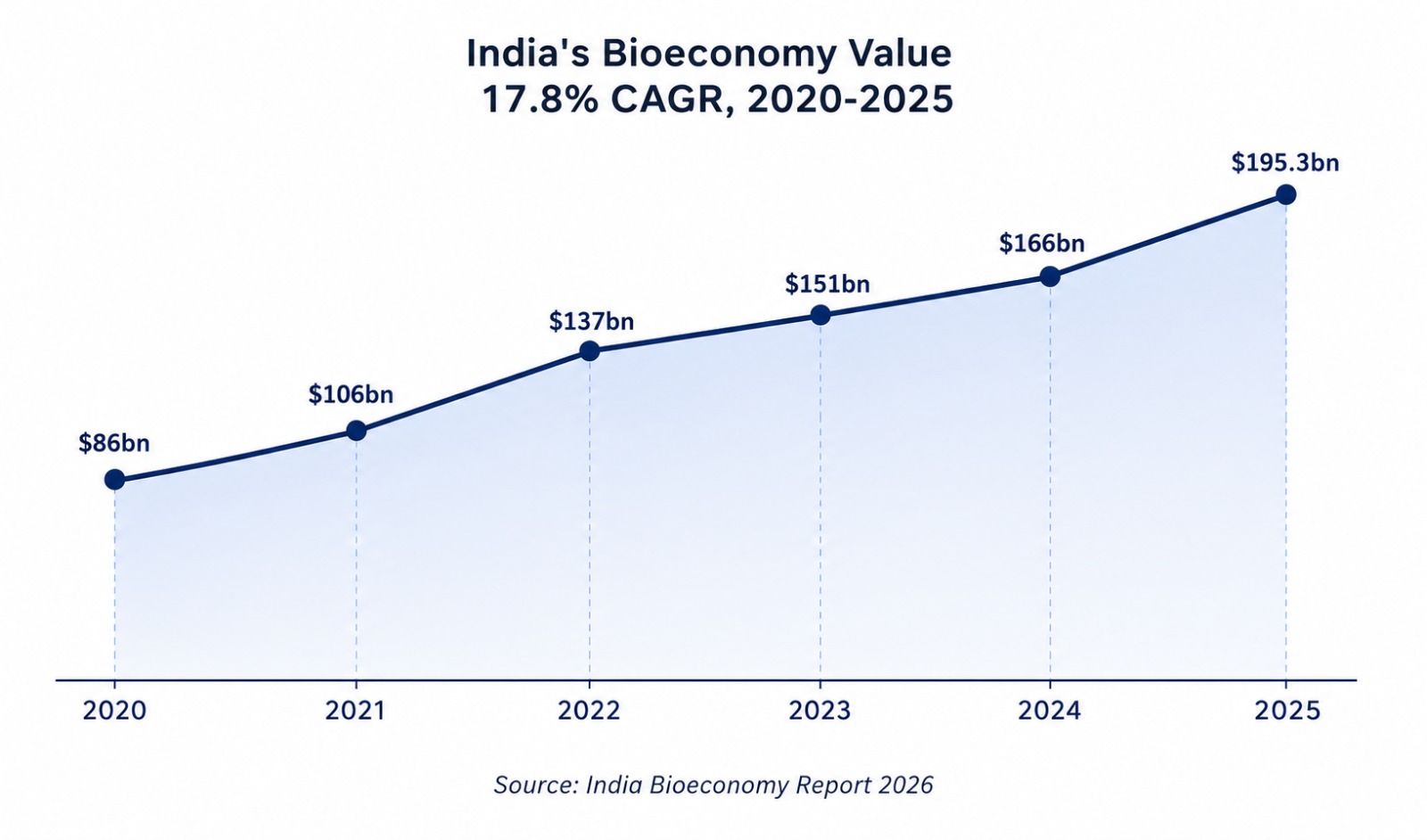
- Scale – India’s bioeconomy stood at $195.3 billion in 2025, up 18% from the year before – a 8% average annual growth rate since 2020, now about 4.8% of India’s GDP.
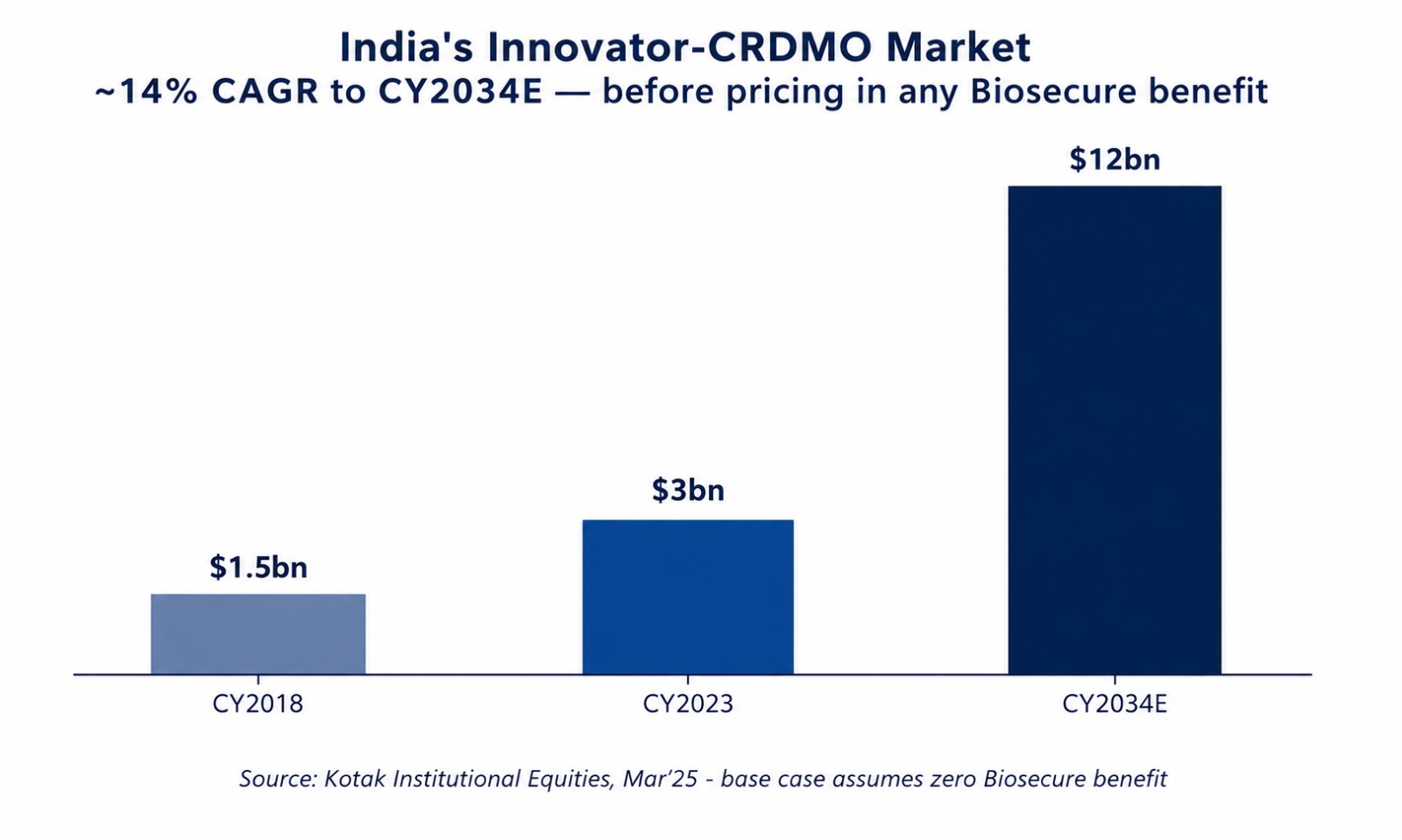
- BioServices – the segment that houses CRO/CDMO work grew fastest of all, doubling to $26 billion between 2023 and 2025. CRO/CDMO work alone: $9.4 billion.
That growth happened while Biosecure sat stuck in Congress, and before the tariff even existed. Neither US policy caused it – which is the strongest reason to hold this theme regardless of how either one plays out.
Where This Could Go Wrong
The Final Takeaway
The pharmaceutical industry is quietly rewriting how medicines are made. Biosecure is one loud chapter inside that rewrite – not the plot.
The deeper shift is the rising value of three things money alone cannot rush: regulatory trust, qualified capacity, and long-term partnership between the company that invents a drug and the one that makes it. A factory can be built in eighteen months. The trust a regulator and a global customer place in one process, at one plant, takes far longer to earn – and that is the asset India’s best CDMOs have spent two decades quietly building, with or without a bill in Washington.

 AIF Investor Charter


NIVESHAAY INVESTMENT ADVISORS
508, SNS Platina, Near Someshwara Enclave, Vesu, Surat, Gujarat-395007
(+91) 7859870559
research.smallcase@niveshaay.com (Equity Baskets)
NIVESHAAY INVESTMENT MANAGEMENT PRIVATE LIMITED
610, SNS Platina, Near Someshwara Enclave, Vesu, Surat, Gujarat-395007
(+91) 7836915478
contactaif@niveshaay.com (AIF)
SEBI Registration No. : INH000017338, IN/AIF3/24-25/1571, IN/AIF2/24-25/1607, INP000009506 | BASL Membership ID: 6276
Disclaimer:
Investment in Securities Market are subject to market risks. Read all related documents carefully before investing.
Registration granted by SEBI and certification from NISM in no way guarantee performance of the intermediary or provide any assurance of returns to investors.
The securities quoted are for illustration only and are not recommendatory
NIVESHAAY INVESTMENT ADVISORS © . All Rights Reserved., NIVESHAAY INVESTMENT MANAGEMENT PRIVATE LIMITED © . All Rights Reserved.Smart ODR