





India's Space Leap: Private. Ambitious. Taking off.
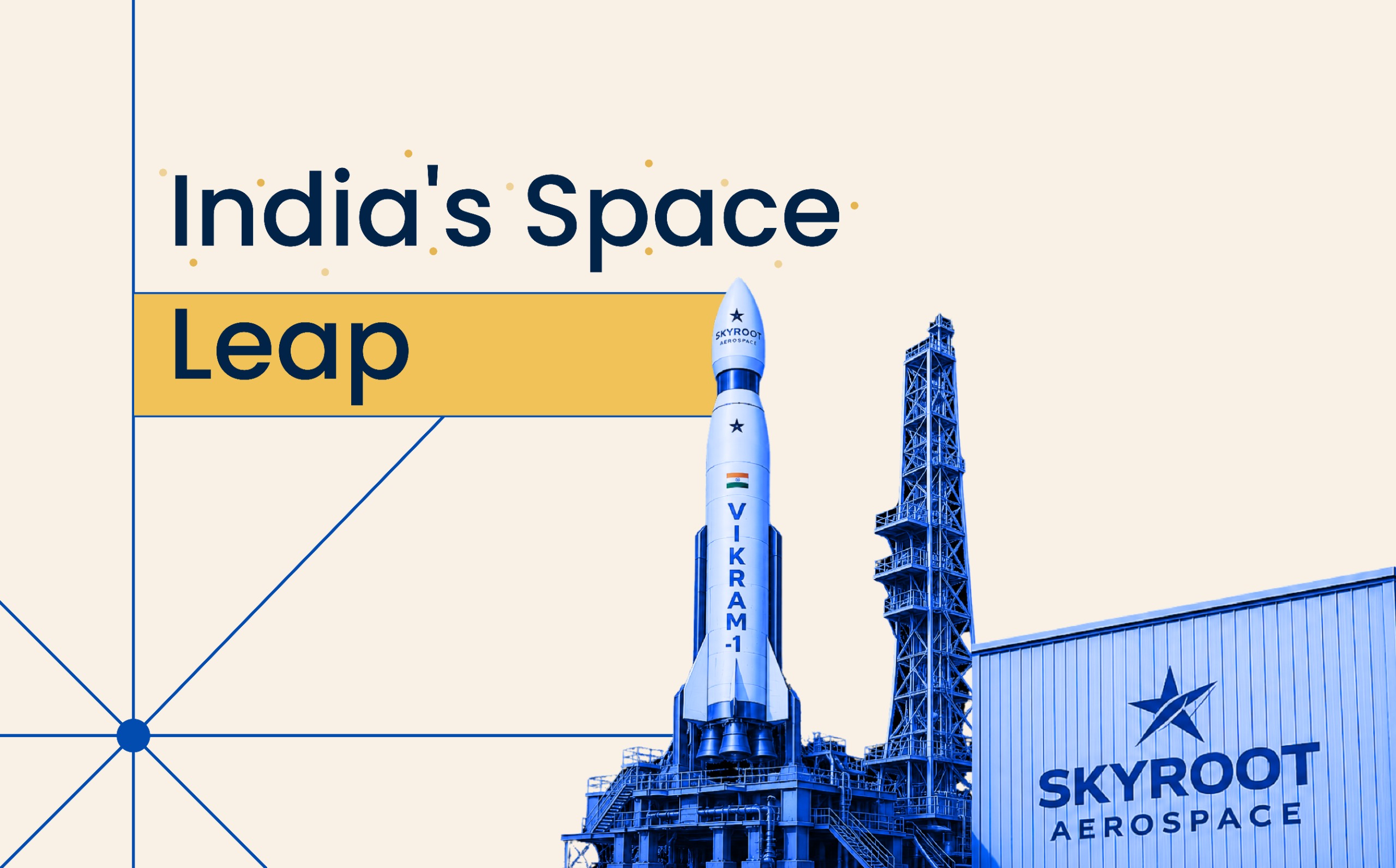
On July 18, 2026, a rocket built entirely by a private Indian company lifted off from Srihari Kota and reached orbit. No Indian company had done this before.
Skyroot Aerospace’s Vikram-1 carried two small satellites to a 450-kilometre orbit, fifteen minutes after liftoff. The mission was named Aagaman – Sanskrit for arrival.
A four-year-old startup has now done what ISRO spent six decades building toward.
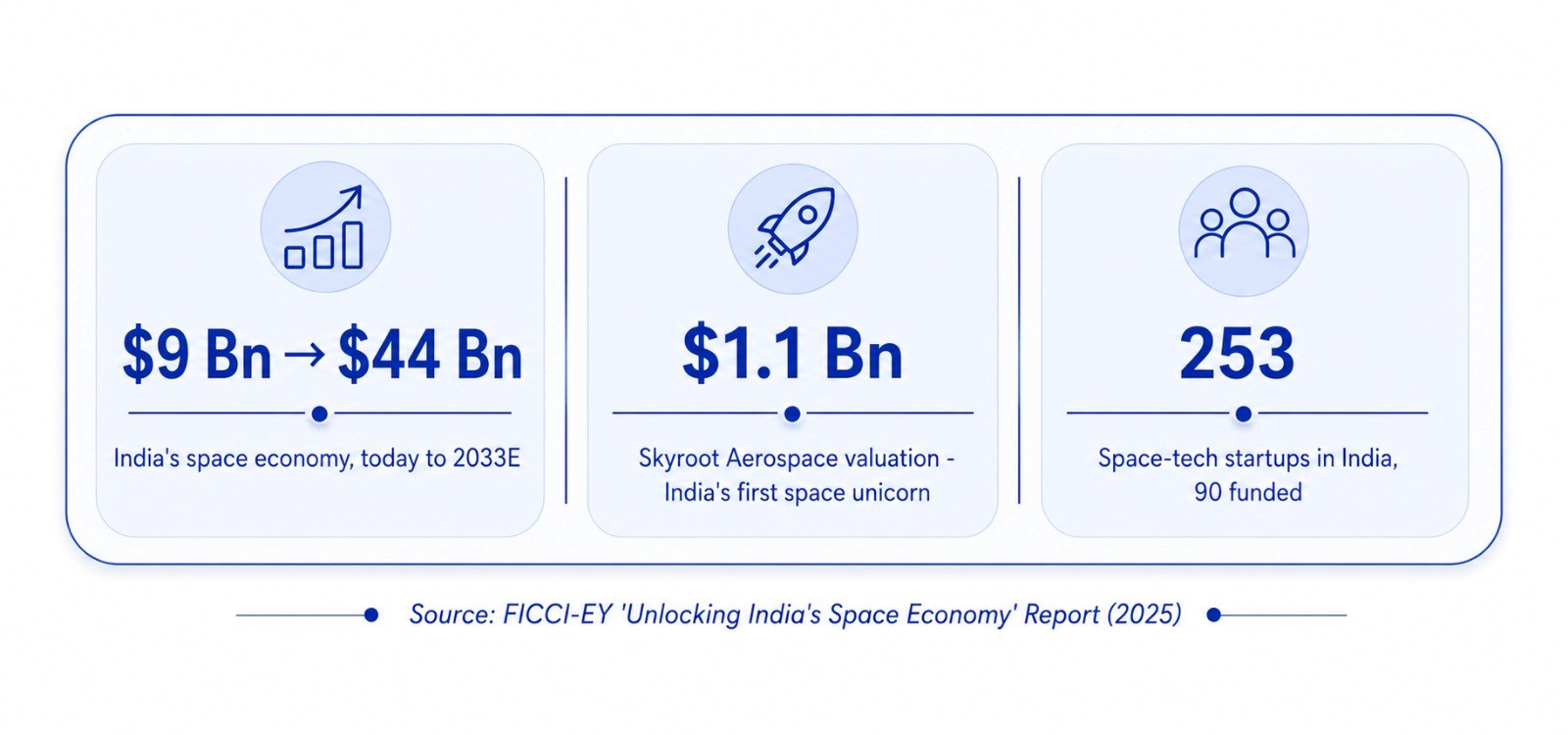
Skyroot is also India’s newest unicorn, valued at $1.1 billion, up from zero in under four years. This piece looks at what the launch means, who else is building around it, and what still has to happen before one good flight becomes an industry.
The Numbers Behind the Moment
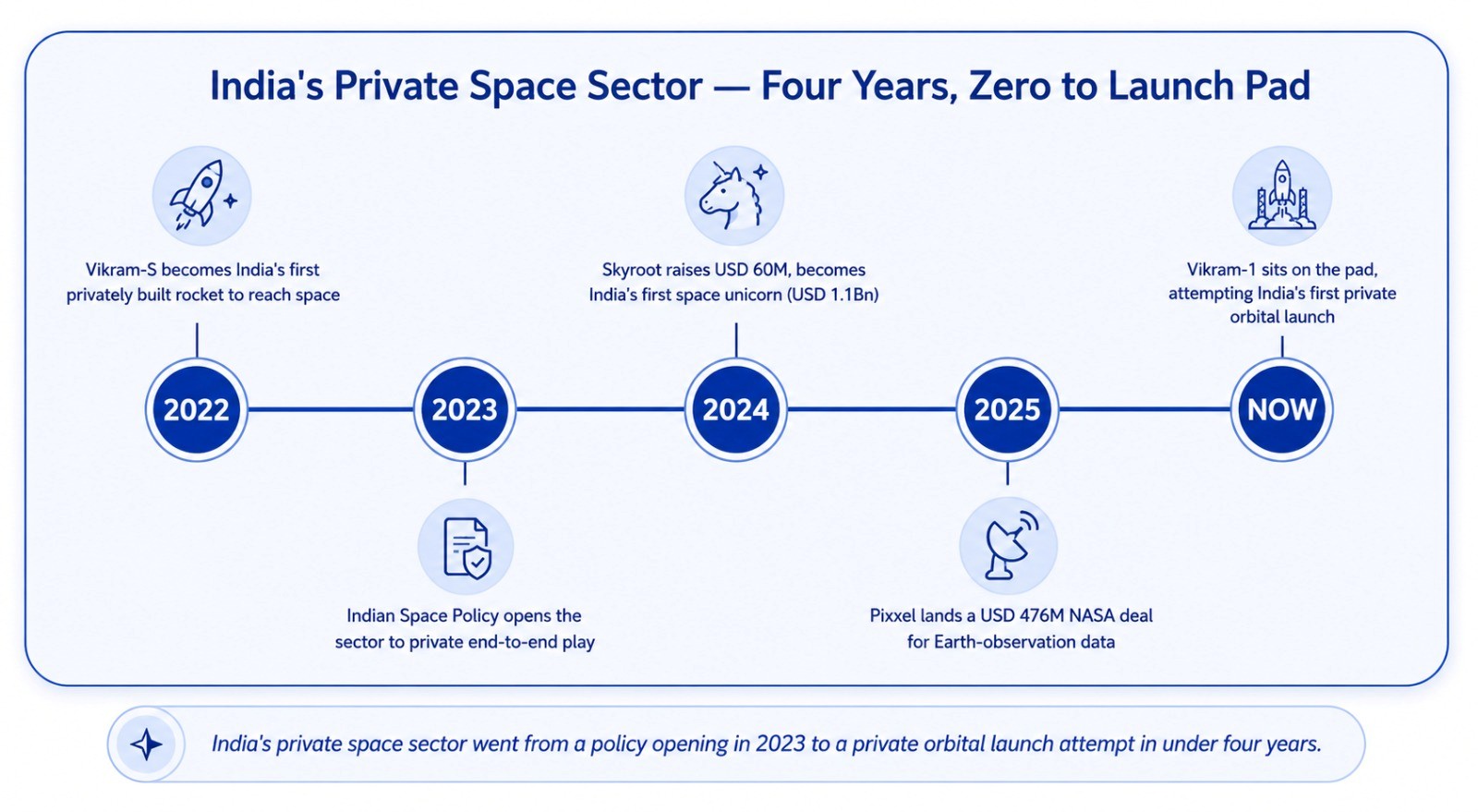
Three years ago, India’s Space Policy of 2023 opened a door that hadn’t existed before: private companies could build, launch, operate, and sell what they see from orbit – not just supply components to a single state operator.
Vikram-1 is the first flight to actually walk through it.
Four Companies Turning Policy into Hardware
Before the launch detail, here is who is converting that opening into hardware, contracts, and revenue.
Skyroot Aerospace: India’s first space unicorn
- $1.1 billion valuation after a $60M round in May 2026 – total capital raised now stands at $160 million, with BlackRock-managed funds among the backers.
- Vikram-1 reached orbit on July 18, 2026, on its first attempt – two cubesats delivered to a 450 km orbit, fifteen minutes after liftoff.
- 1,000+ employees as of 2026, up from a founding team of ten in 2018.
Pixxel: The data business already working
- $476 million NASA contract for hyperspectral Earth-observation data – the largest single commercial signal any Indian space company has landed.
- $95 million raised to date, backed by Alphabet.
- Targeting cash-flow positive by early 2028, with all six Firefly satellites operational since 2025 – this is revenue today, not a roadmap.
Agnikul Cosmos: The engineering-first bet
- Over $75 million raised to date, funding a fully 3D-printed, single-piece semi-cryogenic engine – the Agnilet – that many aerospace engineers considered years from feasibility.
- Operates India’s first privately built launchpad, at Sriharikota.
- Its Agnibaan SOrTeD demonstrator flew from that private pad on May 30, 2024, ahead of Vikram-1’s own orbital attempt.
Centum Electronics: The revenue-generating anchor most people miss
- Supplies 300 to 500 components on every Indian space mission – the largest private hardware contractor ISRO has.
- Already profitable today, unlike the rocket-builders – a genuinely different risk profile inside the same sector.
- Feeds both the private launch boom and India’s satellite-surveillance programme, without betting on either alone.
What Actually Happened on Launch Day
- Founded 2018 – Skyroot was set up in Hyderabad by former ISRO scientists Pawan Kumar Chandana and Naga Bharath Daka.
- November 2022 – Vikram-S became India’s first privately built rocket to reach space, the company’s first big milestone.
- All-carbon composite structure – cuts Vikram-1’s weight by up to 5x versus steel.
- 3D-printed Raman engines – halve engine weight and cut production time by roughly 80%.
- 350 kg payload capacity – on this first flight, the rocket carried its full payload toward a 450 km orbit – and reached it.
The timing added weight to the moment. ISRO’s own PSLV had suffered two consecutive launch failures of its own – in May 2025 and again in January 2026 – and only concluded its investigation into the second one in early July 2026, days before Vikram-1 flew.
For the first time, India’s private and state space programmes were being watched side by side under very different pressure. This time, the private attempt was the one that worked.
One regulatory gap is still worth flagging: India’s Space Activities Bill – which would give IN-SPACe’s authority a legislative foundation under India’s Outer Space Treaty obligations – had still not passed Parliament as of July 2026.
Every other major spacefaring nation passed this kind of law before opening its sector to private launch. A successful Vikram-1 flight is likely to add pressure on Parliament to close that gap.
The Rest of the Ecosystem
Skyroot, Pixxel, Agnikul, and Centum are the headline names. The ecosystem around them is what makes this an industry rather than four lucky companies:
- Dhruva Space – full-stack satellite platforms and orbital transfer vehicles that get other companies’ payloads to orbit.
- Digantara – space debris tracking and orbital situational awareness, now expanding into the US, targeting Rs 260 crore in revenue.
- GalaxEye – satellites combining radar and optical imaging, able to see through cloud cover and darkness.
- Paras Defence, Data Patterns, Astra Microwave, Avantel, Unimech Aerospace – established component suppliers who have fed ISRO for years and now serve the private boom as a bonus market.
There’s also a consumer-facing thread. Jio and Airtel both signed distribution deals with Starlink in March 2025, and regulators cleared Starlink to operate commercially by mid-2025.
Reports now suggest Mukesh Ambani is evaluating a rival LEO constellation of his own – a genuine India-vs-India contest for low Earth orbit connectivity, not just India-vs-SpaceX.
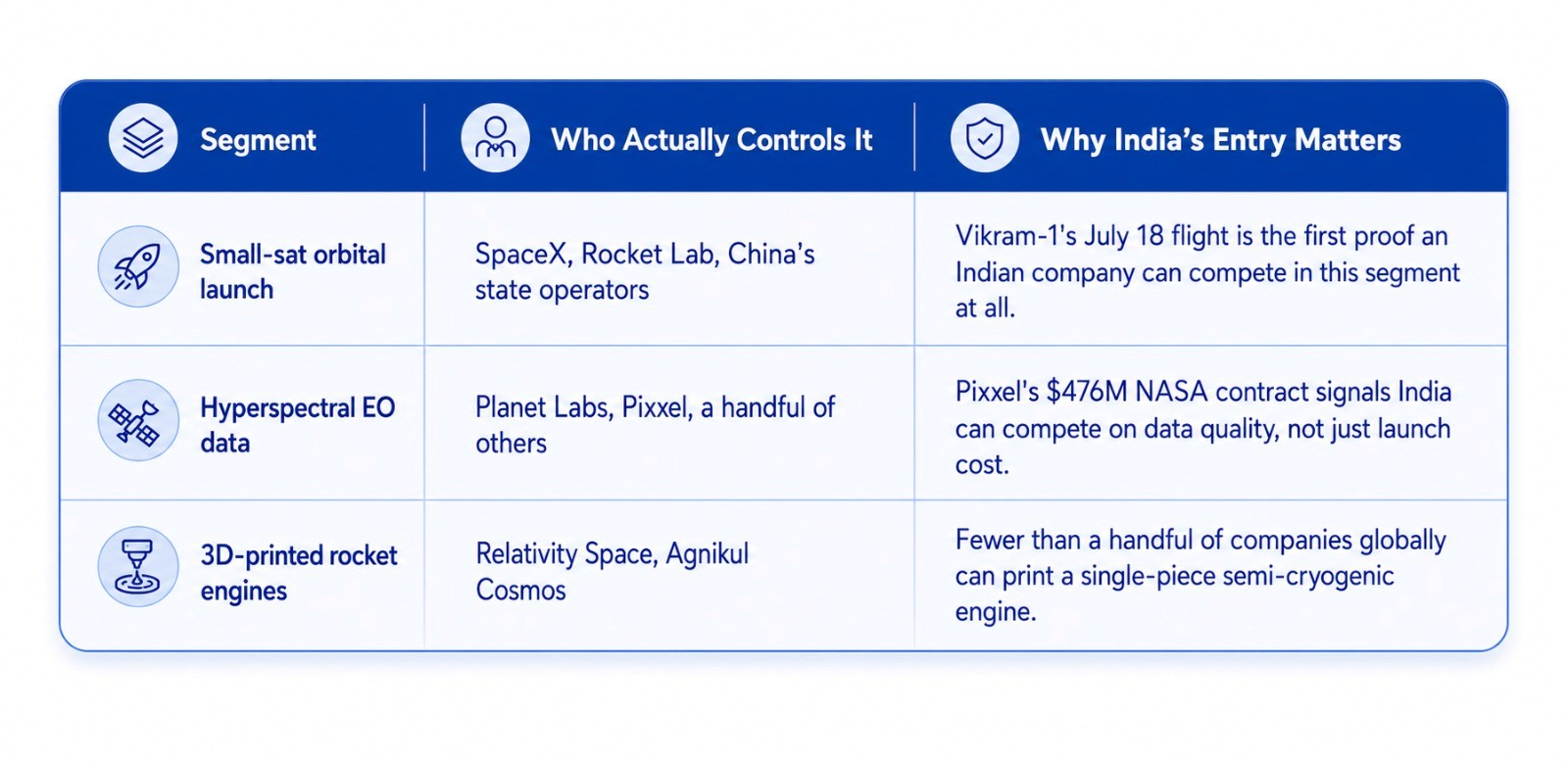
Orbital launch remains a scarcity business globally, which is exactly why an Indian entrant matters:
Many Companies, Four Different Bets
Plotted by what they actually build, and whether they’re already earning from it:
- Rocket-builders (bottom-left) – still pre-commercial-revenue – Skyroot has one successful flight, and Agnikul has yet to attempt an orbital one.
- Component suppliers (top-left) – the opposite – established, revenue-generating businesses that have supplied ISRO for years.
- Data companies (right) – Pixxel and Digantara sit in a newer quadrant entirely – their product is the data a satellite produces, not the satellite itself.
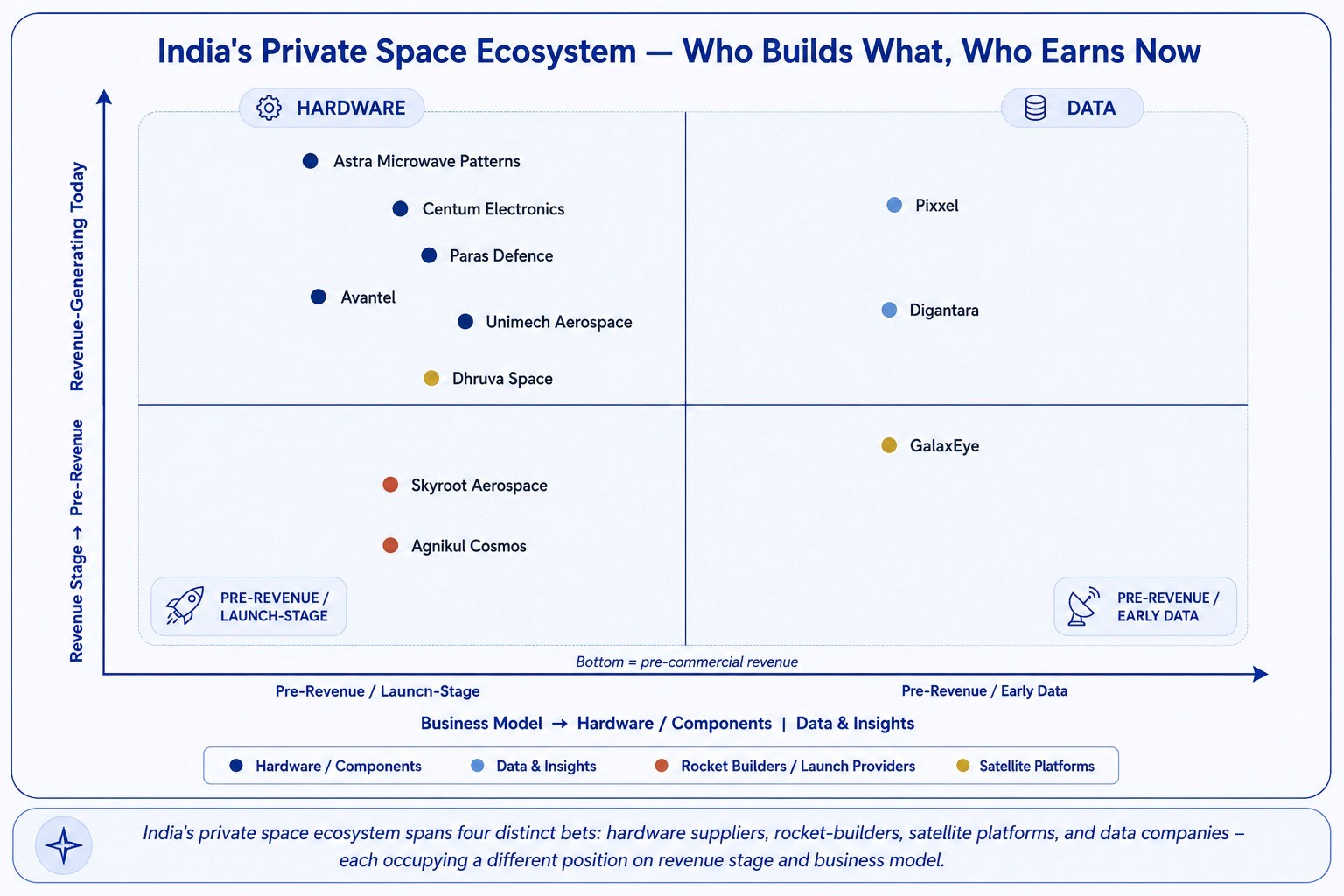
Analysts have noted that India’s emerging ecosystem is arguably more specialised than SpaceX’s own model: rockets, satellites, propulsion, and debris-tracking are each being built by a different company, betting on a different layer.
Skyroot leads on capital raised, but funding size does not equal revenue – Centum and Pixxel are the two closest to real cash flow.
What Still Needs Proving
It’s worth being honest about what one flight does, and doesn’t, prove.
- One flight is not a track record – reliability is built through repetition, and Vikram-1 has flown exactly once.
- Agnibaan hasn’t gone orbital yet – Agnikul’s Agnibaan SOrTeD has demonstrated suborbital flight but has not yet attempted an orbital mission.
- The pricing pressure is real – SpaceX, Rocket Lab, and China’s commercial operators are pricing aggressively for the same small-satellite launch segment Indian companies are targeting.
- Talent is the real bottleneck – IN-SPACe’s own chairman, Dr Pawan Goenka, has been candid that capacity, capability, and skilling are preconditions for the $44 billion outcome, not automatic byproducts of one successful flight.
The next few launches – not this one – will show whether India’s private space sector is a genuine industry, or one very good flight.
Key Insight
India went from zero private orbital launch capability to a $1.1 billion space unicorn in under four years – and on July 18, 2026, Vikram-1 showed that valuation wasn’t the only real thing about it. Pixxel’s $476M NASA contract already proved the data side of this industry works. Vikram-1 has now shown the launch side can too

 AIF Investor Charter


NIVESHAAY INVESTMENT ADVISORS
508, SNS Platina, Near Someshwara Enclave, Vesu, Surat, Gujarat-395007
(+91) 7859870559
research.smallcase@niveshaay.com (Equity Baskets)
NIVESHAAY INVESTMENT MANAGEMENT PRIVATE LIMITED
610, SNS Platina, Near Someshwara Enclave, Vesu, Surat, Gujarat-395007
(+91) 7836915478
contactaif@niveshaay.com (AIF)
SEBI Registration No. : INH000017338, IN/AIF3/24-25/1571, IN/AIF2/24-25/1607, INP000009506 | BASL Membership ID: 6276
Disclaimer:
Investment in Securities Market are subject to market risks. Read all related documents carefully before investing.
Registration granted by SEBI and certification from NISM in no way guarantee performance of the intermediary or provide any assurance of returns to investors.
The securities quoted are for illustration only and are not recommendatory
NIVESHAAY INVESTMENT ADVISORS © . All Rights Reserved., NIVESHAAY INVESTMENT MANAGEMENT PRIVATE LIMITED © . All Rights Reserved.Smart ODR