







On-Ground Observations: SNEC 2026, Shanghai
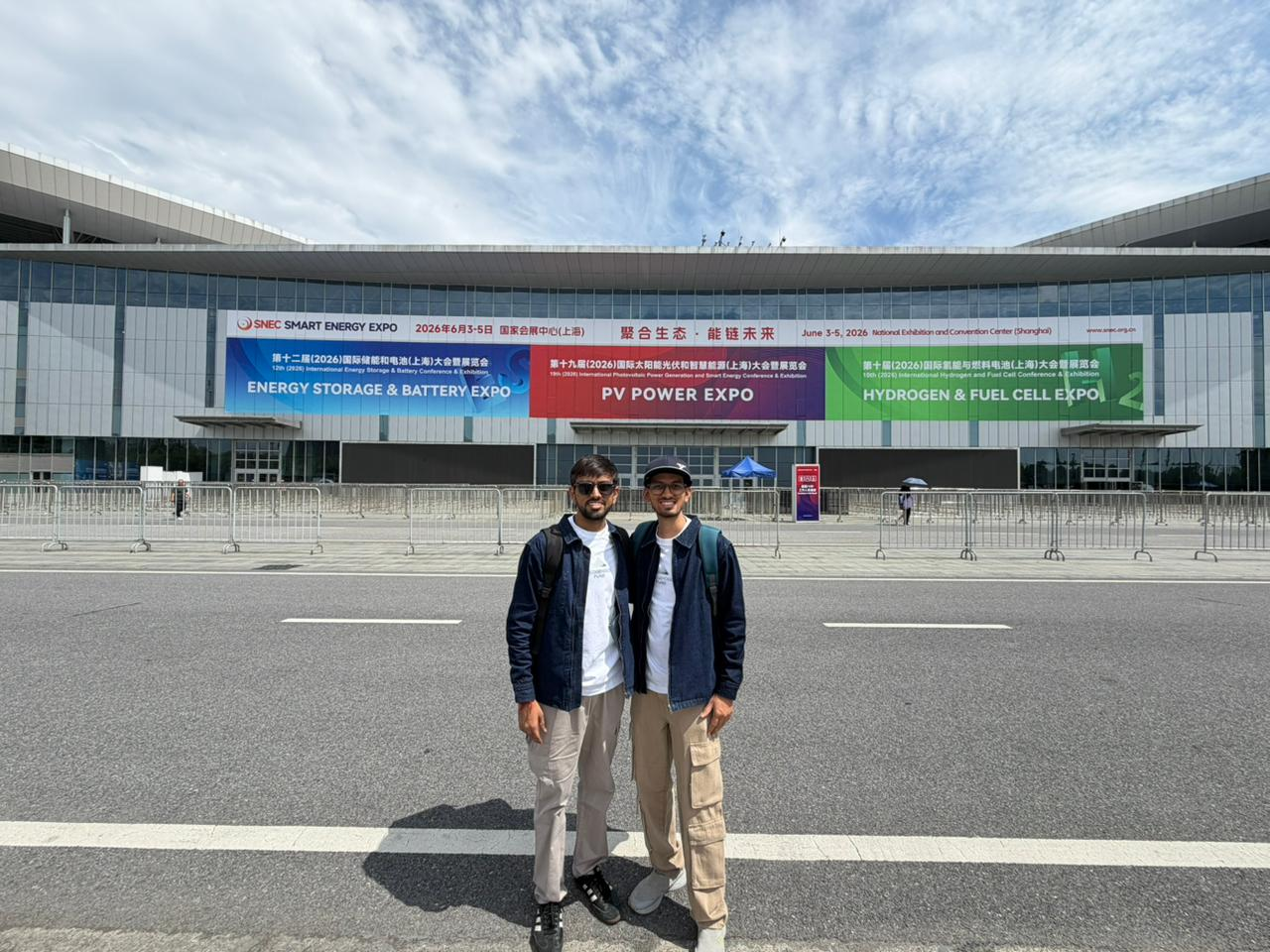
The 19th SNEC PV Power & Smart Energy Expo in Shanghai marked a turning point for clean energy. Our research team walked the floor in person, and the biggest shift wasn’t in any single product – it was spatial. For the first time, energy storage took up more space than solar itself: six exhibition halls, against four for solar panels.
The industry is moving away from a “make more, sell cheaper” model and toward smarter systems – AI-based power management, denser hardware, and grids that can stabilise themselves. Several exhibitors also pointed to home battery storage as the next big growth area, since every new rooftop solar system increasingly needs a battery alongside it.
Here’s what stood out, category by category.
1. Solar Cells: Two Speeds, Not One
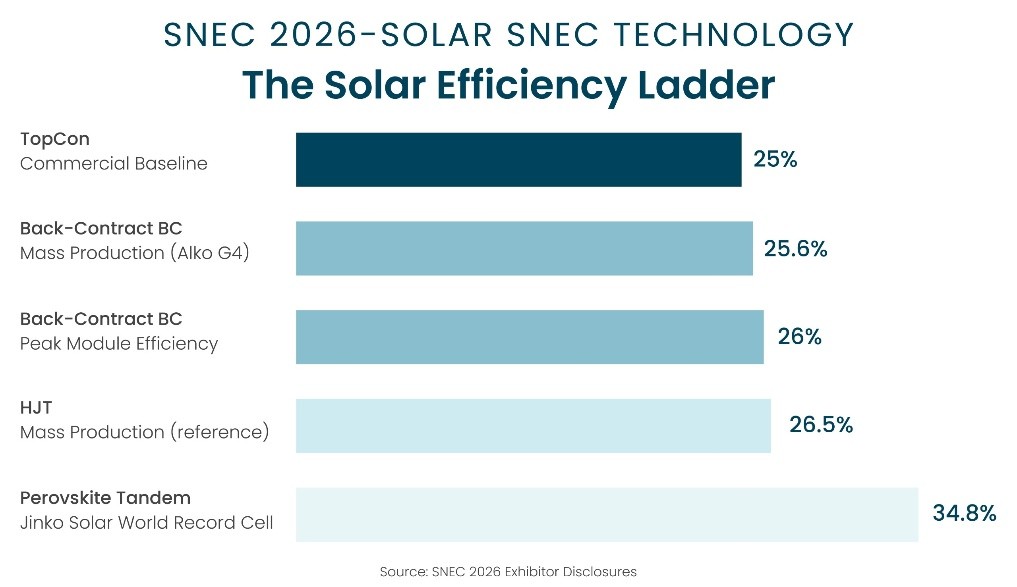
Most solar panels sold today use a technology called TOPCon, which now makes up 60-70% of the market at around 25% efficiency. It’s reliable and affordable, which is why it dominates.
Back-Contact (BC): The premium tier
Above TOPCon, a premium technology called Back-Contact (BC) is growing fast, global shipments are on track to reach 100 GW by the end of 2026. A few examples from the floor:
- LONGi treated BC as its core platform going forward, not a side product.
- Aiko Solar’s G4 panel hit 26% efficiency in a 690W format.
- TCL Zhonghuan’s C3 platform reached 710W+.
- Skyworth PV pushed to an 825W module.
BC panels also handle heat and shade better in the real world. All the wiring sits on the back of the panel instead of the front, so there’s no shadow loss, and the cells run cooler under direct sun, which means less power lost to heat over a day.
Perovskite tandem cells: The next horizon
A newer technology called perovskite tandem cells is closing in fast on record efficiency. JinkoSolar’s cell hit a world-record 34.82% efficiency. Trina Solar showed a large tandem module delivering 865W, independently certified by TÜV SÜD, and GCL Perovskite cleared 30.23% on its own tandem module. This technology is still a few years out, most manufacturers are targeting 2028-2029 for commercial sale.
Better solar cells only matter if the energy they generate can be stored and used later, which is where the show’s real headline was.
The Solar Efficiency Ladder – how the different solar technologies shown at SNEC 2026 compare.
2. Storage: Bigger Batteries, and a New Chemistry
Battery cells got noticeably bigger this year, and bigger cells mean fewer parts inside each system, which lowers the cost of building it.
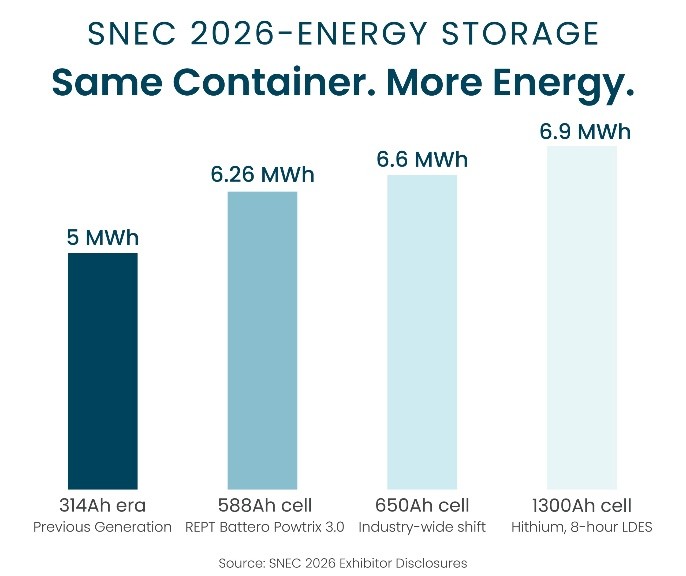
- REPT Battero’s 588Ah cell powers its Powtrix 3.0 system, packing 6.26 MWh into a standard shipping container.
- Hithium’s 1300Ah cell, built for 8-hour long-duration storage – enables a 6.9 MWh container.
- EVE Energy signed large supply deals on the floor for its own 6.9 MWh+ “Mr. Big” series.
Same Container, More Energy – how much a standard 20-foot battery container now holds.
Sodium-ion: a second battery chemistry
At the same time, sodium-ion batteries moved from lab prototypes to real products.
- CATL’s sodium-ion battery is on track for mass delivery by late 2026, a 3.07 MWh container rated for 15,000 charge cycles, built to slot directly into CATL’s existing lithium factory lines.
- REPT Battero’s own sodium-ion cell is rated for up to 20,000 cycles.
Sodium doesn’t store as much energy as lithium for the same size – but it removes the need for lithium altogether, which matters as raw material costs stay unpredictable.
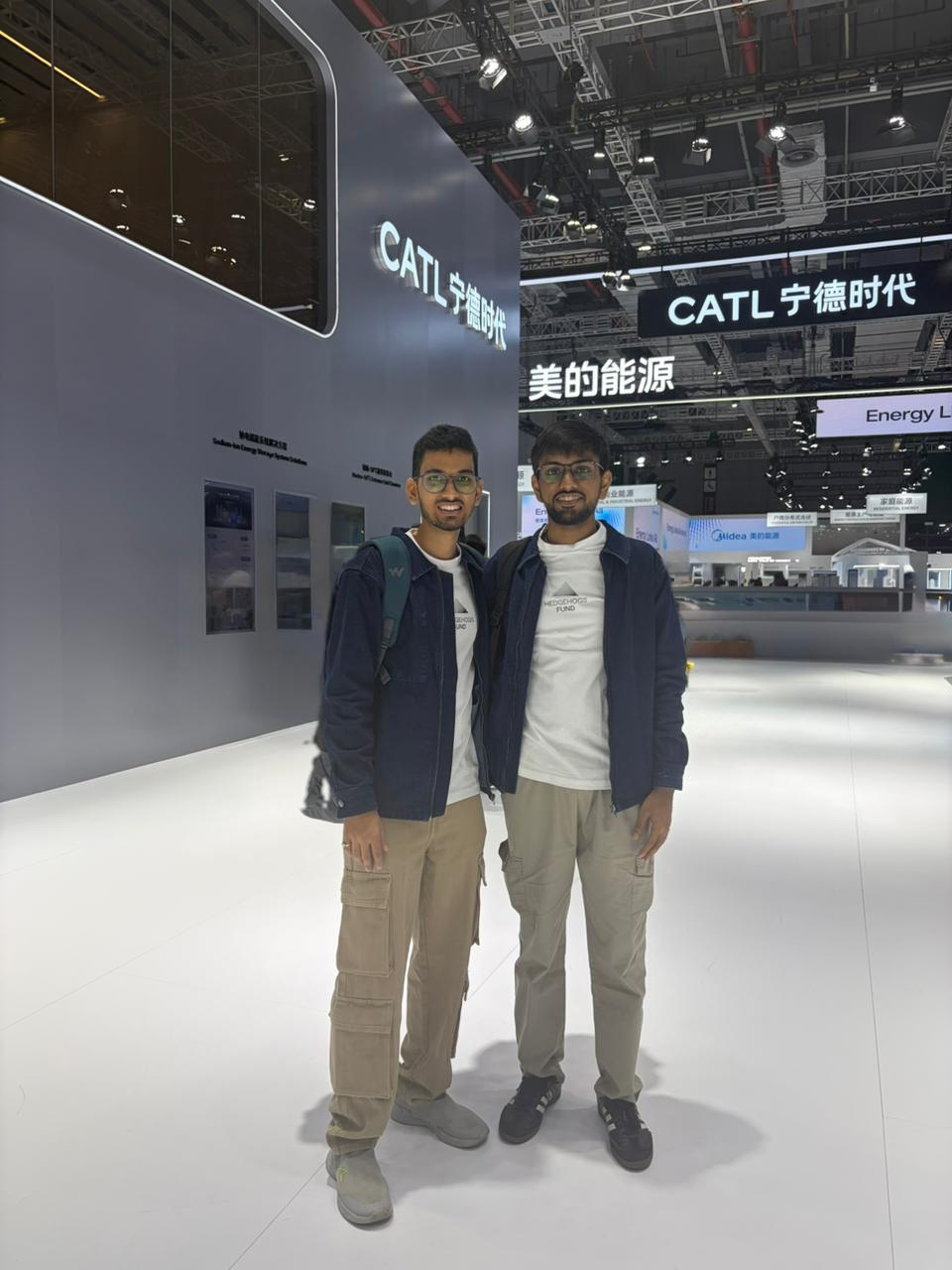
Our team at CATL’s booth, where the company unveiled its sodium-ion battery specs alongside its existing lithium lineup.
Storing energy cheaply solves only half the problem. The other half is getting it onto a power grid that wasn’t built for this much variable power.
Our team at CATL’s booth, where the company unveiled its sodium-ion battery specs alongside its existing lithium lineup.
3. The Grid Needs to Behave Differently
As more solar and battery power connects to the grid, keeping that grid stable gets harder – voltage and frequency become less predictable. The fix on display at SNEC was “grid-forming” technology: inverters built to act like traditional power plants instead of simply feeding into the grid.
- Huawei’s newest inverter reached 99.35% efficiency, and packs six grid-stabilising features – including the ability to hold power steady during faults and restart the grid from a full shutdown in minutes.
- Sineng Electric and TBEA showed similar all-in-one stations, combining transformers and inverters into single units scaling up to 12.5-13.8 MW.
A related technology, solid-state transformers, is also gaining ground. StarCharge showed a new version that skips several unnecessary power-conversion steps – useful for EV charging hubs, battery storage sites, and data centres alike.
That last mention – data centres, turned out to be its own growing category at the show, not just a side note.
4. A New Kind of Customer: AI Data Centres
AI data centres are expected to drive an extra 85-100 GW of solar demand globally by 2030. But their power needs are different from a typical solar project – they need equipment built for constant, high-density power draw.
- REPT Battero showed a battery cell built specifically for data-centre backup power – able to discharge quickly and survive over 60,000 charge cycles.
- Amphenol showed high-power connectors designed for the dense, high-current wiring inside a data-centre rack.
- Mersen showed liquid cooling plates and safety fuses built for the same high-power environment.
- LITEON showed high-voltage safety components that keep data-centre power systems electrically isolated and stable.
Put together, these shifts point to one theme: the industry is standardising its hardware, and competing instead on the software and systems layered on top of it. Companies are no longer just selling parts, they’re selling complete solar-plus-storage-plus-management platforms. That’s where the real value is moving.
Individually, these are product updates. Together, they form a pattern worth sitting with.

 AIF Investor Charter


NIVESHAAY INVESTMENT ADVISORS
508, SNS Platina, Near Someshwara Enclave, Vesu, Surat, Gujarat-395007
(+91) 7859870559
research.smallcase@niveshaay.com (Equity Baskets)
NIVESHAAY INVESTMENT MANAGEMENT PRIVATE LIMITED
610, SNS Platina, Near Someshwara Enclave, Vesu, Surat, Gujarat-395007
(+91) 7836915478
contactaif@niveshaay.com (AIF)
SEBI Registration No. : INH000017338, IN/AIF3/24-25/1571, IN/AIF2/24-25/1607, INP000009506 | BASL Membership ID: 6276
Disclaimer:
Investment in Securities Market are subject to market risks. Read all related documents carefully before investing.
Registration granted by SEBI and certification from NISM in no way guarantee performance of the intermediary or provide any assurance of returns to investors.
The securities quoted are for illustration only and are not recommendatory
NIVESHAAY INVESTMENT ADVISORS © . All Rights Reserved., NIVESHAAY INVESTMENT MANAGEMENT PRIVATE LIMITED © . All Rights Reserved.Smart ODR