







AI Energy Demand: Why Green Energy Is the Only Answer
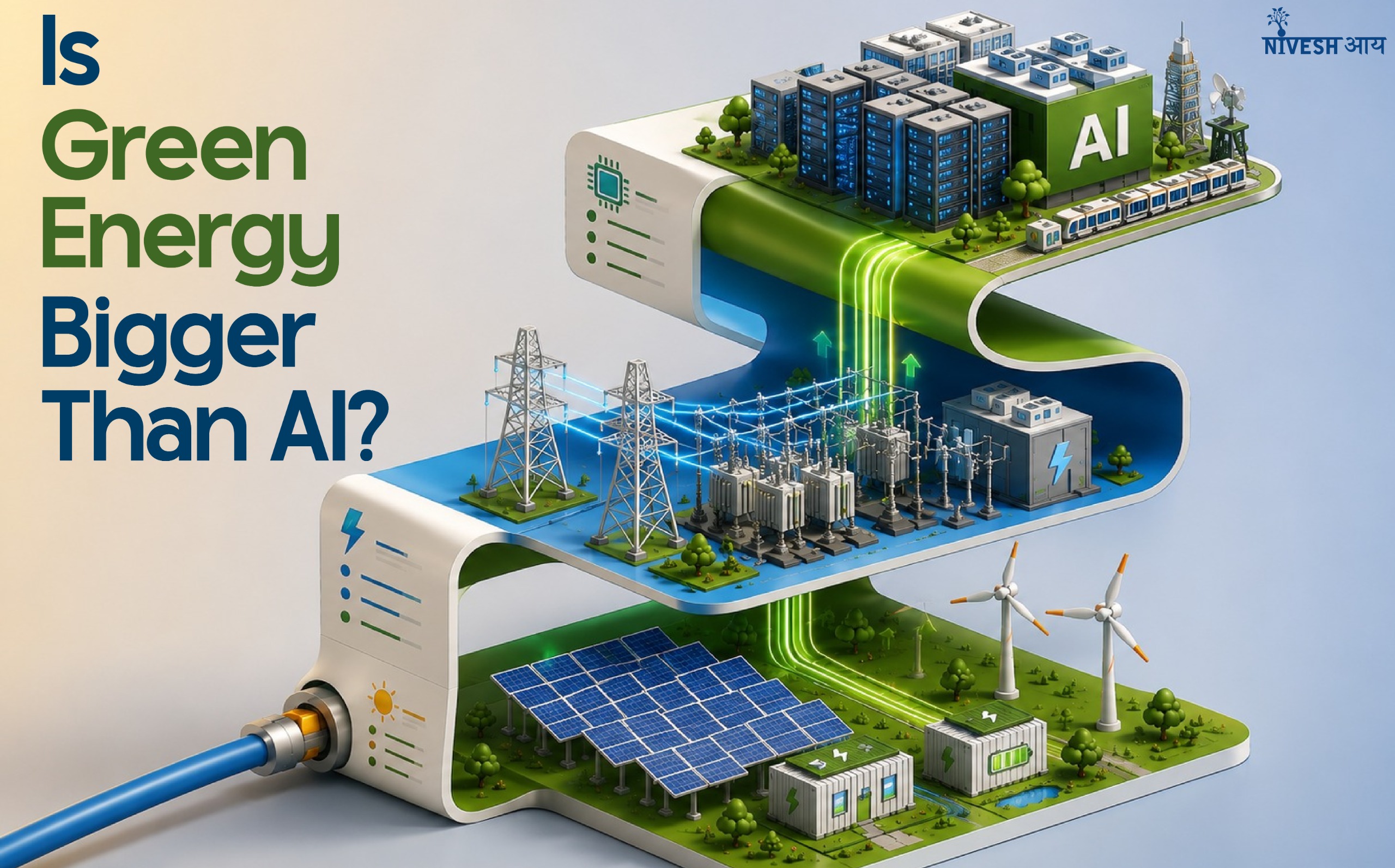
One AI query uses roughly 10× the electricity of a normal web search. Multiply that across trillions of daily interactions and you have a new kind of infrastructure crisis, one that solar is the only technology fast enough to solve.
Goldman Sachs published a landmark report in May 2026 that most people likely scrolled past.
AI token usage will multiply 24 times by 2030.
Every token is a compute job. Every compute job burns electricity.
At 24× scale, this stop being just a tech story. It becomes an energy story.
What One AI Query Actually Cost
The numbers are more dramatic than most people realise.
One AI query uses approximately 2.9 watt-hours of electricity. A standard Google search uses 0.3 watt-hours, the same task, at roughly one-tenth the power consumption.
Now apply a 24× scale-up in AI usage by 2030.
Even if AI models become more efficient per token over time, the sheer volume overwhelms those efficiency gains.
At 120 quintillion tokens per month, the grid impact is not abstract, it is structural.
What a Hyperscale Data Centre Actually Needs
A single hyperscale AI campus, the kind Google, Microsoft, and Amazon build, needs 400–500 MW of electricity. That is as much electricity a small city needs.
The cooling load nobody includes in the headline number
AI chips generate heat at densities that air cooling cannot handle.
Modern data centres now pump liquid coolant directly onto chip packages, and the pumps, chillers, and cooling towers that support this system draw their own electricity load on top of the computing load.
The actual grid draw
Server load (headline): 500 MW
Actual grid draw (with cooling): 600–700 MW, 20% more at best-in-class facilities; 50–100% more at older ones
unlike most industrial loads, this runs continuously, 24 hours a day, 7 days a week.
The Connection Queue Nobody Talks About
Here is the bottleneck that most coverage misses entirely.
Building a hyperscale campus takes approximately 18 months. Connecting it to the electricity network takes 5–7 years.
A single large transformer takes over 36 months to procure. New substations must be built from scratch.
The consequence?
The US power connection queue has grown from roughly 900 GW in 2019 to over 2,600 GW today, more than the entire installed US generation base.
Virginia, which hosts approximately 25% of global hyperscale capacity, has effectively run out of available electricity.
No new large campus power connections are being granted there.
The Hyperscalers Stopped Waiting
When the world’s biggest technology companies encountered this wall, they did not wait for governments to solve it. They began securing their own electricity supply directly:
- Microsoft signed a deal to restart Three-Mile Island, expected online in 2027, specifically to power its data centres
- Google is investing in small modular nuclear reactors for the same reason
- Amazon committed to buying 1.2 GW of nuclear power enough for a medium-sized city
These are not climate decisions. They are infrastructure emergencies.
And here is why solar became the default answer for most data centres:
Solar farm, built and running: 18–24 months
Nuclear plant: 15–20 years
Gas plant: 5–7 years, plus fuel cost forever
Solar moves at AI speed. Nothing else does.
India’s Simultaneous Advantage, and Why the Window Is Narrow
The United States built its data centre infrastructure on coal and gas networks. It is now retrofitting renewables into a legacy system, expensive, slow, and constrained by decades of fixed connections.
India’s data centre base currently stands at approximately 1.4 GW, small enough that the entire sector can still be designed from scratch, with solar and battery storage at the foundation rather than bolted on afterwards.
India data centre power demand
FY24: ~1.4 GW
FY30P: ~9 GW, a 6× increase in six years
₹3.95 lakh crore in confirmed investment from Microsoft, Google, and AWS was announced in FY25–26 alone.
The window to build this infrastructure cleanly and cost-efficiently is open right now.
In most other markets, it has already closed.
Once campuses are built on a power connection, changing that connection takes years. India is still making those foundational choices.
What This Means for Investors
India’s data centre build is a $50B+ infrastructure programme happening in one of the world’s cheapest renewable electricity markets.
Four investment layers compound here:
(1) Renewable IPPs and BESS manufacturers serving data centre campuses, each GW of data centre capacity needs 1.2–1.5 GW of dedicated power when cooling is included;
(2) Power infrastructure equipment makers – Transformers, switchgear, and substation builders are embedded in every campus project;
(3) Liquid cooling technology companies – As chip density rises, air cooling becomes unworkable and liquid cooling becomes the standard;
(4) Data centre developers themselves – Where revenue per MW is rising as power availability, not land or labour, becomes the primary differentiator.
The question is not whether AI drives electricity demand. Goldman Sachs has answered that. The question is which part of the Indian electricity value chain captures the margin.
Key Insight:
AI is no longer just a software story. It is an electricity story. Every query is an electricity transaction. Solar, the fastest source to build, is the only one keeping up with AI’s growth rate.
India is the only major economy where the data centre buildout and the renewable buildout are happening simultaneously. That sequencing is a structural advantage that cannot be replicated later.
→ AI created explosive electricity demand. Solar is the fastest answer. But deploying solar at this speed has created a supply chain constraint that most investors have never heard of. That is the subject of the next blog.

 AIF Investor Charter


NIVESHAAY INVESTMENT ADVISORS
508, SNS Platina, Near Someshwara Enclave, Vesu, Surat, Gujarat-395007
(+91) 7859870559
research.smallcase@niveshaay.com (Equity Baskets)
NIVESHAAY INVESTMENT MANAGEMENT PRIVATE LIMITED
610, SNS Platina, Near Someshwara Enclave, Vesu, Surat, Gujarat-395007
(+91) 7836915478
contactaif@niveshaay.com (AIF)
SEBI Registration No. : INH000017338, IN/AIF3/24-25/1571, IN/AIF2/24-25/1607, INP000009506 | BASL Membership ID: 6276
Disclaimer:
Investment in Securities Market are subject to market risks. Read all related documents carefully before investing.
Registration granted by SEBI and certification from NISM in no way guarantee performance of the intermediary or provide any assurance of returns to investors.
The securities quoted are for illustration only and are not recommendatory
NIVESHAAY INVESTMENT ADVISORS © . All Rights Reserved., NIVESHAAY INVESTMENT MANAGEMENT PRIVATE LIMITED © . All Rights Reserved.Smart ODR