







GREEN ENERGY 2.0 - THE GROWTH INFRASTRUCTURE
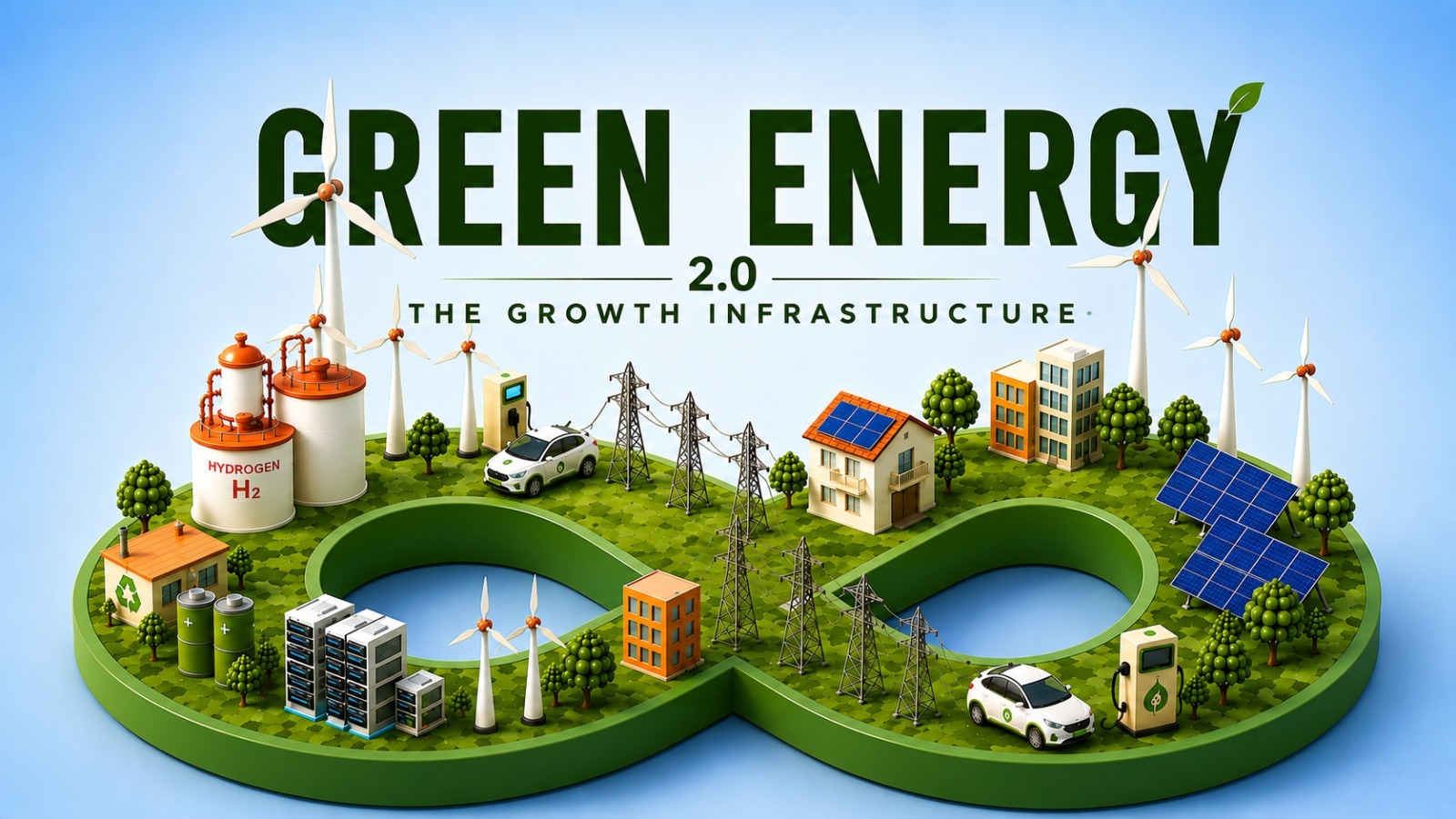
The World Needs More Electricity Than It Can Build. India Might Be the Answer.
Something quietly historic happened in India last year.
India added more solar power in one year than it had built in the previous decade combined.
It crossed 150 GW of installed solar. It became the world’s third-largest solar base.
And it did all of this while spending ₹4.10 lakh every second on imported energy, because solar alone is not the story.
After the panel is installed, nobody talks about what happens next.
Who makes the wire that carries the power. Who builds the battery that stores it. Who manufactures the transformer that connects it to the grid, and why that transformer now takes three years to arrive.
That is where this story lives.
Green energy is not an environmental story anymore.
It is an infrastructure story. A supply chain story. A manufacturing story. A competitiveness story.
And sitting at the centre of all of it, simultaneously, is India.
The world is rebuilding its electricity system at a speed the supply chain was never designed for. Most investors have only seen one piece of it.
Six blogs. One argument nobody is making in full.
Blog 01:
India pays ₹12–14 lakh crore every year for energy it could make at home. 88.2% of every barrel is imported. ₹4.10 lakh leaves the country every second.
That dependence is the starting point. What arrived next turned it into a global emergency.
Blog 02:
By 2030, AI electricity demand grows 24×. One query already uses 10× the power of a Google search. One campus need as much electricity as a small city.
AI exposed how fragile the grid already was. Solar was the only answer fast enough. But moving that fast created a different problem.
Blog 03:
In August 2025, 51.5% of Rajasthan’s peak solar was wasted. ₹700 crore lost in six months to power India made but could not move. Transformer lead times tripled.
India’s bottleneck turned out to be global bottleneck. Just at a different scale.
Blog 04:
$2.3 trillion invested in clean energy in 2025. Four economies. One supply chain. No second tier anywhere.
That crunch is reshaping who can manufacture competitively. And one country is building into it from the inside.
Blog 05:
At the 2022 crisis peak, European industrial electricity cost 3–5× more than India’s. From 2026, the EU will tax carbon at the border. India’s green buildout reduces both costs at the same time.
The cost advantage is structural. What India is building on top of it closes the story.
Blog 06:
₹9.15 lakh crore committed. Tendered. Executing. Now. Six systems scaling simultaneously, each one making the others faster.
Read all six. The investment map looks very different by the end.

 AIF Investor Charter


NIVESHAAY INVESTMENT ADVISORS
508, SNS Platina, Near Someshwara Enclave, Vesu, Surat, Gujarat-395007
(+91) 7859870559
research.smallcase@niveshaay.com (Equity Baskets)
NIVESHAAY INVESTMENT MANAGEMENT PRIVATE LIMITED
610, SNS Platina, Near Someshwara Enclave, Vesu, Surat, Gujarat-395007
(+91) 7836915478
contactaif@niveshaay.com (AIF)
SEBI Registration No. : INH000017338, IN/AIF3/24-25/1571, IN/AIF2/24-25/1607, INP000009506 | BASL Membership ID: 6276
Disclaimer:
Investment in Securities Market are subject to market risks. Read all related documents carefully before investing.
Registration granted by SEBI and certification from NISM in no way guarantee performance of the intermediary or provide any assurance of returns to investors.
The securities quoted are for illustration only and are not recommendatory
NIVESHAAY INVESTMENT ADVISORS © . All Rights Reserved., NIVESHAAY INVESTMENT MANAGEMENT PRIVATE LIMITED © . All Rights Reserved.Smart ODR