







India Defence Technology: Sovereignty In The Making
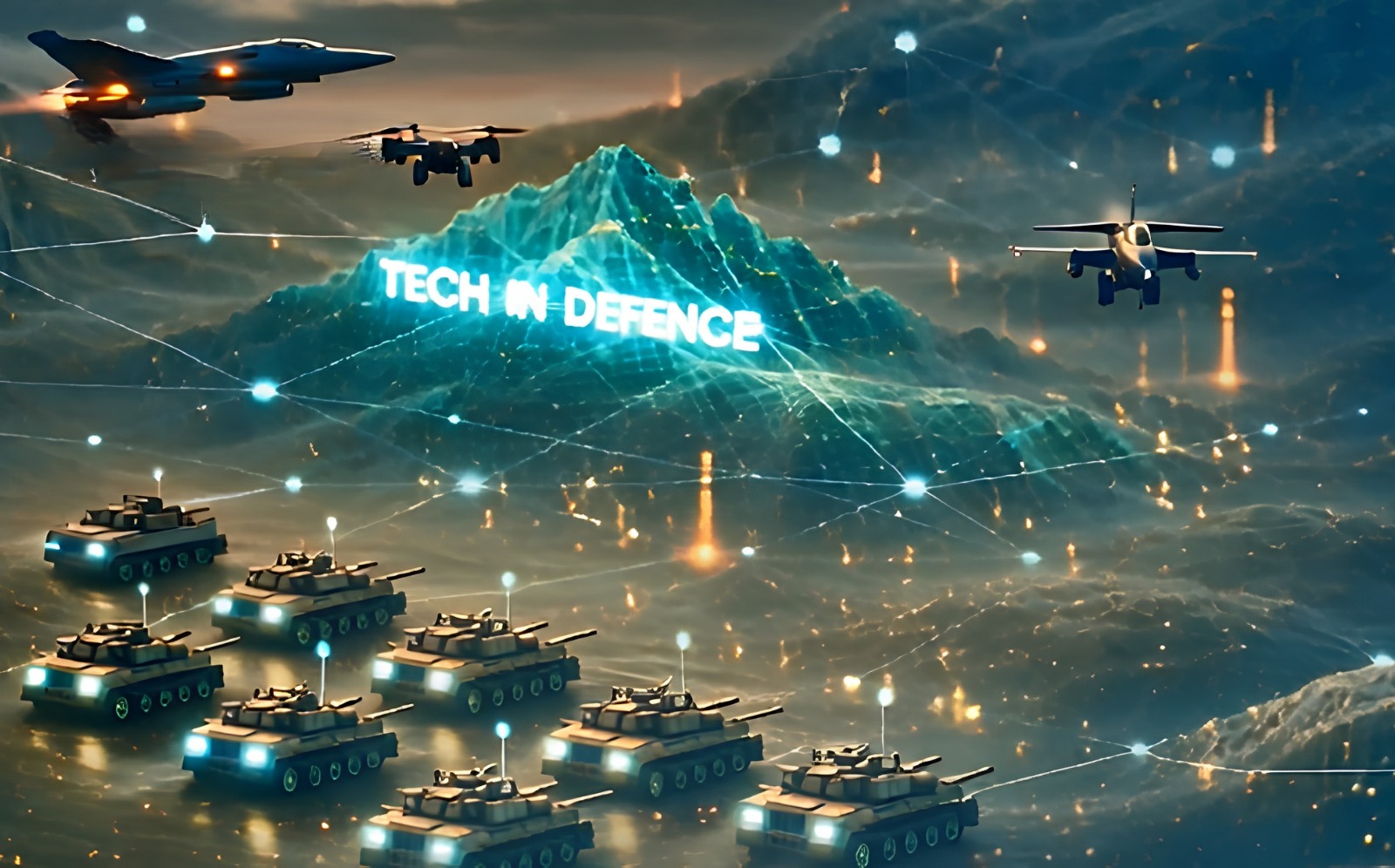
What does it take to win a war today? Not just soldiers or missiles, but the speed of decision-making, the precision of targeting, and the depth of technological integration across air, land, sea, space, and cyberspace.
The battlefield of the 21st century is a software-defined, data-driven arena and the nations that master this terrain are quietly redrawing the global power map.
India, long categorised as a mass-based military with heavy dependence on foreign procurement, is making a move that most retail investors haven’t fully priced in yet. Quietly but purposefully, it is building a defence architecture that mirrors and – select domains – challenges the technological ambitions of far larger military economies.
This blog unpacks each of those capabilities, the numbers behind them, and why this structural shift matters for investors with a long-term view on India’s defence sector.
1) LOW COST DRONES : REDEFINING THE ECONOMICS OF MODERN WARFARE
Here is a number that reframes how modern conflict works: “Iran’s Missile Math: $20,000 Drones takes on $4 Million Patriots.” In this kind of fight, the attacker doesn’t need to win the sky. It just needs to make the sky unaffordable.
That is the strategic playbook Iran introduced with its Shahed-136 and it is a playbook the world’s major military powers have since adopted.
The United States and Russia followed with their own equivalents: LUCAS and Geran-2 respectively. These are not exotic, high-budget weapons. They are engineered to be cheap, numerous, and relentless.
Broadly, all these low-cost drones operate within comparable performance envelopes:
- Operational range: 1,000 to 2,500 km
- Endurance: 5 to 10 hours
- Payload capacity: 30 to 50 kg
Why does this matter so deeply for defence strategy and by extension, for investors thinking about where defence budgets will flow? Three structural reasons stand out:
- They force defenders to spend money and burn inventory. Every cheap drone intercepted depletes expensive missile stocks, creating an economic war of attrition the defender cannot sustain indefinitely.
- They exploit the scale and production gap. Russia can produce 1,000 Geran-2 drones daily, while Lockheed Martin aims for only 600 Patriot interceptors for the entire year of 2025. When offence outpaces defence at this ratio, the doctrine of deterrence starts to crack.
- They widen the map of war. The UAE reported 2256 drones launched towards its territory by Iran as of 10th April, 2026 demonstrating that no geography is truly out of reach.
India’s answer to this category and this is where the domestic opportunity begins, the Sheshnaag-150. An indigenous loitering munition with:
- Range exceeding 1,000 km
- Five-plus hours of endurance, and a
- Payload capacity of 25–50 kg
It matches the core performance parameters of its global peers.
But matching specs is not what makes the Sheshnaag-150 strategically interesting. The true innovation lies not in its airframe, but in its sophisticated software architecture, often referred to as the “mother-code”, which enables autonomous swarm coordination, mid-mission recalibration, and continued strike effectiveness even when individual units are intercepted or communications are jammed.
That is not an incremental upgrade. That is a doctrinal capability.
2. GHATAK UCAV: INDIA’S STEALTH ANSWER TO MODERN AIR WARFARE
If the Sheshnaag-150 is India’s answer to the economics of drone warfare, the Ghatak UCAV is its answer to the physics of it. A jet-powered stealth drone designed to operate where no human pilot can safely go, the Ghatak represents the sharpest edge of India’s indigenous defence technology push.
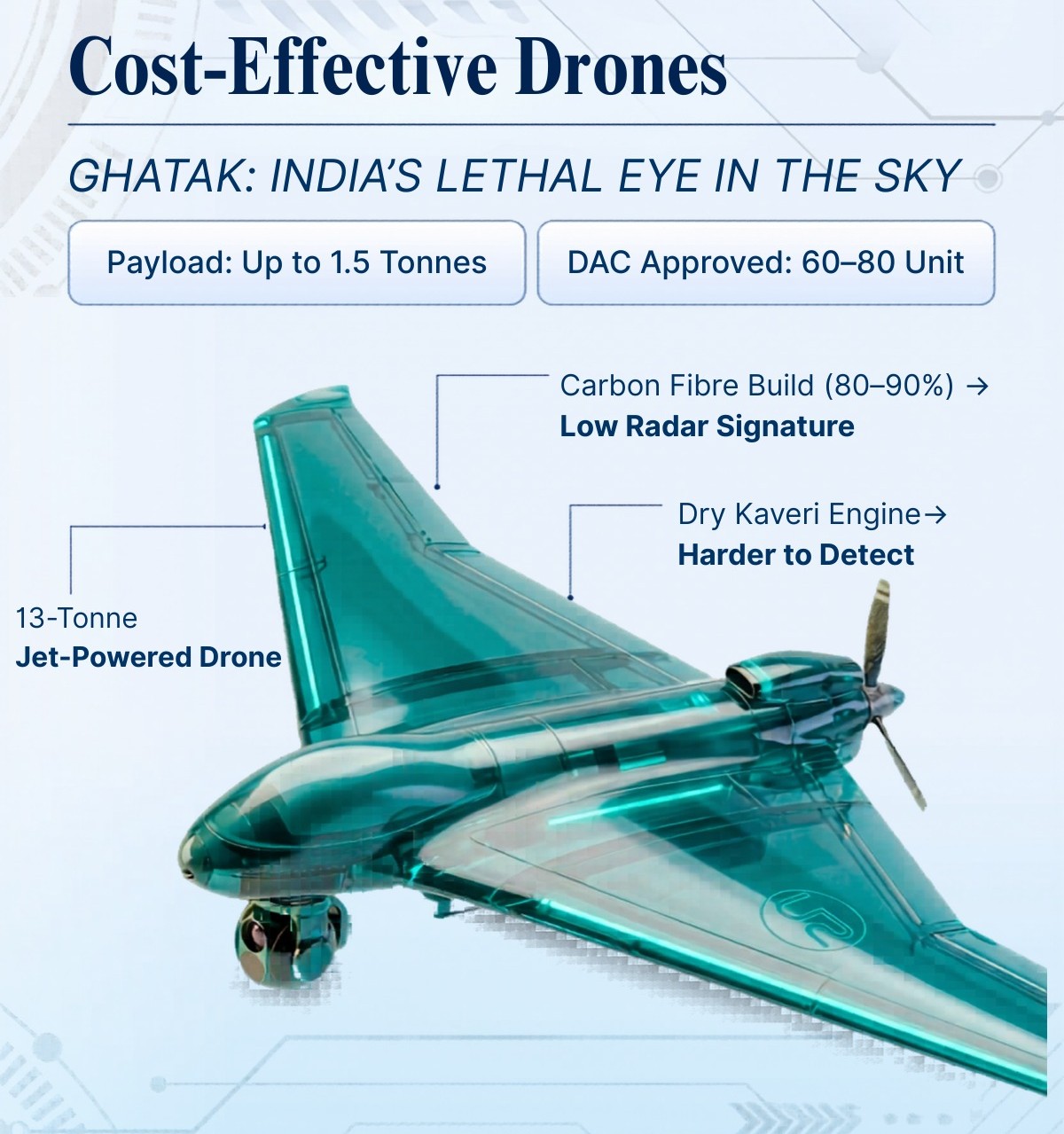
Three things set Ghatak UCAV apart:
- Home-grown engine: Powered by the Kaveri engine, built entirely in India; the Ghatak eliminates dependence on foreign propulsion technology, a milestone India has pursued for decades.
- Stealth by design: Its carbon composite airframe absorbs radar waves, making it nearly invisible to enemy detection systems before it reaches its target.
- Hidden weapons bays: Munitions are stored internally , which means the drone arrives at its target before the enemy even registers the threat.
At an estimated $63 million per unit versus $80 million-plus for a conventional fighter jet, the Ghatak delivers equivalent striking power at a meaningful strategic discount.
Ghatak is proof that India’s defence ambition has finally caught up with its technological capability.
3. PROJECT KUSHA: BUILDING INDIA’S LONG-RANGE AIR DEFENCE SHIELD
Every drone and missile capability India builds on the offensive side raises an equally urgent question on the defensive side: who is protecting Indian airspace from the same threat? That is precisely the gap that Project Kusha is designed to close.
For context, India’s most advanced long-range air defence asset today is the S-400 Triumf System, procured from Russia under a $5.43 billion deal signed in 2018. It is a capable system but it is also a foreign one. That means logistical dependencies, geopolitical strings, and zero control over software, integration pathways, or future upgrades.
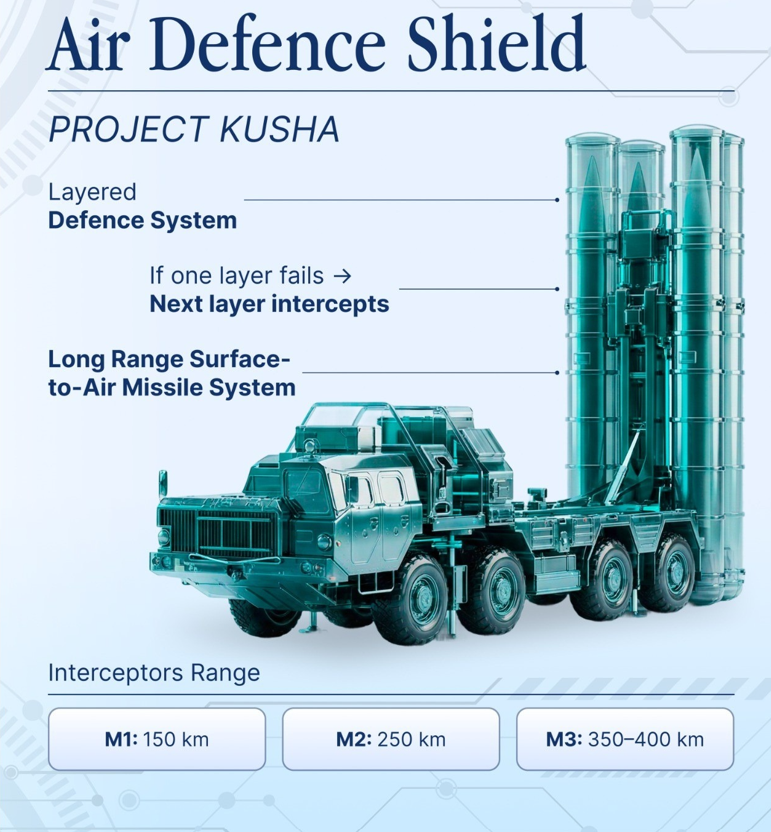
Project Kusha is India’s indigenous alternative; a layered, long-range surface-to-air missile system built around three interceptor variants, each calibrated to a different threat range:
- M1 Interceptor: 150 km engagement range
- M2 Interceptor: 250 km engagement range
- M3 Interceptor: 350–400 km engagement range
The layered structure ensures that even if one layer is saturated or breached, subsequent layers can engage the target, thereby increasing overall kill probability. No single point of failure. No single point of foreign dependence.
And because it is built entirely within India’s own ecosystem, Project Kusha provides full control over software, integration, and future upgrades and integrates seamlessly into India’s Integrated Air Command and Control System.
For investors, this translates into a programme that generates sustained demand across radar systems, propulsion technology, command software, and electronics manufacturing, all increasingly served by domestic players.
4. MISSION SUDARSHAN CHAKRA: MOTHER OF ALL DEFENCE SYSTEMS
Project Kusha protects airspace. But what if the threat is not just from the air, but from missiles, drones, cyber intrusions, and physical attacks arriving simultaneously across multiple vectors? That is the scenario that Mission Sudarshan Chakra is built for.
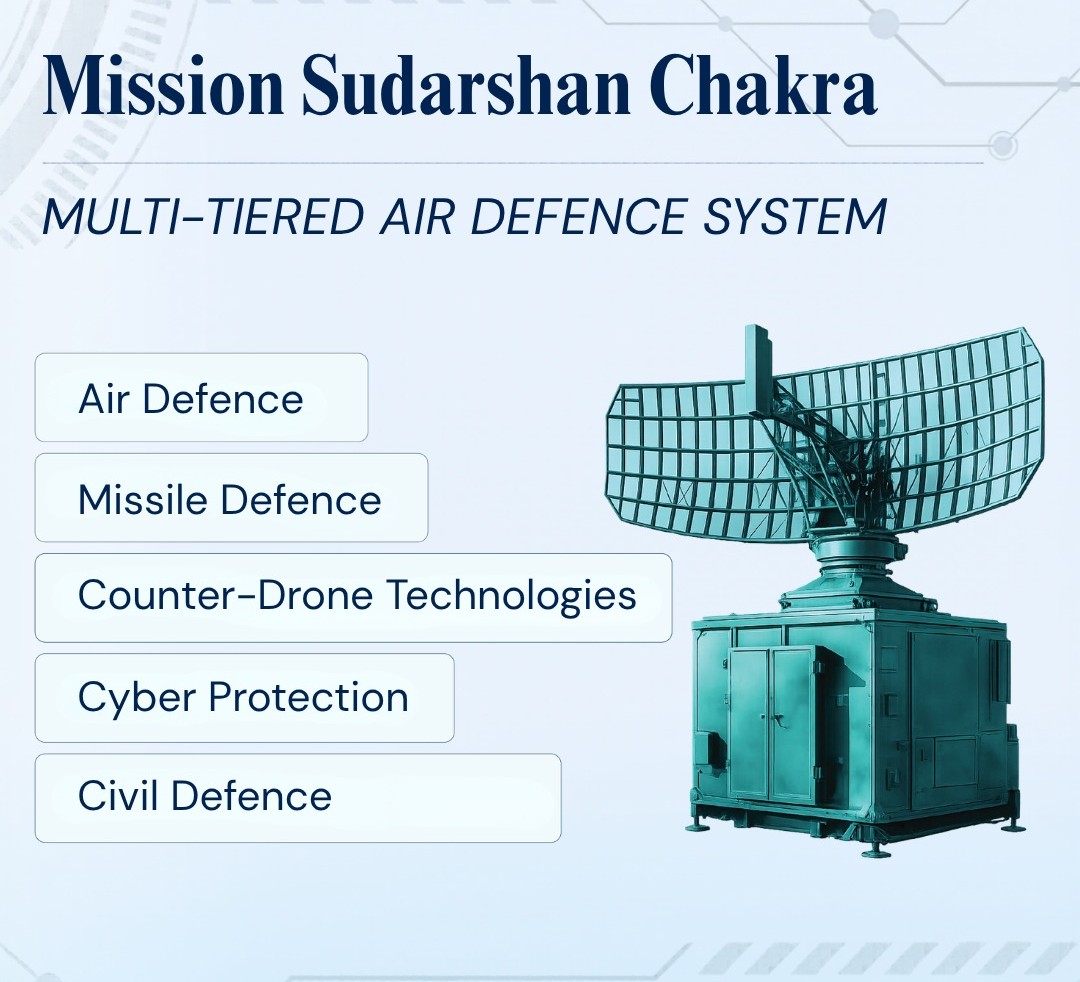
Announced in August 2025 and drawing its name from the weapon of Lord Krishna, the Sudarshan Chakra Program is India’s most ambitious defence initiative to date, a nationwide defence shield targeting full operational capability by 2035.
Its scope goes far beyond what any single system can accomplish. It is a multi-tiered air defence system that integrates: Air defence, Missile defence, Counter-drone technologies, Cyber protection and Civil defence measures
Providing layered protection for strategic assets and civilian infrastructure while ensuring strategic autonomy through full indigenisation of R&D and manufacturing. Beyond interception, it will also offer precision counterstrike capacities and anti-cyber warfare measures to neutralise digital threats including hacking and phishing at a national scale.
To appreciate the scale of this ambition, consider the two global benchmarks India is measured against:
- Israel’s Iron Dome : The 90% Standard
– Highly effective against UAVs, rockets, and short-rang missiles.
– Operates at an interception rate of approximately 90% — widely cited as the benchmark Sudarshan Chakra is designed to meet or exceed.
- The United States’ Golden Dome : The Next Frontier
– A ground, sea and space-based missile defence system estimated to cost US$ 175 billion.
– Combines space-based surveillance, detection, and tracking of hypersonic and ballistic missiles — with the ability to intercept them in space.
– Designed to neutralise a threat before it can even be launched.
India’s Sudarshan Chakra sits in this company — not as an imitation of either system, but as a sovereign, full-spectrum architecture designed around India’s own strategic reality.
5. QUANTUM COMMUNICATION: WHERE EXCELLENCE LIES IN THE MARGINS
In defence, as in investing, excellence often comes from the barest of margins. The ability to intercept a threat five seconds faster, to receive intelligence that the adversary cannot decode, these micro-advantages compound into decisive strategic superiority. That is the domain of quantum communication.
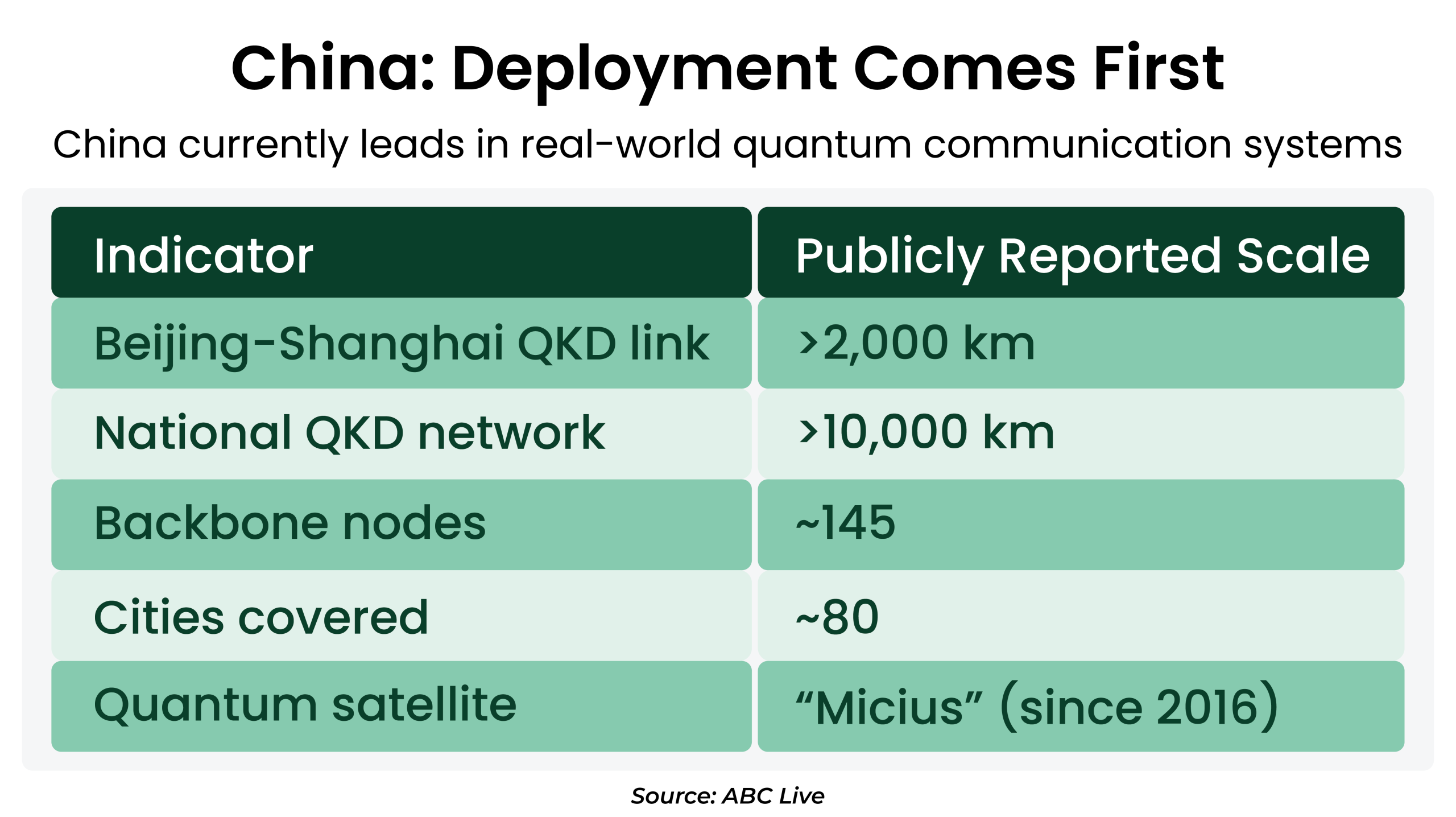
China currently leads in real-world quantum communication deployment, giving it an edge in narrow but sensitive regions where early warning and unbreakable secure links define operational advantage. India is closing that gap faster than most anticipated.
India’s National Quantum Mission (NQM) has an ambitious mandate: satellite-based secure quantum communications between ground stations spanning 2,000 kilometres domestically, long-distance quantum-secured channels with partner nations, and inter-city Quantum Key Distribution (QKD) networks.
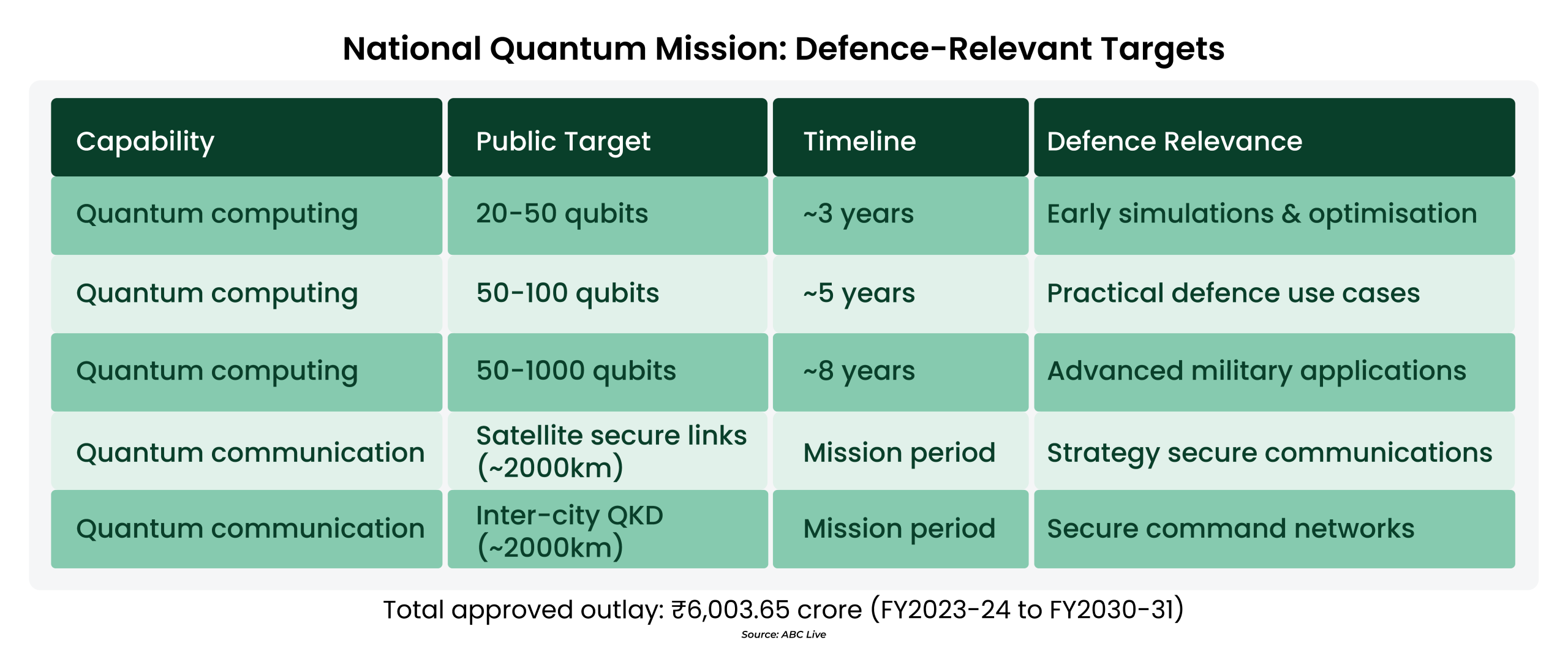
In January 2026, the mission gained further strategic weight when India unveiled its Military Quantum Mission Policy Framework — embedding four critical pillars of quantum technology across its armed services:
- Quantum communication
- Quantum computing
- Quantum sensing & metrology
- Quantum materials & devices
What has made headlines is not merely the ambition but the pace of execution. India achieved a 1,000-kilometre quantum communication network in under two years, a feat originally projected to take eight years. This milestone puts India firmly on course to realise its full 2,000-km vision well ahead of schedule.
The implications reach far beyond a laboratory record. This technology delivers interception-proof communication for defence operations, financial systems, and critical national infrastructure, domains where a security breach is not a compliance issue but a national emergency. What makes it even more powerful is its versatility, engineered to function across underwater and underground environments, extending India’s strategic reach into some of the most operationally challenging terrains.
6. SKY IS THE LIMIT: INDIA’S BROADER DEFENCE PIPELINE
The capabilities discussed above represent India’s headline programmes — but the pipeline runs deeper. Three additional systems deserve attention from any investor building a view on India’s long-term defence trajectory:
SBS-III : India’s 52-Satellite Surveillance Network
- A dedicated programme to build and launch 52 surveillance satellites over the next decade.
- Creates a dense, persistent, real-time intelligence-gathering network across India’s strategic perimeter.
- AI-enabled: capable of flagging anomalies, prioritising urgent imagery, filtering irrelevant data, and autonomously coordinating between satellites.
QRSAM : Intercepting Every Threat, From Every Direction
- Developed by DRDO in collaboration with BEL.
- Dual radar configuration delivering full 360-degree coverage.
- Designed for simultaneous detection, tracking, and engagement of multiple aerial targets — giving frontline formations mobile, all-weather air defence.
BrahMos : From Deterrence to Export Revenue
- A two-stage missile with a solid propellant booster engine, combining supersonic speed with stealth technology.
- India’s first full-scale weapon to receive a historic export contract — the Republic of the Philippines, for a shore-based anti-ship missile system.
- Indonesia has also procured the BrahMos Missile System, with the deal valued between $200–$350 million.
BrahMos marks an inflection point that is easy to understate: India is no longer just a buyer in the global arms market. It is becoming a seller — and that changes the economic calculus of defence investment entirely.
BUILDING THE ARSENAL WITHIN: THE INVESTOR’S LENS
Step back and look at what India is assembling — drone swarms with autonomous software brains, layered interceptor shields, a nationwide multi-domain defence umbrella, space-based surveillance, and quantum-secured communications. A pattern becomes unmistakable: technology is no longer a supplementary element of India’s defence posture. It is the foundation of it.
Each programme in this blog reflects a deliberate pivot: away from foreign procurement and imported platforms, toward sovereign capabilities engineered for India’s specific threat environment and strategic priorities. That is not a policy trend. It is a structural economic shift — one that creates a multi-decade procurement pipeline flowing directly into domestic manufacturers, system integrators, electronics companies, and deep-tech startups.
For retail investors, the context is worth holding: global uncertainty, geopolitical tensions, supply chain disruptions, and escalating conflicts are making defence self-reliance not just a strategic goal but a commercial imperative. The “Defence Forces Vision 2047” institutionalises this momentum — creating a future-ready military through dedicated Space, Cyber, and Drone Forces — and anchoring it to a clear policy roadmap and sustained capital allocation.
As the trajectory of indigenisation accelerates, India is not merely closing the technological gap. It is building a sovereign, data-driven arsenal that redefines its strategic standing on the world stage. For the patient investor, that is a story worth tracking from the very beginning.

 AIF Investor Charter


NIVESHAAY INVESTMENT ADVISORS
508, SNS Platina, Near Someshwara Enclave, Vesu, Surat, Gujarat-395007
(+91) 7859870559
research.smallcase@niveshaay.com (Equity Baskets)
NIVESHAAY INVESTMENT MANAGEMENT PRIVATE LIMITED
610, SNS Platina, Near Someshwara Enclave, Vesu, Surat, Gujarat-395007
(+91) 7836915478
contactaif@niveshaay.com (AIF)
SEBI Registration No. : INH000017338, IN/AIF3/24-25/1571, IN/AIF2/24-25/1607, INP000009506 | BASL Membership ID: 6276
Disclaimer:
Investment in Securities Market are subject to market risks. Read all related documents carefully before investing.
Registration granted by SEBI and certification from NISM in no way guarantee performance of the intermediary or provide any assurance of returns to investors.
The securities quoted are for illustration only and are not recommendatory
NIVESHAAY INVESTMENT ADVISORS © . All Rights Reserved., NIVESHAAY INVESTMENT MANAGEMENT PRIVATE LIMITED © . All Rights Reserved.Smart ODR